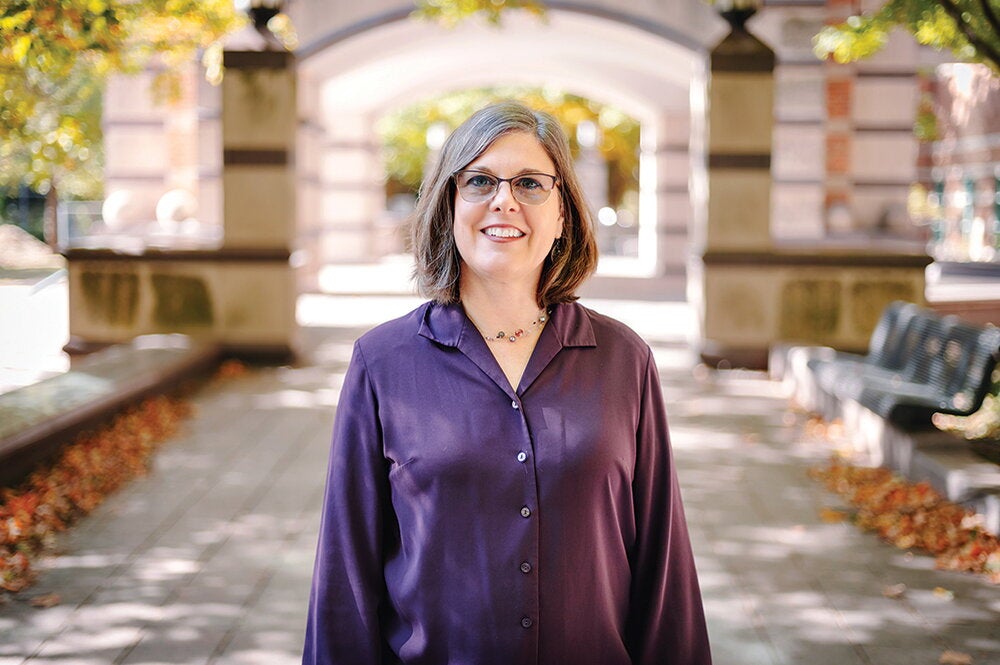
Renée Baillargeon, the University of Illinois Alumni Distinguished Professor of Psychology, has been elected to the American Academy of Arts and Sciences. She and the other 226 newly elected fellows will be honored at the annual Induction Ceremony on Oct. 6 at academy headquarters in Cambridge, Mass.
Other new members this year include former Vice President Al Gore; former Supreme Court Associate Justice Sandra Day O'Connor; New York City Mayor Michael Bloomberg; Google Chairman and CEO Eric Schmidt; astronomer Donald Brownlee; and filmmaker Spike Lee.
Baillargeon is the director of the Infant Cognition lab, where she studies infants' physical reasoning (their ability to make sense of the placement, displacement and interrelation of objects) and psychological reasoning (their ability to make sense of others' actions and interactions). Her work on infants' physical reasoning has challenged previous theories of infant development by demonstrating that even very young infants are able to differentiate events that are physically possible from those that appear to be physically impossible.
Her work on psychological reasoning also shows that an infant's ability to reason about how others will behave is more sophisticated than previously thought. In a 2005 study published in the journal Science, former student Kris Onishi and Baillargeon reported that infants as young as 15 months of age were able to predict how an adult actor would behave in a situation that involved moving an object from one hiding place to another.
If the adult actor saw the object being moved from one box to another, the researchers reported, the infant "expected" the adult to look for the object in its actual hiding place. If the object was moved while the adult was out of the room, the infant "expected" the adult to look for the object in its previous location. The infant's expectations were demonstrated by the amount of time it spent staring at the staged event. Unexpected events-those that defied logic -elicited longer episodes of staring, the researchers found.
A native of Quebec, Canada, Baillargeon earned her bachelor's degree in psychology from McGill University in 1976, and her doctorate in psychology from the University of Pennsylvania in 1981. She conducted her post-doctoral research the following year at the MIT Center for Cognitive Science, and in 1982 became an assistant professor of psychology at the University of Texas at Austin.
Baillargeon joined the Illinois faculty in 1983.
Founded in 1780 by John Adams, James Bowdoin, John Hancock and other leading scholars and civic leaders of their day, the academy has elected fellows and foreign honorary members ever since. The current membership includes more than 170 Nobel laureates and 50 Pulitzer Prize winners. The academy is an independent policy research center that studies emerging problems.