A whiteboard outside a lab on the fourth floor of Morrill Hall is likely to catch the eyes of those passing by. “Welcome to the Ngumbi Lab,” it greets in blue marker, surrounded by colorful drawings of tomatoes, butterflies, caterpillars, and cicadas.
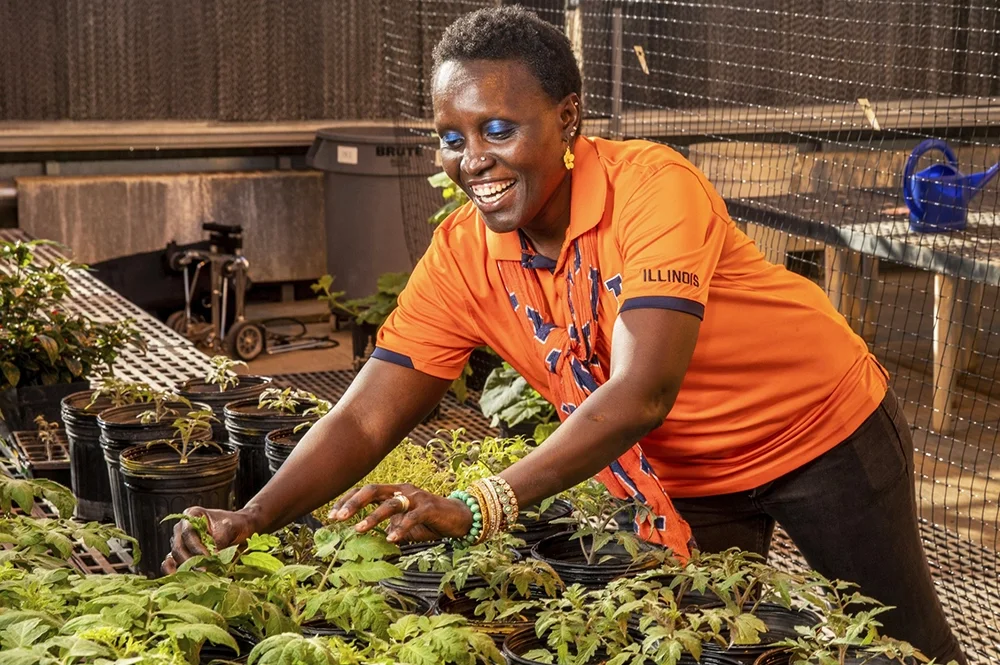
Esther Ngumbi, professor of entomology, runs this lab with the goal of understanding how insects and plants communicate with each other through chemical signals.
“Chemistry is the language that plants use to communicate,” Ngumbi said. “When we can understand this language, we can manipulate it to strengthen plants’ ability to withstand many stresses.”
Those stresses include biotic factors, like insects looking for something to munch on, and abiotic factors, like temperature changes, drought, and flooding. This research leads to more resilient crops, meaning more food to go around — a benefit for farmers and consumers.
Even if you recall learning about biotic and abiotic factors in science classes, there is a good chance you will not know what “arbuscular mycorrhizal fungi colonization” or “microbe-driven and chemical-mediated plant and insect interactions” are, unless you are in the same field as Ngumbi. Yet the problems she seeks to solve with her research have a significant impact on the general public.
How, then, does she make sure her research is accessible and understandable for the people who need it?
Communication breakdown
Ngumbi’s interest in entomology began when she was growing up in Kenya, where her family had a farm.
“Halfway through the growing season, I would actually watch a lot of our work go to waste because insects would come and eat a lot of our crops … meaning we won’t have food,” she said. “I was very curious how these insects managed to find our plants.”
That curiosity led Ngumbi to entomology, the study of insects. But she encountered another problem: Her research was reaching other scientists, but not the people who were directly impacted by the issues she sought to find solutions for.
There was a communication breakdown between scientists like herself and the general public. Ngumbi said she, like many scientists, was trained to focus on getting her work published in scientific journals. The average person does not have the background knowledge necessary to comprehend a scientific paper filled with niche jargon and concepts that are taught in advanced college courses for a specific field, so those scientific papers are not very accessible for the general public.
Knowing her research was important to farmers and consumers, Ngumbi took it upon herself to become a trained science communicator. That means connecting with the public and sharing research in an understandable way.
Ngumbi’s essays and op-eds have been published in Scientific American, El País, NPR, USA Today, Inter Press Service, and Wired, to name a few. This is all in addition to teaching students and continuing research.
To make her writing accessible, Ngumbi embraces analogies, personal stories, and relatability. In a 2019 Scientific American article, she shared an anecdote from one of her presentations at the U of I. The topic, “volatile organic compounds as multitrophic messages among plants, microbes and insects,” is one she figured sounded “technical and daunting” to many in the audience.
“I compared volatiles and volatile organic compounds to 911 calls,” Ngumbi wrote. “I explained that in nature, 911s frequently go out from plants, insects and even soil microbes.”
Ngumbi credited her mentor, department head and professor of entomology May Berenbaum, for helping her simplify the topic in preparation for the talk. Berenbaum has had a long career in entomology and science communication, with one of her outreach efforts being the Insect Fear Film Festival.
Just a few years later, Ngumbi was honored with the Mani L. Bhaumik Award for Public Engagement with Science from the American Association for the Advancement of Science.
“I can honestly say that I’ve never encountered a more prolific, effective, and productive science communicator than Dr. Ngumbi,” Berenbaum wrote in a nomination letter, according to the AAAS article announcing Ngumbi’s honor. Berenbaum won the same award in 2010.
Ngumbi’s writing had a wide impact. Her research in pest-resistant and drought-tolerant plants helped farmers. She gave presentations to students of all levels, in the U.S. and Kenya. The AAAS named all of these as reasons for Ngumbi to receive the award.
Ngumbi said science communication is a matter of trust, built through a two-way conversation. She listens to feedback from her audience and changes her communication style as needed. This additional work, she said, is part of a scientist’s public duty. But there are many scientists who lack these communication skills.
Why so many scientists lack communication training
Science communication is a skill that requires training that can be difficult to come by.
“It took a very interested scientist to go out of their way to find a workshop, to find training, to find another scientific communication community,” Ngumbi said.
Many scientists will not put in that work, especially when it can negatively impact their career in the short run.
“Academia doesn’t reward a lot of science communication,” Ngumbi said. “They look really hard at published journals work. So, when you say, ‘I’m communicating, I’m doing outreach, I’m meeting the public every day,’ that’s kind of counted like just soft work contributions to the academic world.”
Let’s say Scientist A decides to set aside time to make some explanatory videos about their research for the public. Scientist B, on the other hand, uses that time to put out more published journal articles written for other scientists.
When being judged against other scientists, Ngumbi said academia tends to favor those with the most scientific publications. That means Scientist A could be putting themself at a disadvantage career-wise by devoting time to communicate with the public.
Ngumbi also mentioned “academic impostor syndrome.” She said some scientists might not feel confident enough in their work to discuss it with the public. They may feel their work does not connect to an everyday person, or they may worry that they are not “expert enough” to be the one speaking on the topic.
Despite these concerns, Ngumbi said it is a scientist’s duty to connect with the public.
“The public is paying for [the research] through their tax dollars, so it’s an ethical responsibility,” she said. “They deserve it. We need to step out and tell them what we’re doing.”
The mutual benefits of science communication
Ngumbi said science communication benefits both the scientist and the public.
“You get better at explaining things; you get better at breaking down things,” Ngumbi said.
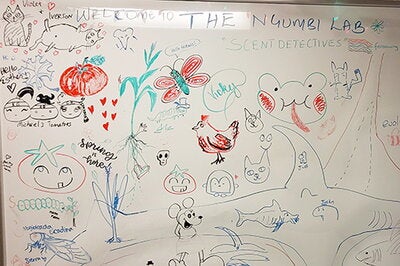
In the Ngumbi Lab, she encourages her students to do exactly this, as well as find connections between their work and an everyday person. She said when the public cares about science, they can contribute questions and provide insight to the problems scientists seek to solve.
“[Science is] supposed to be helping solve these everyday challenges that an everyday person is facing,” Ngumbi said. “It’s not on them to beg us to talk about our work. We should be actively sharing and taking on every opportunity to talk about what we are doing and how it is relevant to their challenges.”
In times when research is seeing funding cuts, if the public knows that the work being done may benefit them, Ngumbi said they can advocate in defense of the research. Also, through public connection, scientists can inspire other future scientists.
“By us communicating, getting out there, you really broaden and demystify who is doing science and inspire many more others,” Ngumbi said. “When we go out, another person can be like, ‘Ah, I can be a scientist! Because somebody that looks like me is a scientist already.’”
On top of all that, scientists get to see their own work from a new perspective.
“I think it makes you fall in love with what you’re doing again and again,” Ngumbi said. “You’re like, ‘Damn, I have such a good job. How did I get so lucky?’”