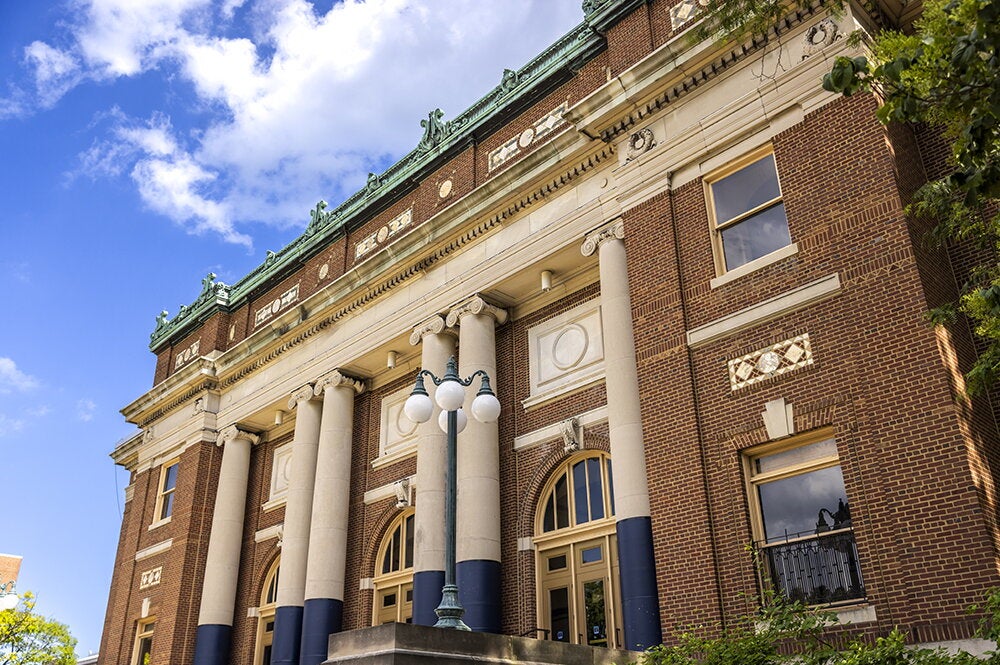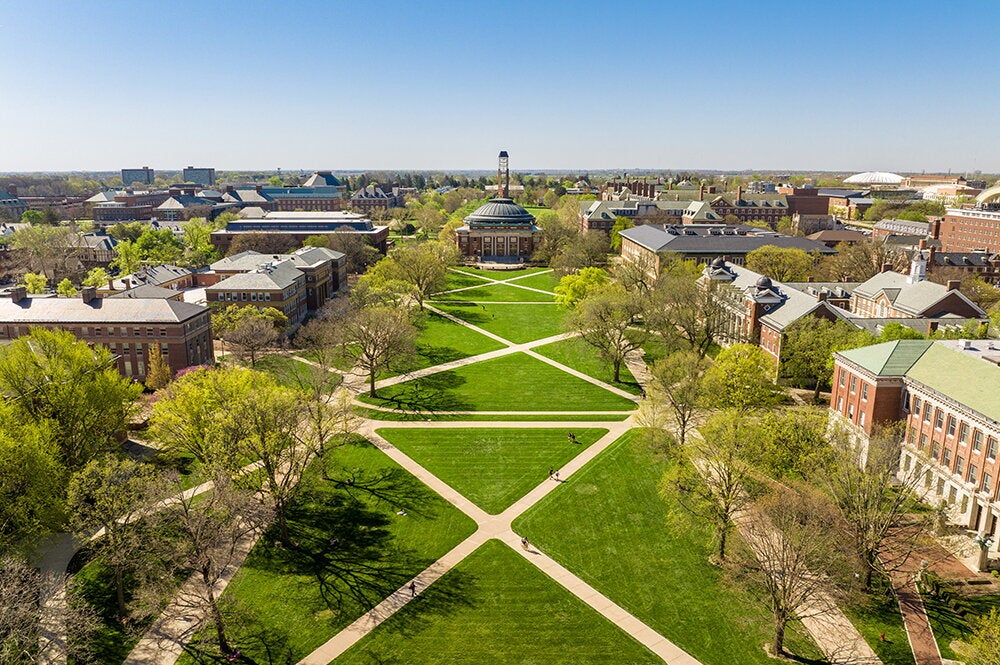
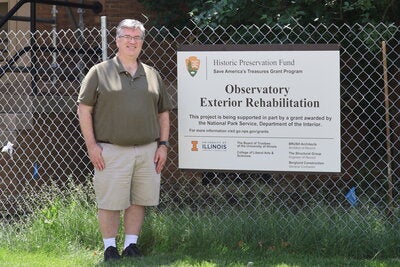
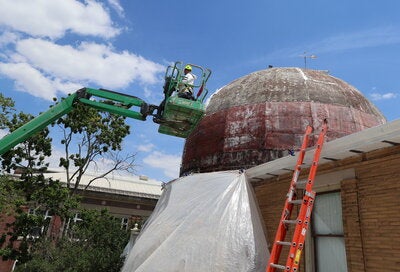
The University of Illinois Observatory is undergoing renovations this summer that will bring back some historical features of the national landmark.
The project is supported by a grant from the National Park Service through the Save America’s Treasures program, which funds the preservation of properties designated to have national historical significance.
Bryan Dunne, observatory director and teaching assistant professor in the Department of Astronomy, said there are many parts to the renovation, including the return of a special viewing area and old transit.
A site of national historic significance
The U of I Observatory is one of 89 National Historic Landmarks in Illinois. The Morrow Plots next door is the only other site in Champaign-Urbana with this designation.
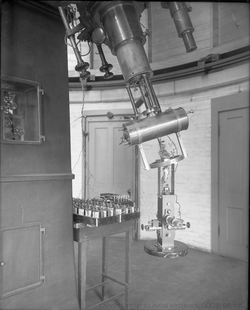
Built in 1896, the U of I Observatory witnessed some significant developments in astronomy. Astronomer Joel Stebbins and physicist Frederick C. Brown are believed to be the first in the U.S. to use electricity to measure astronomical brightness, via selenium cells. Stebbins was also the observatory director in the early 20th century.
“Joel Stebbins actually did a lot of really important work on the development of photoelectric photometry,” Dunne said. “That’s measuring the light of stars electrically.”
This technology was useful for studying stars with changing apparent brightness. Those could be eclipsing binary stars, where one star passes in front of another, affecting how bright it looks to viewers. Stars can also have variable brightness on their own, sometimes through cycles of swelling and contracting.
Before the development of photoelectric photometry, star brightness was measured through visual comparison and photographic plates. These methods could not offer accurate quantitative measurements.
Stebbins spent his first few years at U of I researching relative brightness of binary stars. This was in the 1900s, so he was using visual and photographic methods.
Stebbins’ wife, May Stebbins, assisted him through the slow, tedious process by working as the data recorder. The National Register of Historic Places registration form includes part of a speech Joel Stebbins gave to the American Astronomical Society, where he shares this anecdote:
“She (May Stebbins) wrote down the numbers as the observer called them, but after some nights of recording a hundred readings just to get one magnitude, she said it was pretty slow business. I responded that someday we would do all this by electricity. That was a fatal remark. Thereafter she would often prod me with the question, ‘When are you going to change to electricity?’
“It happened that within two or three months, the Department of Physics gave an open house, and one of the exhibits was in charge of a young instructor, F. C. Brown. He showed how, when he turned on a lamp to illuminate a selenium cell, a bell would ring; when the lamp was off, the bell would stop. Here was the idea: Why not turn on a star to a cell on a telescope and measure a current?”
Electric photometry’s precision in measurements made it the new standard for determining stellar magnitudes.
“That’s why the observatory is on the National Register of Historic Places,” Dunne said.
Some of the renovations will restore historical features the building had lost. For one, they are bringing back the rooftop deck.
“The whole goal of it is that you’ll be able to set up some telescopes out there, and we’ll be able to do observations from the deck,” Dunne said.
It’s been decades since the roof was used in this way. For open house events at the observatory, smaller telescopes are often set up in the backyard. To get from the dome to the yard, you have to go down a narrow staircase and through a hall, which can end up congested. Dunne expects the deck to make for better flow.
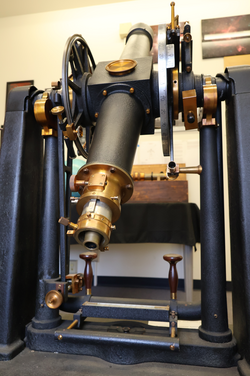
The observatory was also once home to multiple transit telescopes.
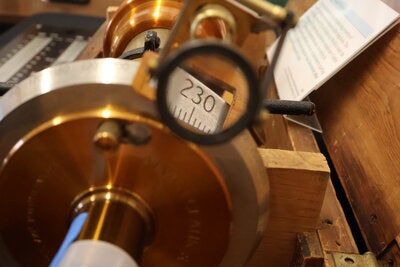
“The observatory had four transits when it was originally built,” Dunne said. “Those transits would open up to allow a transit telescope to observe stars as they would pass directly overhead. One of the four is going to be recreated so that we can show how the observatory functioned when it was originally built.”
The transit telescopes were used to teach celestial navigation and keep time. Faculty used a professional-grade one, and others were used by students.
Each telescope stood on top of a brick pier that ran through the building, down to bedrock, without touching the building itself. There are gaps between the floors and the pillar to prevent footsteps from shaking the telescopes and messing up measurements.
Back to its original mission
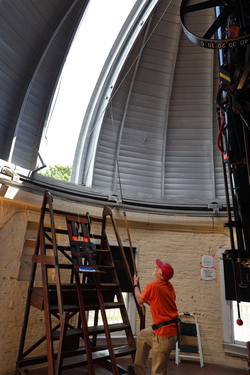
Those who have visited the observatory for classes or open house events will likely remember the large telescope in the dome. That is a 12-inch Brashear refractor telescope.
Dunne said it’s a beautiful telescope, but no longer research-class. Modern research-class telescopes are bigger and use reflective mirrors instead of refractive glass.
“Today, it’s used again for teaching — its original mission — and outreach to the public,” Dunne said.
Dunne’s introductory-level astronomy classes have come to the observatory to see planets, moons, nebulae, and star clusters at night. Special filters have also allowed his students to safely view the sun during the day, with enough detail to see solar prominences and sunspots.
“Because a lot of students may come from heavily light-polluted skies, it’s maybe their first chance to really see those objects through a telescope,” Dunne said. “Especially one as big as the one we have here.”
While Champaign-Urbana does not have ideal darkness for celestial viewing, the observatory takes some measures to make do. The nearby sidewalk lights have black covers on the sides facing the observatory, so they do not drown out the stars as much. This makes the observatory’s backyard one of the best places on campus for stargazing.
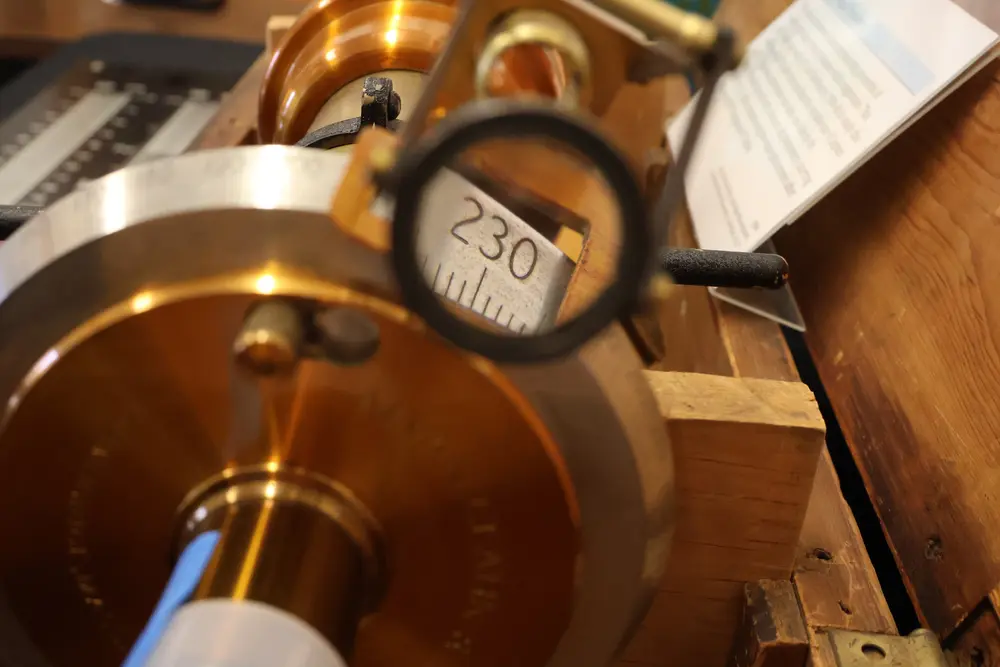
In addition to class-related activities, the observatory is the home base of the University of Illinois Astronomical Society. Though UIAS is a registered student organization, their monthly open houses welcome anyone interested in looking through the telescopes or seeing the observatory’s collection of antique astro instruments. They also open for special celestial events, like lunar eclipses, which tend to draw crowds.
“The fact that we actually got this grant is in large part thanks to the Friends of the Observatory, and very much in particular, Mike Svec,” Dunne said.
The Friends of the Observatory is an alumni group formed in 2010 to help preserve the observatory. Svec (BS Physics, ‘88), a former president of the UIAS, was one of the founding members.
UIAS is continuing their monthly open houses through the summer. Open houses can be affected by weather; the UIAS mailing list and Discord server offer updates on dates and times. Links to those can be found on the UIAS website.
Construction is expected to conclude in the fall.