The first lesson Marianne Alleyne learned from working with engineers had nothing to do with insects.
It had to do with language.
"Actually doing interdisciplinary research or transdisciplinary research is really difficult," said Alleyne, a professor of entomology at the U of I. "We also use almost different languages."
She likes to point to the word "stress." For a biologist, stress might mean anxiety or a physiological response to environmental conditions. For a mechanical engineer, stress describes forces acting on a structure and whether it might break.

When researchers from different fields use the same words to mean different things, collaboration can be slow. It takes patience. It takes years of conversations. It takes a willingness to admit you do not know what someone else knows. For Alleyne, that challenge became the foundation of an unusually long collaboration between entomology and engineering, one that has changed both how scientists study insects and how engineers think about building machines.
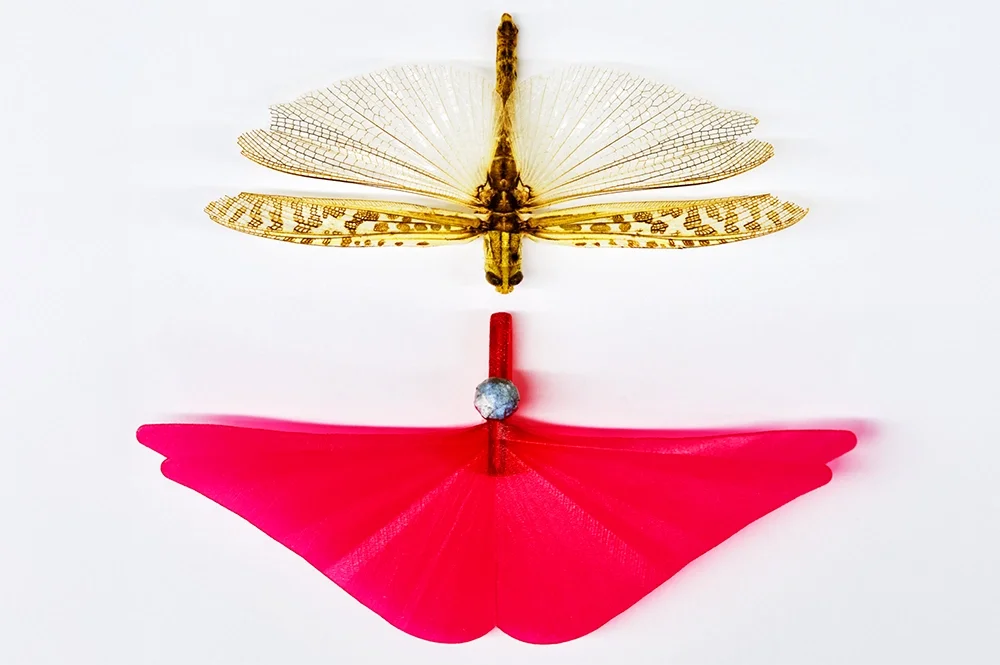
Today, her lab focuses on bioinspiration, a field that looks to biology for solutions to technological problems. Researchers study how organisms solve challenges such as movement, sensing, or water repellency, then adapt those biological strategies into new materials or machines. But Alleyne did not begin her career there.
Originally trained as an entomologist studying parasitic insects, she spent years researching insect parasites before a long-standing interest in interdisciplinary science pulled her in a new direction. She gradually shifted directions after teaching a course on bioinspiration at U of I, and also launched a blog that focused on the topic and discussed it frequently on social media. Engineers, chemists, and materials scientists began reaching out.
"And then people started contacting me," she said. "Do you want to work together?"
More than a decade later, those conversations have completely reshaped her research program.
Engineers wanted answers. So did the insects.
At first glance, the relationship seems straightforward.
Engineers want to know how insects accomplish feats that human technology still struggles to replicate. An insect can fly, run, jump, cling to surfaces, navigate cluttered environments, and power itself, all within a tiny body.
"In the end insects are still so much better at flight than we are," Alleyne said. "Or any kind of locomotion really."
She points out that insects routinely perform forms of movement that remain difficult for robots. They transition from flying to running to swimming. They carry their own power source. They can survive collisions and continue moving.
"Our robots can only do one thing," she said.
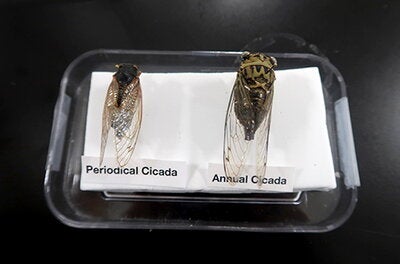
One area of interest is the structure of cicada wings.
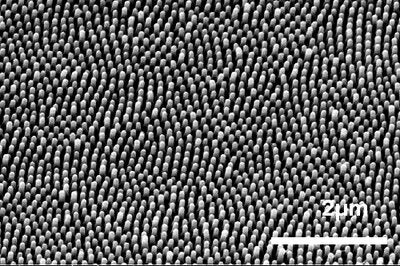
Under powerful microscopes, the wings reveal forests of microscopic pillars. These structures are so small that they are measured in nanometers. Yet they produce an impressive collection of effects. The surfaces repel water. They clean themselves. They interact with light in ways that help camouflage the insect.
"You have all these multifunctionalities," Alleyne said. "Camouflage and superhydrophobicity and things like that."
For engineers, that is an irresistible design challenge.
Imagine a manufactured material that stays clean, sheds water and manipulates light without requiring separate coatings or components.
The problem is that recreating nature is often much harder than admiring it.
"They have to be just so to get all those functions to work properly," Alleyne said of the tiny structures.
That is where the engineers come in.
Nenad Miljkovic, professor of mechanical science and engineering, has worked with Alleyne on the cicada nanopillar research for years. He says the partnership works because each side brings something the other simply does not have.
“As engineers, we see an insect, and it all looks the same to us. She, on the other hand, can help us understand the species, where it resides, how it replicates... information we would never have access to without working with someone of her caliber,” Miljkovic said. “This helps us to conduct studies on bioinspiration which very few teams do.”
He also credits Alleyne's approach for keeping the lab environment open, especially for students still learning to work across disciplines.
“She is very humble and down to earth, so it makes the research very smooth... She is one of the best collaborators I have on campus,” Miljkovic said.
Then the engineers gave biologists something unexpected
If the story ended there, it would be a familiar tale of engineers borrowing ideas from nature. But Alleyne says the more interesting part is what happened next.
As engineers developed ways to fabricate biological structures, those same tools became useful for answering biological questions.
For example, scientists can recreate the microscopic pillars found on cicada wings. Once they can manufacture those structures, they can start changing them.
What happens if the pillars are taller?
What if they are shorter?
What if their spacing changes?
Those are not engineering questions. They are evolutionary questions.
"Why is a nanopillar the height it is?" Alleyne said. "Why is it not twice as high?"
By building artificial versions, researchers can test hypotheses that would otherwise be impossible.
"Now because we can fabricate it, we can test those hypotheses of why evolution went in this direction and not another direction," she said.
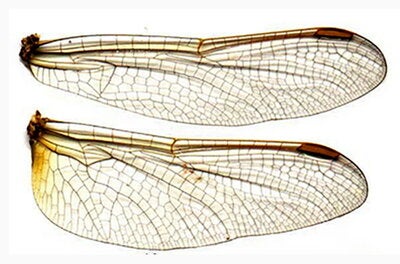
That exchange extends beyond cicadas. David Ehrhardt, research assistant professor in aerospace engineering, joined a project in Alleyne’s lab comparing migratory and nonmigratory dragonflies. Using his background in mechanical testing, Ehrhardt helped measure differences in stiffness between the species and taught one of Alleyne’s students how to conduct the tests.
“I didn't even know there were migratory dragonflies,” Ehrhardt said.
The collaboration also took him outside the engineering lab.
“I was able to spend a few hours catching dragonflies and cicadas,” he said. “Her group and her students have always been welcoming and eager to learn a structural engineer's perspective on their work.”
For Alleyne, that is the larger point. Her lab may work with engineers to develop new technologies, but the goal is still to answer biological questions.
"In the end, in my lab, we are biologists and we want to understand biology better," she said. "And those technology tools that we're developing with engineers is beneficial for that."
The collaboration stopped being about borrowing from nature.
Instead, engineering became a way to learn from nature.
Chasing grasshoppers in parking lots
Some collaborations begin in conference rooms. Others begin with someone chasing insects across asphalt.
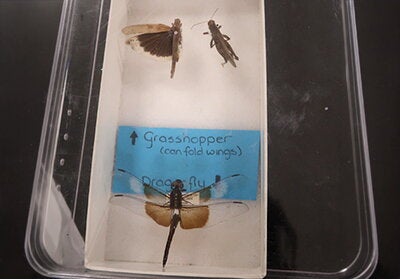
One project that drew public attention involved studying insect collisions. The engineering team wanted to understand why certain insects are so good at surviving impacts.
There was one problem: the researchers needed insects.
Lots of them.
And they needed someone who knew how to catch them.
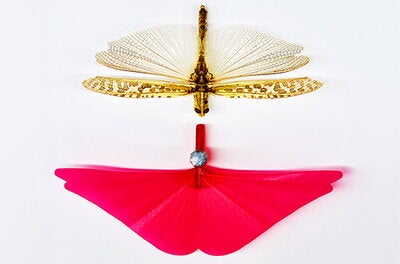
"He can only really do that work if he also works with an entomologist," Alleyne said.
The answer turned out to be surprisingly mundane.
"The best place to catch grasshoppers is actually in parking lots because it's a wide open space and they're easy to follow," she said. "Otherwise, they end up in the bushes and you can't see them."
The image is almost comical. Engineers interested in collision mechanics and aerodynamics running around parking lots after grasshoppers while entomologists explain how insects actually behave.
Yet it captures something essential about interdisciplinary work—neither group could do the project alone. The engineer needed biological expertise and the biologist needed engineering tools.
The technologies crossing the disciplinary divide
As the collaborations deepened, Alleyne noticed another pattern.
Many tools developed for one field could become revolutionary in another.
Researchers routinely use advanced imaging systems to study cancer, medical conditions and human anatomy. Yet some of those same technologies could potentially reveal details of insect biology that scientists have never been able to see before.
"A lot of those tools have actually been developed for cancer research," Alleyne said. "But some of those tools would also be really interesting to use on an insect."
The challenge is often simply recognizing the possibility. Scientists rarely know what technologies exist outside their own disciplines.
"It takes a lot of just talking to people and trying things," Alleyne said.
Interestingly, she mentioned that the next frontier may involve drones. As drone technology becomes smaller and more sophisticated, Alleyne hopes some of the systems developed to track and analyze drone flight could be adapted to study insects.
Engineers are using technology to understand flying machines.
Biologists may soon use the same technology to understand flying animals.
"By now we can also use those tools to study flight in insects," she said.
Nature's designs still have the upper hand
Despite years spent collaborating with engineers, Alleyne remains humbled by what insects can do.
One example still amazes her after more than three decades as an entomologist: the insect exoskeleton.
"It is made out of maybe six elements from the periodic table," she said. "But it is so versatile."
The same basic material can become the rigid armor of a beetle or the soft body of a caterpillar. It can support flight, flexibility and protection. It forms under ordinary temperatures and atmospheric pressures.
When an insect dies or molts, the material naturally degrades.
"It is not like our plastics," Alleyne said.
For engineers searching for sustainable materials, it remains a remarkable benchmark.
"It would be great if we could be fabricating that kind of material," she said.
A dream bigger than any one project
After years of collaboration, Alleyne's biggest goal is no longer tied to a particular insect or technology. It is about changing how research gets done.
She worries that many projects labeled "bio-inspired" involve engineers borrowing ideas from biology without involving biologists. Researchers identify an interesting animal trait, replicate it in a machine and move on.
In the process, they miss much of what biology has to offer.
"There is still so much more to discover," Alleyne said.
Her vision is something she calls "engineering informed biology."
The phrase captures the two-way relationship she believes should define the field.
Biologists help engineers understand nature. Engineers help biologists understand nature more deeply.
"If you truly are going to do bioinspired research, you need biologists," she said. "And the best way to keep biologists in the room, to keep them involved in the team, is by also acknowledging that those tools can be used to study biology and come up with new knowledge in biology."
After spending time in Alleyne's lab, that may be the most striking takeaway.
The insects on display are not merely models for future machines. They are still mysteries in their own right.
And sometimes the best way to understand them is to invite an engineer into the room!