Stories of paleolithic humans often depict men hunting megafauna like the mammoths, while the roles of women, children, and elders were assumed to be minimal. That was, until a Manhattan fashion executive turned archeologist helped to prove that women were crafting textiles long before such technology was believed to exist.
Esteemed archaeologist and U of I professor emerita Olga Soffer died June 20, 2026, at 83 years old. The New York Times called her “one of the world’s top experts on the Upper Paleolithic period.” Perhaps most notable of her findings was discovering that Paleolithic women were crafting textiles — woven cloth, baskets, skirts, and caps — thousands of years before such technology was believed to exist. This discovery was published widely, tearing down the stereotypical caricature of a cave woman sitting around while the men hunted.
The road to archaeology
Soffer was born in Nazi-occupied Yugoslavia Sept. 9, 1942. Her uncle, who had been captured by German forces in World War II, immigrated to New York in 1953 with his wife under U.S. legislation that gave immigration priority to former Allied prisoners of war. Soffer’s family followed a couple years later.
Soffer earned her political science degree from Hunter College in Manhattan, then got her first job at a department store. She eventually became the special events coordinator for fashion, working with marketing campaigns. Though she loved this role, after 12 years, she became less interested in seasonal trends and more interested in studying art.
From fashion, she moved to art. From the art classes she took, she learned about prehistoric art. And from prehistoric art, she entered the world of archeology.
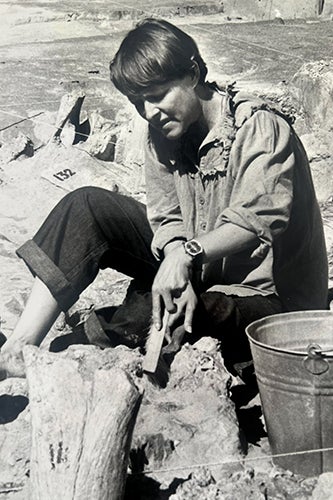
“She came to archeology from a background in business and fashion, both of which are fairly unusual for any scholar, let alone an archeologist,” said Alma Gottlieb, professor emerita in anthropology. “She brought those very different and creative approaches to her scholarship, and I think that’s why she was so brilliant.”
After earning her doctorate in anthropology from the City University of New York and teaching at various institutions, she ended up at the University of Illinois Urbana-Champaign in 1985.
“She was always, I’d say, the best-dressed of the female professors in my department,” Gottlieb said. “I once asked her what her secret was, and she told me it was TJ Maxx.”
Gottlieb brought up a course Soffer created that studied the archeological record through fictional stories. Students would read the stories and figure out which parts were based in fact versus creative embellishments.
It was an example of Soffer’s unique approach to archeology, stemming from her atypical background. The course’s goal seemed to intrigue students who might have been deterred from pursuing archeology because it felt dauntingly technical. The course was quite popular, Gottlieb said.
Gottlieb also commented on how energetic Soffer was. She was not alone in remembering that about Soffer.
“Dr. Soffer — who quickly insisted I call her Olga — was the first member of the [U of I] Anthropology Department I met in person, during my initial campus visit in spring 1994,” said Sarah Phillips, professor of anthropology at Indiana University.
Phillips earned her master’s and doctorate in anthropology from the U of I in 1998 and 2002, respectively. She initially studied the Russian feminist movement, before switching her focus to Ukraine. Soffer, who also headed the Department of Slavic Languages & Literatures through most of the ‘90s, insisted on speaking in Russian with Phillips so Phillips could practice the language.
“Olga brought fascinating guests to campus and freely shared stories of her own exciting fieldwork adventures,” Phillips said. “... By all accounts, Olga was a generous and very engaged mentor.”
Paleolithic women and textiles
A 2007 book titled “The Invisible Sex: Uncovering the True Roles of Women in Prehistory” opens with a story of how the authors came to know each other. Two of those authors were Soffer and James M. Adovasio, who the book refers to as Jim.

As the story goes, Adovasio was the leading scholar in North America for perishable artifacts such as basketry and cordage.
“Jim had for 30 years been telling everyone in his field how important a diagnostic tool was to be found in all those perishable artifacts he had come to know so well,” the book states. “Nobody seemed to give a damn — except that Olga did. Right off, perhaps in part because she was as attuned to fashion as she was to ancient ceramics, she also took up the cause.”
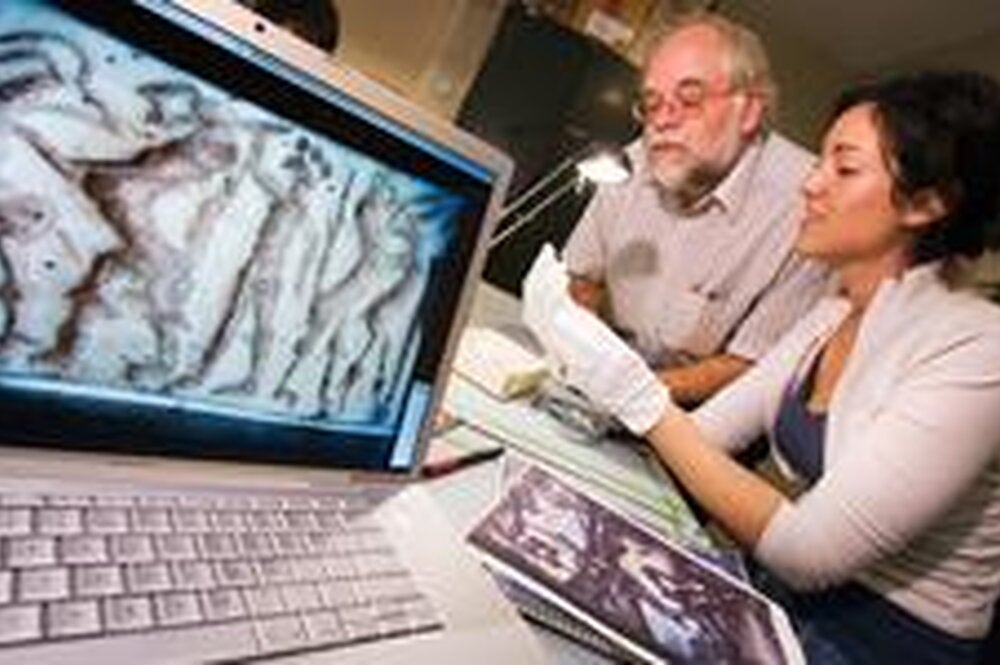
The story continues in 1995 in Soffer’s Urbana home. She projected some slides onto her refrigerator — images of impressions left in clay over 26,000 years ago, showing parallel lines. Adovasio could confirm these parallel lines were impressions of textiles, making them the first examples of such technology from the Paleolithic era.
This discovery also showed an example of the kind of work women, children, and elders were doing while the young men were out hunting. They were masters of a craft that was previously thought to have not been invented until far later.
“While it is clear that Upper Paleolithic lives were lived by a diverse set of actors doing a great variety of things, our past research has privileged just one segment of people — namely, prime age males,” Soffer and Adovasio’s chapter in “The Magdalenian Household: Unraveling Domesticity” reads.
One reason for the lack of information on what people outside of those “prime age males” were doing is the materials used for the tasks. Evidence of stone tools used for hunting are more likely to last tens of thousands of years than evidence of plant-based items.
“The discrepancy between the ethnographic reality, the archeological record from well-preserved sites, and our Upper Paleolithic inventories, warns us that we are envisioning Paleolithic life in highly biased ways, ones based on considerably less than 10% of what was actually made and used,” the chapter continues.
Soffer and Adovasio point out that plant-based items — like nets, baskets, and clothing — were cross-culturally associated with women, children, and elders. The lack of surviving evidence of those items thus led to assumptions that these people were not up to as much. Major pieces of the story of these early humans were missing, until Soffer and her colleagues looked closer.
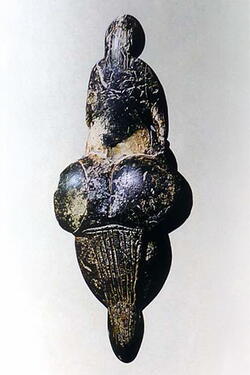
In a 1999 New York Times article sharing this research, Soffer commented on a 25,000-year-old figurine called the Venus of Lespugue. The figure appears to be wearing a string skirt, which Soffer compared to a 1930’s-style beaded curtain and said was likely a form of ritual wear.
“That skirt is to die for,” she is quoted saying. “Though maybe it’s an acquired taste.”