While completing his pediatric oncology fellowship at the University of Michigan, Carl Koschmann (BS, ‘02, biology honors) met a young patient battling cancer.
Her name was Vara James. At 9 years old, she was diagnosed with a Wilms tumor in her kidney. At 11, it recurred in her lung.
Vara became one of Koschmann’s patients as he was finishing his fellowship.
“When she finished her second rounds of therapy, she had a lot of sequelae from the treatment in terms of numbness and tingling in her hands, weakness in her upper arms and upper extremities, and also some issues with anxiety and sort of physical confidence,” Koschmann said.
He had an idea for something to help.
“I thought to myself, ‘Boy, you could address many of those in a climbing gym.’”
Starting in Illinois
Koschmann currently works at the University of Michigan with patients who have midline glioma, a rare and aggressive brain tumor. But his medical career began at the University of Illinois.
“I really enjoyed my time in Illinois,” he said. “I was in the biology honors program, which was a really wonderful smaller community of folks who were interested in careers in science, and a lot of pre-medical classmates. I appreciated that time as sort of starting to plant the seeds of how to approach biology, but also how to ask questions in a research perspective.”
He recalled studying the cardiovascular function of largemouth bass by putting them on what were essentially underwater treadmills.
“Obviously, that’s a little further away from the research I’m doing now, but it planted the seed of how you can use animal models to learn a lot about human disease, and I really appreciated the opportunity there,” he said.
Through summers working as a camp counselor, he realized he liked working with kids. That led him to pediatrics.
After completing his undergrad in 2002, he attended medical school at the University of Wisconsin-Madison. There, he entered the realm of pediatric oncology — studying cancer in children and adolescents.
“Kids were often having real big swings in their health and really leaning on their providers to help them through that period,” Koschmann said. “I appreciated that challenge and interface.”
From there, he moved onto his fellowship at the University of Michigan and met Vara.
Let’s go climbing
Koschmann had occasionally climbed in his youth. After moving to Ann Arbor for his fellowship, he realized the city had a prominent rock climbing community. He got involved.
Emily Gordon, Vara’s mother, said she was nervous when Koschmann first suggested rock climbing for Vara.
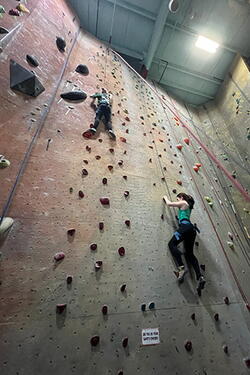
“It was not something I would have expected, and my instinct as a parent was to be cautious about things that were hard for her physically,” Gordon said.
Despite Gordon’s worries, she trusted Koschmann’s judgement. It turns out, she said, “It was perfect for what she needed.”
“[Koschmann] made the activity feel safe, supportive, and manageable,” Gordon continued. “She found success in ways we could not have predicted, and it changed her recovery path. As a non-climber still, I am in awe of how much this program helps and am so glad he suggested it to us to this day.”
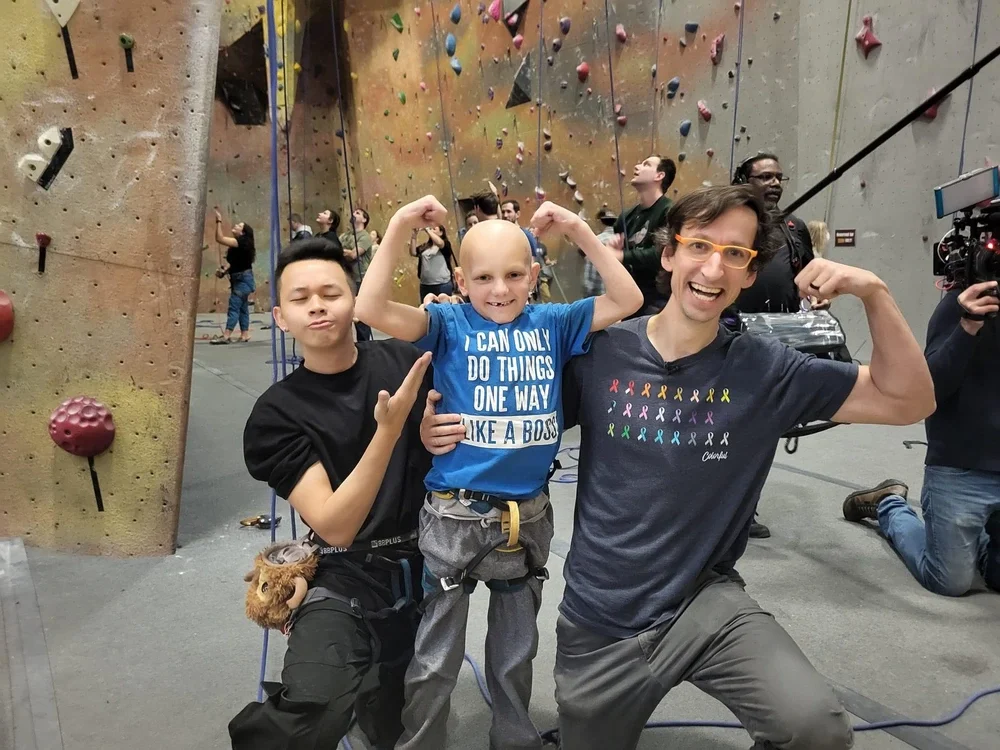
It started as an informal get-together with Vara, Gordon, and some other families meeting at the gym once a month to climb.
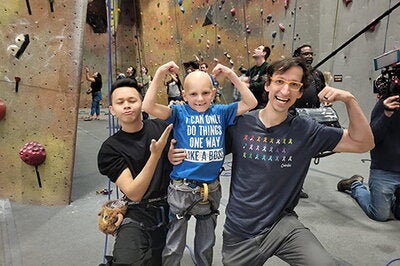
“[Vara] and [Gordon] thought this would be a good thing to offer to other children and young adults who were finishing cancer, so we fundraised and built this program,” Koschmann said. “It’s become a nonprofit that we call Rock Cancer.”
The program expanded to include patients still undergoing therapy, and a new group was added for older adults.
“Where it really took off was maybe two or three years ago,” Koschmann said. “The program was profiled by NBC Nightly News. One of their producers was a rock climber and had heard about our program. That really put us on a different scale.”
Next thing they knew, other cities around the country were wanting to join in on the idea. Rock Cancer was formalized as a nonprofit, and now their reach extends as far as Prague, Czechia.
“The benefits went beyond the physical activity,” Gordon said. “Rock climbing helps Vara and the other participants build confidence, set goals, and experience a sense of progress during a difficult time.”
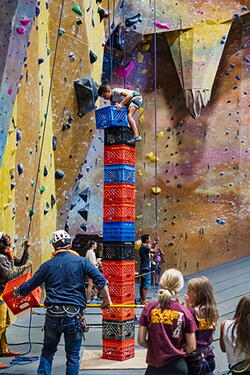
The program was also expanded to include patients still undergoing treatment. Koschmann likened climbing to a sort of advanced physical therapy.
Gordon also noted the sense of community Rock Cancer brings. “Participants and families are with others who understand what they are experiencing, while also having the chance to focus on something positive.”
That community is key.
“I think that when some of these kids return to school, or if they’re in school while they’re in therapy, it is hard for them sometimes to feel similar to their peers,” Koschmann said. “They’re going through something that’s completely life-changing. Maybe they’re experiencing some of those symptoms while they’re in class. Maybe they have a little harder time, due to some of the treatments, performing well in class. Maybe they look slightly different because of their treatment.
“When we take them into the rock climbing gym as a group, it’s a group that’s very comfortable with whatever is going on with their treatment, their condition, how their body looks — and no one’s talking about it. We’re just climbing. We’re just having fun.”
Looking forward
Koschmann’s research into treatment for midline glioma continues.
“It felt like a particular challenge and interest because there were no treatments at the time that I started my research,” Koschmann said.
People diagnosed with midline glioma — who are mostly children to young adults — typically live for nine to 15 months. It is universally fatal. However, Koschmann and other researchers’ efforts are showing progress.
He has been working on a treatment called dordaviprone, which became the first treatment for this cancer to be approved by the Food and Drug Administration. In patients he studied, median survival time increased when receiving this treatment. It is not a cure, and it does not work for everyone, but it is progress.
Meanwhile, Koschmann also hopes to expand the Rock Cancer program even further to allow patients with a broader spectrum of function to participate, using special equipment and training.
“[Koschmann] creates an environment that is inclusive and fun while staying attentive to what each person needs,” Gordon said. “He is like this in work and in the gym.”