The College of Liberal Arts & Sciences has joined forces with Dow Chemical Company and UIDP, a nonprofit that fosters university-industry partnerships, on a new program to help develop the next generation of research leaders.
Thanks to the shared investment of participating universities like Illinois, industry partners like Dow, and the National Science Foundation, the NSF UIDP Industry-Integrated PhD Scholars Program (I-PhD) provides up to four years of financial support for STEM PhD students.
“The chemical sciences here at Illinois already had strong connections with corporate partners such as Dow in the energy and materials domain. This new program, spearheaded by NSF’s relatively new Directorate for Technology, Innovation and Partnerships, expands and deepens these relationships with existing corporate partners, while also lowering the hurdle for new corporate partnerships,” said Paul Kenis, director of the School of Chemical Sciences and a professor of chemical and biomolecular engineering. “What I believe is a significant added value of this new I-PhD program is formal joint mentorship of the participating graduate students by academic and industry researchers, and the students pursuing a significant fraction of their dissertation research at one or more sites of the corporate partner.”
"The Dow/UIUC partnership is an important element of our talent strategy as it supports the development of amazing talent with exposure to challenges of relevance to our industry,” said Rui Vogt Alves da Cruz, Dow’s R&D vice president, Enterprise Innovation & Growth. ”We are very thankful for Illinois’ flexibility and collaboration as we sort out how to work together on all aspects of an one-of-a-kind pilot that we are now very eager to expand."
The I-PhD program will create new opportunities for LAS graduate students in the highly-ranked Department of Chemical & Biomolecular Engineering (ChBE). As part of its mission to prepare graduates for high-impact careers in academic and industry, ChBE maintains strong ties to companies like Dow that are harnessing cutting-edge biomolecular knowledge and techniques to tackle challenges in health, energy, and the environment.
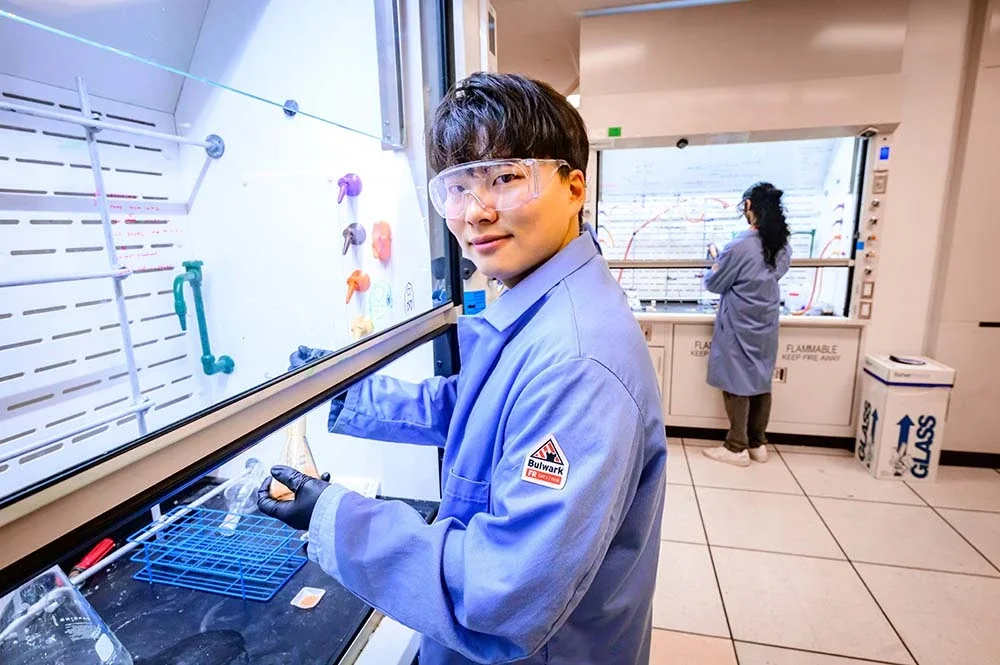
Three members of this year’s ChBE doctoral student cohort will be selected for this innovative program. In addition to working and learning in the labs of ChBE professors Alexa Kuenstler, Simon Rogers, and Charles Sing, the I-PhD doctoral graduate students will be co-advised by industry scientists and will be embedded with Dow for a full year of hands-on research experience.
“In ChBE we’ve always trained students with the skills needed to attack chemical problems in industry,” Kuenstler said, “but this is an opportunity for our students to get a more cross-cutting education through those interactions in a professional setting.”
Dow presented the Illinois scientists with the challenge of creating materials that are both soft and impact resistant, which presented an exciting opportunity to the Kuenstler, Rogers, and Sing labs–all of which research different aspects of materials–to collaborate both across their research teams and with industry scientists.
“It’s a really valuable opportunity to collaborate–with my colleagues, but also with Dow, which has world-class scientists,” Kuenstler said. “It’s a really exciting opportunity to take expertise from our labs and translate them to industrial problems, and for students to experience what’s happening in industry and bring that back to Illinois.”
While Illinois scientists, including both Rogers and Sing, have a long history of collaboration with Dow through the company’s University Partnerships Initiative, “it’s exciting that this new chapter really centers students and ways that we can improve their education holistically,” Kuenstler said.
"Dow has a long history of partnership with the University of Illinois, and we’re excited to build on that foundation by participating in the UIDP I-PhD pilot,” said Patrick Hanley, R&D director for Advanced Development & Strategic Partnerships at Dow. “Illinois has long been an outstanding developer of scientific and engineering talent, particularly through its strengths in chemistry, chemical and biomolecular engineering, and materials science. We see this program as another opportunity to deepen our relationship with the university while helping prepare the next generation of scientists and engineers for careers that connect leading-edge research with real-world impact.”