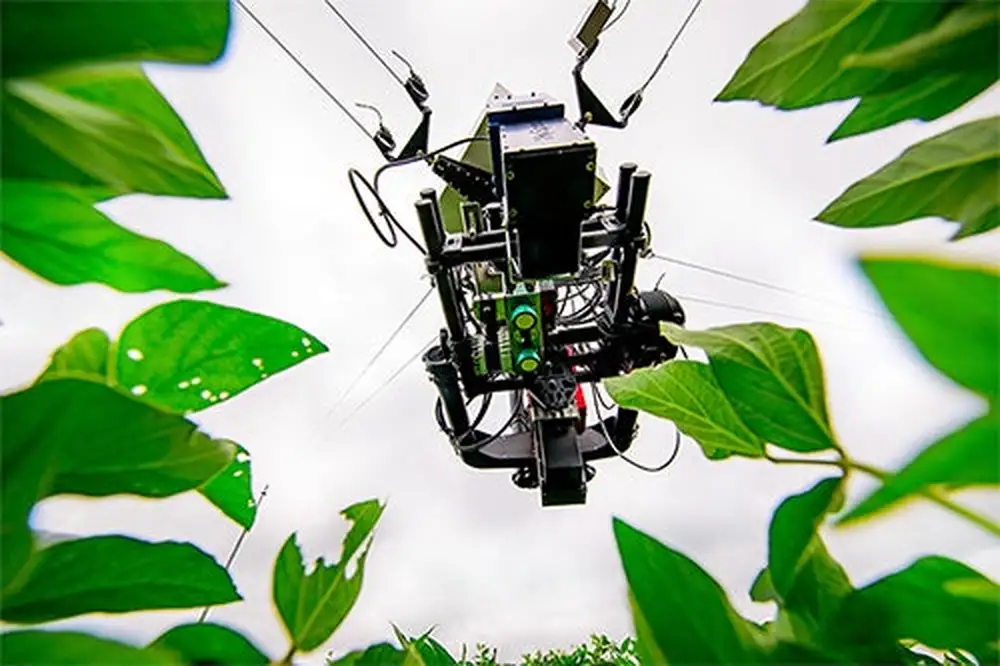
Laboratory and field experiments have repeatedly shown that modifying the process of photosynthesis or the physical characteristics of plants can make crops more resilient to hotter temperatures. Scientists can now alter the abundance or orientation of leaves, change leaf chemistry to improve heat tolerance and adjust key steps in the process of photosynthesis to overcome bottlenecks, researchers report in a new review in the journal Science.
While these changes can overcome some of the losses experienced from rising global temperatures, they are not easy to implement at the scale that will be needed to keep the world fed, the authors said.
“The timeline from identifying a beneficial trait to getting it in a farmer’s field is long,” said Donald Ort, who wrote the review with Stephen Long and Carl Bernacchi, all professors of crop sciences and of plant biology at the University of Illinois Urbana-Champaign. “The breeding cycle for a conventional trait can be 10 to 12 years.”
Altering gene expression in plants via bioengineering is faster, but regulatory frameworks require years of laboratory and field trials, Long said.
“Given the high cost of taking a bioengineered trait to market, you want to be sure that it works everywhere. It goes through a lot of multilocation field trials, which, together with legal costs, is very expensive,” he said. “You must show that the protein that you put into the plant is not toxic, and you’ve got to produce a very large legislative document to meet all the requirements. There are various estimates out there, but the one you hear most often is that for a single transgenic trait, it costs about $115 million to get it deregulated and takes more than 16 years to go from invention to seed systems.”
Some alternative approaches, however, use DNA editing to increase the number and/or expression of genes that are already in the plant, which does not involve introducing foreign DNA and so avoids many of these costs, Long said.
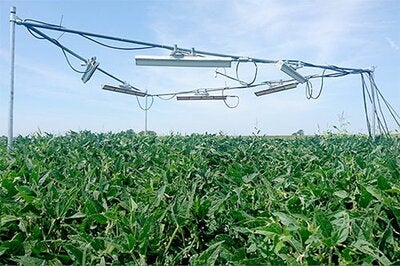
In laboratory experiments and field trials, many potential approaches to increasing crop resilience to heat stress have already been tested and validated, Long said. One intervention involves altering the orientation of crop canopy leaves — through plant breeding or bioengineering — to optimize light distribution over the entire plant, increase water-use efficiency and minimize the scorching of leaves in high temperatures.
Other methods include increasing the reflectivity of plant leaves or regulating water loss through pores in plant leaves without reducing productivity.
“Many studies focus on Rubisco, the most abundant protein on our planet and the plant enzyme through which carbon dioxide is assimilated in what becomes the crop and our food,” Long said. The Rubisco molecule and associated proteins differ between plant species, with some performing better than others in conditions of higher heat and light. Modeling studies indicate that giving a soybean plant a more efficient Rubisco enzyme from another species would improve its performance in hotter conditions.

Scientists also can manipulate the distribution of chlorophyll in plant leaves to allow lower leaves to capture more of the light that filters through the canopy. This, along with altering the orientation of leaves, would increase photosynthetic efficiency while also helping to distribute the heat loads more uniformly across the plant.
Many other avenues of research are being explored, but timing is critical to overcoming the heat-related challenges of climate change. Projected temperature increases between 2010 and 2050 are expected “to depress yields of the major grains by 6%-16%, against a backdrop of a potential >50% increase in demand over this period,” the authors report.
“There are real opportunities to address temperature increases, to future-proof the crop against rising temperatures,” Long said. “It isn’t an impossibility. But it’s going to mean significant, very significant effort.”
The authors are all affiliates of the Carl R. Woese Institute for Genomic Biology, the Center for Advanced Bioenergy and Bioproducts Innovation and the Realizing Increased Photosynthetic Efficiency project. Long and Ort are professors emeritus of plant biology and crop sciences.