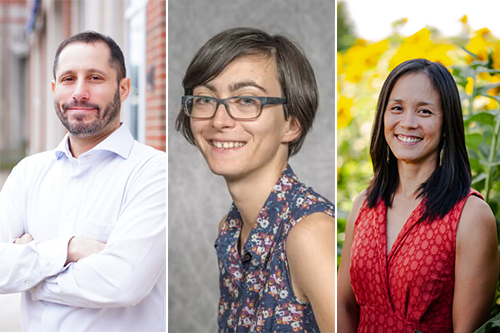
Three LAS professors have been named 2026-2027 University Scholars in recognition of their achievements in teaching, scholarship and service.
The program honors faculty excellence and provides $15,000 to each scholar for three years to enhance their academic careers. That money may be used for travel, equipment, research assistants, books or other purposes.
“The University Scholars program recognizes faculty whose work exemplifies the very best of the University of Illinois System,” said Nicholas Jones, the executive vice president and vice president for academic affairs for the University of Illinois System. “Through their groundbreaking research, innovative teaching and service to their disciplines and communities, these scholars advance knowledge, enrich the student experience and help address society’s most pressing challenges.”
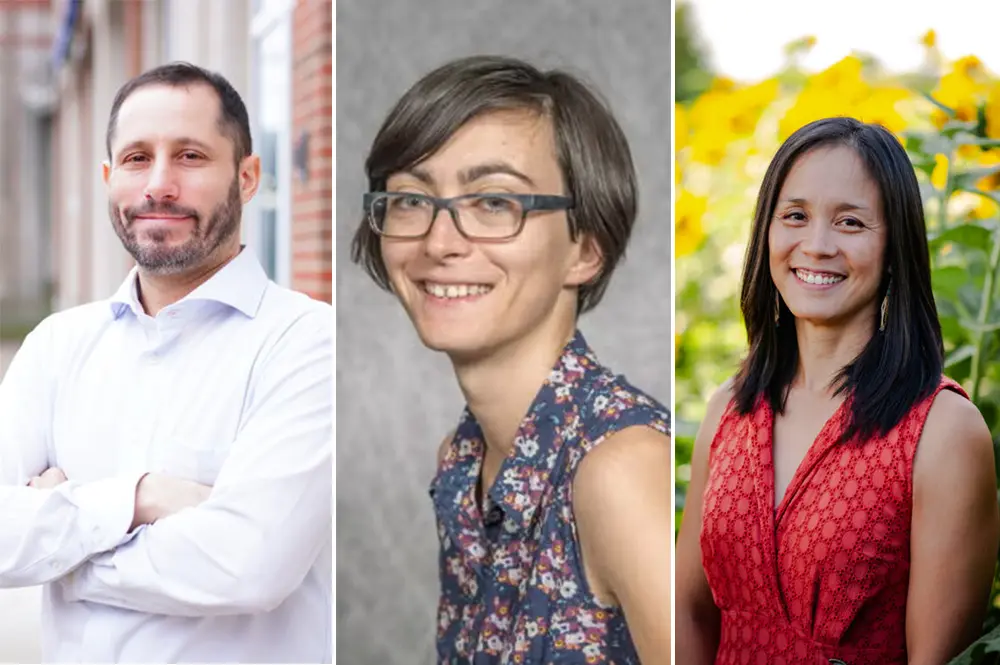
The three Urbana campus recipients in the College of LAS, as described by their nominators:
History professor Marc Hertzman specializes in the history of Brazil and Latin America with special interests in race, the African diaspora, culture, slavery and its legacies, labor and gender. Hertzman has additional affiliations at Illinois with the Department of Spanish and Portuguese, the Unit for Criticism and Interpretative Theory, the Center for Latin American and Caribbean Studies, the Lemann Center for Brazilian Studies, the Center for East Asian and Pacific Studies and as the director of graduate studies for the history department.
While his previous work focused on the 19th and 20th centuries, Hertzman’s current scholarship explores deeper into the past: the colonial era of Brazil. Specifically, he has examined the afterlives and cultural, spiritual, physical and monetary inheritances of Palmares, one of history’s largest and longest-standing fugitive slave settlements, and its iconic leader, Zumbi. His 2024 book, “After Palmares: Diaspora, Inheritance, and the Afterlives of Zumbi,” won the American Historical Association’s 2025 James. A Rawley Prize in Atlantic History and the Brazilian Studies Association’s 2026 Roberto Reis Book Award. Hertzman values the impact of public engagement and has shared his expertise in written pieces for New York Magazine and Time as well as appearances on Al-Jazeera to provide news analysis on Brazil.
Vesna Stojanoska is a professor of mathematics and a Norman P. Jones Professorial Scholar. Her research interests include chromatic phenomena in stable homotopy theory, a branch of mathematics studying properties of shapes that remain invariant under continuous deformations. Those properties are encoded by generalized cohomology theories; the chromatic approach is a way to systematically sort cohomology theories by a quality reminiscent of wavelength. Stojanoska’s work focuses on questions of duality and invertibility for chromatically interesting cohomology theories, reflecting a specific type of self-symmetry or reversibility and often creating fascinating connections with geometry and arithmetic.
Stojanoska has garnered several accolades for her work as a mathematician. She received the Simons Fellowship in Mathematics in 2022 and was named to the 2026 Class of Fellows for the American Mathematical Society. She also has shepherded the educational and career prospects of numerous undergraduate and graduate students by supplying thoughtful, caring mentorship.
Wendy Yang, a professor of plant biology, oversees research in terrestrial biogeochemistry and ecosystem ecology with a focus on the mechanisms driving patterns in soil emissions of greenhouse gases and rates of nutrient transformations in the environment. Yang broadly seeks to improve understanding of plant-soil-microbe interactions to better predict, adapt to and mitigate the effects of global environmental changes. An important component of her research has been the development of novel methodologies — using tracer and natural abundance stable isotope techniques — to measure production and consumption of nitrous oxide, a potent greenhouse gas, in soil. Her scholarly output includes numerous projects, such as studying the effects of rainfall intensification on soil greenhouse gas emissions in the Midwest and the ecological sustainability implications of bioenergy cropping systems.
Yang has maintained a busy profile in her 13 years at Illinois. In addition to her lab pursuits, she serves as the deputy director of research and development of the Center for Advanced Bioenergy and Bioproducts Innovation and as the associate director of the Agroecosystem Sustainability Center. She earned the LAS Dean’s Award for Excellence in Undergraduate Teaching in 2021 and the Campus Award for Excellence in Guiding Undergraduate Research in 2025. She is affiliated with the Institute for Sustainability, Energy and Environment, Carl R. Woese Institute for Genomic Biology and the Center for Digital Agriculture.