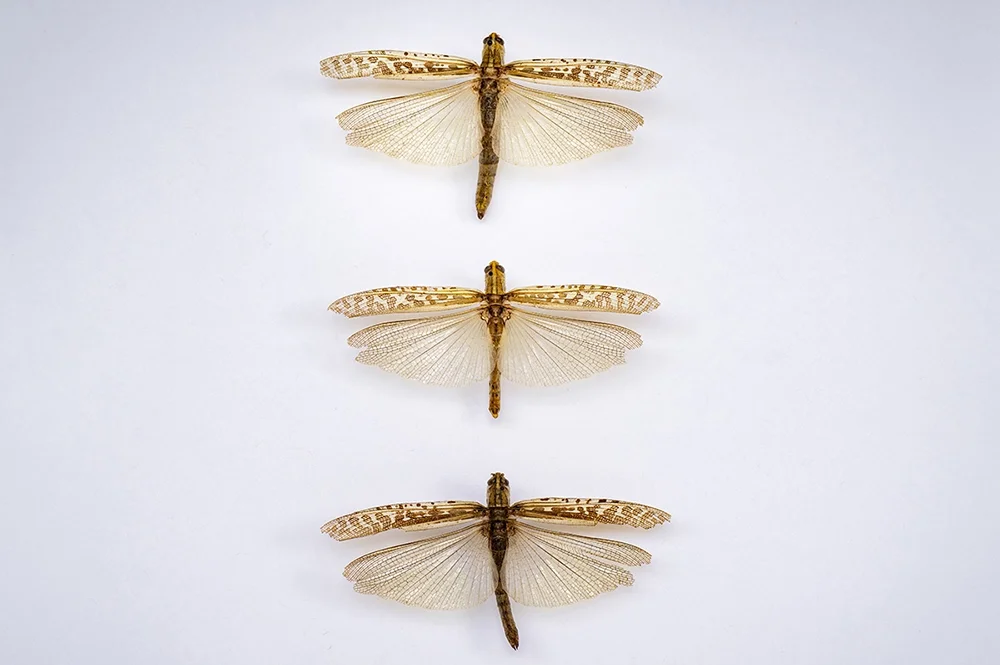
A collaboration between Princeton University engineers and entomologists at the University of Illinois Urbana-Champaign began with the researchers chasing grasshoppers in a hot parking lot. Their eventual focus on the hindwings of one species of grasshopper, Schistocerca americana, the American grasshopper, is inspiring a new approach to untethered gliding flight.
The scientists detail their findings in the Journal of the Royal Society Interface.
Study principle investigator Aimy Wissa, a professor of mechanical and aerospace engineering at Princeton, teamed up with U of I entomology professor Marianne Alleyne, whose laboratory uses insects as model organisms for discovering attributes that may be advantageous in engineering applications.
The researchers were fascinated by the grasshoppers’ ability to glide for extended distances using very little energy, Alleyne said.
“Grasshoppers have two pairs of wings,” she said. “The forewings are very leathery and are mostly used to protect the hindwings, which can fold. It is the membranous hindwings that are large and can flap and help with gliding.”
“Gliding is a mode of cheap flight,” Wissa said. “When we want to produce thrust, we flap. When we want to conserve energy, we fully deploy the wings and glide.”
The researchers observed that the grasshoppers spread their wings to glide, but the wings were not flat when spread. They were corrugated.

“As an entomologist, I was mostly interested in what the benefits of this corrugation might be,” Alleyne said. “I was wondering if corrugation is a disadvantage, or if it might be a neutral trait that came about to allow them to fold their wings. Corrugation also could be beneficial. We didn’t know.”
The engineers and the biologists worked together to uncover the grasshoppers’ secret to efficient gliding locomotion. They took CT scans of the grasshopper wings. This technique uses X-rays and computing to capture the detailed geometry of an object. Insights from their analyses allowed them to 3D-print model wings and to test whether corrugation, wing shape or the curvature of the wing surfaces contributed to efficient gliding flight.
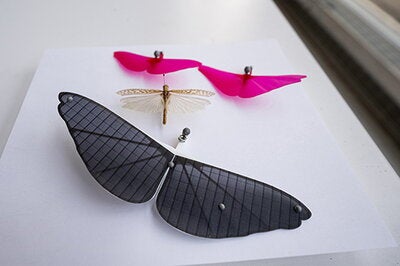
The Princeton team evaluated the aerodynamic performance of their gliders both in a water chamber and by launching them across the Princeton Robotics Laboratory.
While corrugation of the wings helped with lift, the best-performing gliders were smooth, not corrugated, the team found. Future research will focus on how to incorporate the corrugations to enable wing folding while still maximizing gliding efficiency, the researchers said.
“As an entomologist, I am now interested in using the different prototypes and launch pad that the engineers developed to delve further into insect wing morphology,” Alleyne said. “While my lab often collaborates with engineers to do biology-inspired engineering, this can also go in the other direction, where we use engineering models and experimental tools to answer key biological questions.”
Alleyne also is a professor of mechanical science and engineering in the Grainger College of Engineering and in the Beckman Institute for Advanced Science and Technology at the U of I.