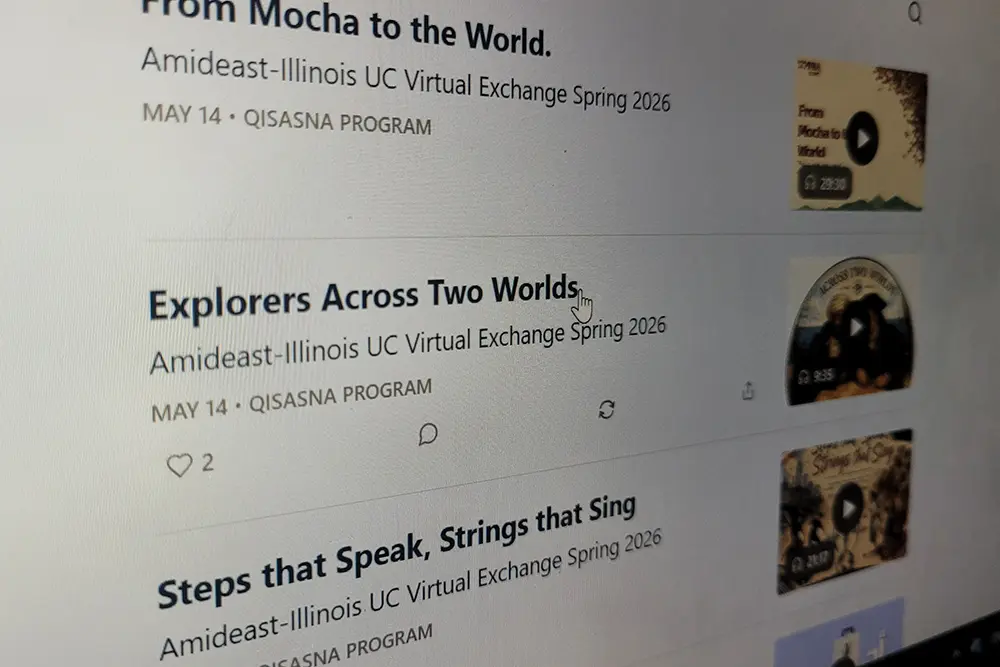
“Qisasna” means “our stories” in Arabic. A program by that name in Aden, Yemen, connects young adults with peers around the world to create podcast episodes sharing their experiences and ideas. The program is open to students from high school to graduate school, as well as young professionals.
Angela Williams, associate director for the Center for South Asian and Middle Eastern Studies and instructor for SAME 250, saw the program as an opportunity for her students to hear firsthand stories from other young adults on the other side of the world. She got in contact with the program to collaborate.
“The historical accounts and everyday realities of Aden offer perspectives that are rarely accessible to U.S. students, and the Yemeni participants bring lived experiences that challenge assumptions and enrich classroom learning,” Williams said.
SAME 250 covers Middle Eastern histories, cultures, and contemporary issues. The course focused on Yemen for the past two semesters, welcoming guest speakers to share their perspectives on current events and culture. Williams did the podcast project with the Qisasna program for both semesters.
“The collaboration consistently deepens students’ understanding of the Middle East by grounding abstract concepts in real conversations,” Williams said. “The podcast format helps students translate their learning into public-facing storytelling, and the cross-cultural exchange builds confidence, empathy, and curiosity.”
Williams’ students had weekly virtual meetings with the Yemeni participants. They were grouped up and tasked with making a narrative-driven podcast episode on a topic of their choice that related to course themes.
“They selected topics together, drawing on themes such as food, music, daily life, cultural misconceptions, or shared values,” Williams said.
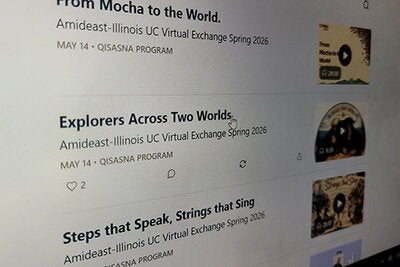
One group’s podcast episode is titled, “Steps that Speak, Strings that Sing.” It explains how music and dance are woven into everyday life in Yemen, serving as a raw expression of emotions. The Illinois students compared that to their experiences with baile folklórico, a traditional dance style from Mexico.
The group discussed how dance and music styles from different parts of the world can influence each other, such as hip-hop techniques working their way into K-pop dances. They concluded that music and dance are powerful mediums for expression, cultural identity, and emotion, and they can help people to better understand each other.
Another group studied historic explorers, examining the approaches of Yemeni geographer and writer Al-Hamdani versus Lewis and Clark. The third group compared the cultural significance of coffee in Yemen and the U.S.
In feedback Williams collected from her students, they said the course and podcast project reshaped their views on the Middle East. One said it helped them realize the Middle East is not one place with one experience, but a region with many languages, histories, and cultures. Another said they only knew the Middle East as a region of conflict, until this course showed them the region’s art, innovation, and science rarely shown in mainstream media.
“Many [students] describe the meetings as the moment when the Middle East shifts from an abstract region to a set of real people with whom they share humor, curiosity, and everyday experiences,” Williams said. “This human connection is one of the project’s most powerful outcomes.”
It was a mutual learning experience, Williams added, with the Yemeni participants also having their ideas of the U.S. challenged. “Illinois students came from a wide range of ethnic and cultural backgrounds, and it was genuinely meaningful to have them represent the diversity of students in the U.S.,” she said.
Through this project, Williams’ students practiced cross-cultural communication and media skills, which she said are “directly applicable to work in international affairs, journalism, education, community engagement, and global nonprofit organizations.”
The episodes are publicly available through the Qisasna program page. Williams said making them public makes these stories more accessible to those who might not otherwise encounter perspectives from a young Yemeni person.