Adrien Reetz is a junior majoring in journalism and is a news writing intern for the College of LAS.
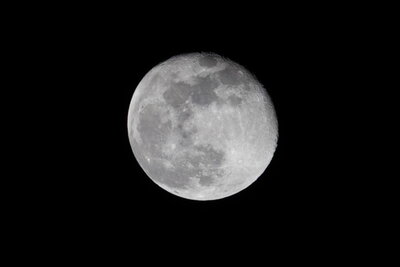
Living at Allen Hall my freshman year, I passed by the University of Illinois Observatory often. Though I did not come to U of I to study astronomy, I’ve always enjoyed looking up at the night sky and seeing how many constellations, asterisms, and planets I could identify.
I come from a small town where the stars are brilliant. When I traveled for marching band in high school, we’d pass through endless fields, and I prided myself on how I could take steady pictures of the stars through the window of a moving school bus.
I didn't realize how much I'd miss that clear view of the cosmos. I took the fact that my backyard was right next to a dark cornfield for granted. According to some light pollution maps, campus is ranked around 8 on the Bortle scale (a scale out of 9), meaning only a few hundred stars are visible to unaided eyes. For comparison, Chicago is a 9 with about 30 visible stars, and most of rural Illinois is in the 4-5 range with a few thousand visible stars. Taking evening strolls after moving to a city was like waking up day after day hoping to see the Sun, only to be met with a dull, overcast sky.
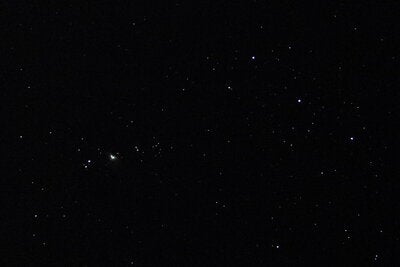
As I walked past the Morrow Plots, I realized the sky was clearer-- The lights in that area are blacked out in the direction of the observatory. I found myself stopping along that path to try taking some pictures of the stars. Then, I tried the observatory backyard. It’s far from the clarity I saw back home, but probably the best view on campus. I’d visit there at night with my camera and tripod, crouched in the darkness next to the bushes while I waited for long-exposure images to reveal more than my eyes could see.
I was a journalism major in the tiny College of Media, scoping out the vast campus for anything that would pique my curiosity. Dance. Religion. Film. Coding. With so many classes open to non-majors, why not explore? I ended up taking an astronomy course, partially to fulfil a general education requirement, but also because I couldn’t ignore a class title like “Killer Skies: Astro-Disasters.”
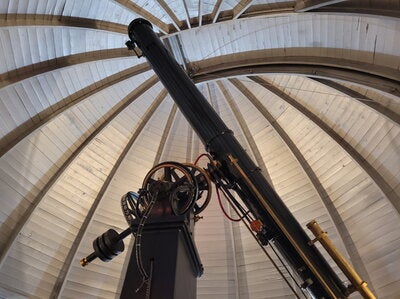
This astronomy class came with night observing sessions, where we would learn about types of telescopes and what we could see at different times of the year. The telescope in the dome at the campus observatory has a larger-than-life feeling about it. I was mesmerized when the operator made it spin. Such a gargantuan piece of equipment, yet able to move with such graceful precision.
However, the most stunning thing I saw that night was the view that scope offered. A pale yellow ball of gas boasting magnificent rings, suspended in the black of space alongside a few little moons. I had seen pictures of Saturn before, of course, but to see it like this took my breath away.
There was an almost eerie stillness to the view. Perhaps I would even use the word haunting. I knew Saturn was a massive planet with crazy wind speeds, so the fact that it looked like a motionless marble from here made me consider the scale of our solar system, and that is thrillingly frightening.
While my work as a journalist deals in true stories from real people, I’m also a big fan of fantasy. I spend my free time telling stories about dragons and magic. Occasionally, my old wizard verbiage spills into my reporting work, and an editor will smite me for my excessive use of words like “plethora.”
Astronomy calls to me because it’s fantastical and true. It draws me in with majestic wonder. Dazzling, glittering skies. Clouds that look like a 3D version of watercolor. Scales beyond mortal comprehension. The universe is a dark ocean of eldritch horrors, and we are a duck bobbing on the surface, sometimes dipping our head to peer beneath at the limited portion visible to us.
Our current understanding of the cosmos is thanks to millennia worth of minds from around the world. Some of the first examples of writing in ancient Babylonia discuss the predictable cycles of planets and stars. The oldest known analog computer, the Antikythera mechanism, is an ancient Greek hand-powered solar system calculator. Halley’s comet is documented in ancient Chinese records and Babylonian tablets from thousands of years ago. Centuries upon centuries of questioning and studying brought us to where we are today, and it could not have happened without those early astronomers looking up at the night sky with wonder.
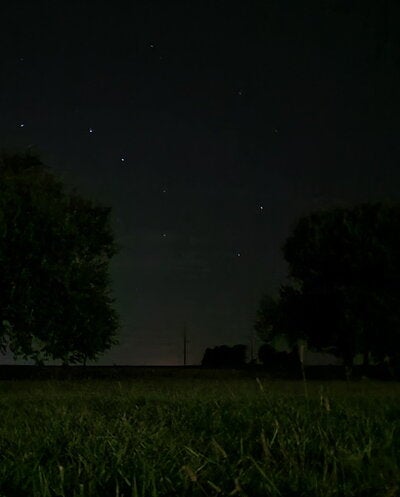
Astronomy makes for spectacular stories. One of my favorites is the Voyager golden records. Imagine being tasked with creating a mixtape to represent all of humanity, past and present. Imagine having to encode images into an audio format, and then write instructions for how to play the record, without using any human words or numbers. As an aspiring documentarian and someone who believes strongly in the importance of archival media, sending a record of humanity into space is fascinating to me. Those golden records are soaring further from Earth than any other spacecraft before, so that if — and that’s a big if — some extraterrestrial intelligent life discovers it, they will know we were here.
I would not have discovered this subject area I have so fallen in love with had I not looked beyond my major — had I not followed my curiosity to that big telescope in the dome. Interdisciplinary work is extremely important. In the case of science reporting, a scientist who is not trained in journalism is likely to struggle with effectively communicating with the public, and a journalist who is not trained in science is likely to struggle with properly explaining a scientific topic. We need people who hold multiple expertises. So, if something outside of your target field makes your eyes light up, look into it.
I have a collage on my wall with pictures of my favorite artworks, astrophotos, and phrases. One is: Per aspera ad astra, inveniam viam. The first part is a famous saying, “Through adversity to the stars.” The second is the incantation for the Misty Step spell in Baldur’s Gate 3, “I will find a way.” I think they pair nicely together.