Mia Alibi is a Visiting Project Coordinator at the Russian, East European, and Eurasian Center at the University of Illinois.
At the University of Illinois Urbana-Champaign, QazTalk has created a welcoming space for students, staff, and faculty to explore the Kazakh language while learning more about the traditions, stories, and culture of Kazakhstan. Organized through the Russian, East European, and Eurasian Center (REEEC), the series has become a meaningful example of cultural exchange on campus, bringing people together through language, conversation, and shared experience.
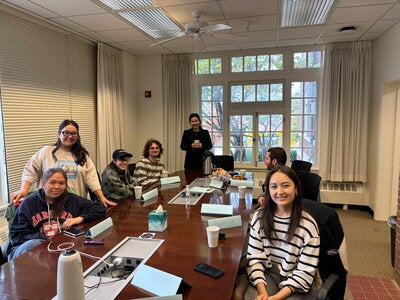
The series started with the help of the Bolashak (“Future”) program. Scholars Aigerim Askarova, Mariya Begunova, and Aslanbek Murzakhmetov helped establish the program and introduced participants to Kazakh language and culture. Today, QazTalk continues to attract new students who are eager to learn more and are making impressive progress. “As a coordinator of QazTalk, I am very impressed by their enthusiasm and progress,” said Mia Alibi.
Meeting regularly during the academic year, QazTalk offers participants an introduction to both linguistic and cultural topics in an engaging and informal environment. Sessions have included basic greetings such as Sälem!, vocabulary connected to everyday conversation, and cultural themes ranging from hospitality and family traditions to cuisine, folklore, and music. Participants have also learned about well-known Kazakh foods such as baursaq and qurt, listened to traditional and contemporary music, and discussed stories such as Kozy-Korpesh and Bayan-Sulu, often described as a Kazakh Romeo and Juliet.

What makes QazTalk especially memorable is its relaxed and supportive atmosphere. For many participants, the club offered a first introduction not only to the Kazakh language, but also to Kazakhstan more broadly.
Kiyoung Lee, undergraduate English and literature major student shared that: As someone who is interested in learning other languages and cultures, I found QazTalk fun. Although I had no prior knowledge of Kazakhstan and its language, I was able to start learning from scratch in a free and relaxed environment. What I particularly like about QazTalk is that there is no pressure of having to memorize everything I learn, because Kazakh native speakers are very willing to help with anything I struggle with. I also enjoy doing various activities after learning some words or phrases, which is both fun and helpful for using them.
Laurie Sterzinger, undergraduate student in REEES, shared: “One of the best parts of QazTalk is how many different topics we cover, both linguistic and cultural. My favorite days were when we tried authentic Kazakh food and tea and listened to traditional and modern Kazakh music. Each meeting is structured differently and has a different lead instructor, so it never feels boring or repetitive. We always learn a lot of relevant new vocabulary and discuss cultural norms and differences. It's always a lot of fun to just be able to talk to everyone else in the club and hear so many new perspectives that I had never experienced before."
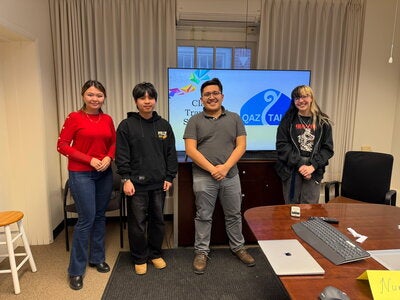
"The club was my main introduction to Kazakhstan," Emma Shepherd, undergraduate linguistics major student said. "Thank you for sharing something so cool in such a fun way." She's now looking into studying abroad in Kazakhstan.
That's the magic of QazTalk. It doesn’t just teach vocabulary – it opens doors to a culture, sparks friendships, and plants seeds that are still growing.
Programs like QazTalk demonstrate the value of creating spaces where language learning and cultural exchange can happen together. Although Kazakh is one of the major languages of Central Asia, it has not traditionally been offered as a regular language of instruction at many U.S. universities. QazTalk has helped address that gap in a creative and community-based way, showing that there is real interest among students in learning more about Kazakhstan and the wider region.
In doing so, QazTalk has become more than a language club; it is a space for curiosity, friendship, and cultural discovery.
And if you are curious about Kazakhstan? We are meeting every Wednesday in 108 Coble Hall, or reach out to Mia Alibi.