At U of I, students whose majors stretch across very different fields say the extra planning and pressure are worth it for the freedom to keep following their curiosity.
Written by Fancy Cheng, communication major and LAS news writing intern
What happens at the end of science? Philosophy?
It is the kind of question that can pause a conversation. Not because science fails, and not because philosophy is waiting at the edge of the laboratory to correct it, but because every discipline, if you follow it far enough, begins to run into its own foundations. What counts as truth? What can be known? What is real? What do numbers describe, and what do they leave out? At a certain depth, questions begin to blend between fields of study.
At U of I, a group of students has chosen to move between science and the humanities. Their schedules are crowded; their degree plans are complicated. But they are trying to make room for the fact that curiosity does not always arrive in a single form.
Of the roughly 12,517 undergrads in LAS, more than 1,000 are pursuing degrees in more than one major, according to the LAS Student Academic Affairs Office. I spoke with a few of them to learn more about their thoughts and college experience.
Jess Johnson
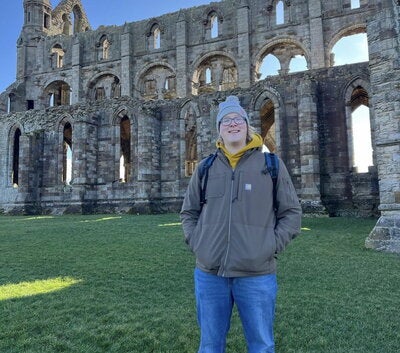
Jess Johnson, a senior majoring in history and geography and geographical information science, did not come to college planning that kind of academic split. He arrived as a history major, the subject that felt closest to him since high school.
“In elementary school, I was maybe a little bit of everything,” Jess said. “But it was definitely history, and a bit of science, by the time I was a teenager.”
Jess said that the challenge of double majoring does not always announce itself right away. But as students move into junior- and senior-level work, the assignments become more specialized, and the act of moving between them becomes its own skill.
“There have been plenty of days where I’ve gone from writing a paper in history to creating a map for a cartography class,” he said. “Those things aren’t very similar, but it has become natural to me.”
Jess talks about his majors as two different ways of learning how to think. That, to him, is where the overlap lives. History and GGIS both require independence of mind. Both ask students to make judgments, form conclusions, and explain those conclusions clearly. In history, that may mean building an argument from sources. In GGIS, it may mean deciding how to represent information and what story a map is telling.
While history and GGIS seem to be distant from each other, there is the possibility of the two halves of his education meeting directly in the job market as he has seen job openings that involve both fields.
When asked why he would still recommend double majoring to first-year students, his answer is rooted less in career strategy than in the purpose of college itself.
“You come to college to learn things,” Jess said. “There’s never been a day where I’ve had classes from both majors where I haven’t, at the end of the day, realized that I learned something.”
Eryn Van Wijk
That same faith in learning—in learning widely, seriously, and without apology—runs through Eryn Van Wijk’s story. A junior majoring in astrophysics and philosophy, they thought they would become a freelance artist for a long time, though Eryn has always been drawn to science.
Eryn entered U of I as undeclared. Later, they added astrophysics, and then philosophy.
The result is a course of study that may sound exhausting. But Eryn describes it with a kind of relief.
If they were doing only STEM, or only humanities, they said, they would burn out. The double major is difficult, but it is also what keeps Eryn intellectually awake.
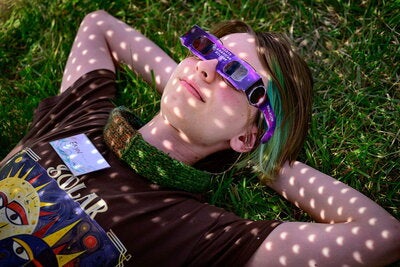
“It's good for keeping a sustained level of energy throughout the semester, which in some ways makes the academic part of it a lot easier, but in other ways it's a lot harder because the pacing on both majors is a lot slower since I'm having to balance both of them. It's not like I'm finishing one degree and then getting the other one.”
Double majoring, especially across very different fields, can leave students slightly out of sync with everyone around them. They do not always move through a major in the same sequence as their classmates. They miss the repetition that turns classmates into familiar faces and familiar faces into friends.
“It’s socially challenging to be a double major,” Eryn concluded.
Their solution is deliberate effort: talk to people, go to office hours, join clubs, invest in relationships that will not happen automatically.
And yet Eryn remains deeply convinced that their two majors speak to one another. Many philosophy courses, they noted, are cross-listed with other disciplines. But the deeper overlap is in the habits of mind each field demands. Philosophy and astrophysics both ask students to begin with fundamental questions and reason outward. They are both concerned, in their own ways, with first principles.
This is where I asked them: Do you think that the end of science is philosophy?
For Eryn, science, when followed all the way down, begins to resemble philosophy again. The modern sciences emerged from it. The academy itself grew from questions that were once all housed under philosophy. Even the degree title PhD, used by virtually all disciplines, carries that history: doctor of philosophy.
“Philosophy has gotten us here,” Eryn said.
That belief helps explain Eryn’s interest in science communication, an area where their majors seem mutually illuminating. Eryn is on the board of the Astronomical Society.
“I would really enjoy being an observatory curator or working for an observatory sometime in my future and just doing public outreach and science communication because I think it's so important that we communicate science properly to the public and make it accessible in ways that don't diminish its legitimacy,” Eryn said.
Vicente Chomalí-Castro
If Eryn’s story is about how two disciplines can sharpen one another, Vicente Chomalí-Castro’s story is about what happens when curiosity overcomes almost every boundary.
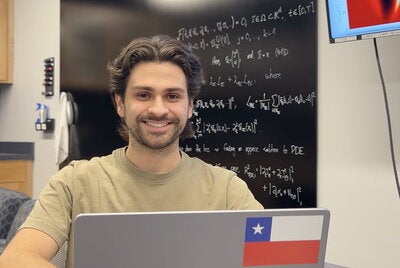
Vicente is a junior studying physics, philosophy, and mathematics, a remarkable triple major. His journey began in sixth grade with a school project on electricity. Vicente went online and started asking basic questions: What is electricity? What are electrons? What are atoms?
Vicente still remembers the chills from learning that everything in the universe, that every person, every object, every place, is made of the same fundamental constituents. That idea did not feel dry or technical to him. It felt enormous.
To learn more, he bought Stephen Hawking’s “Black Holes and Baby Universes and Other Essays.” This book became a long, challenging project. Physics led to more reading, more courses, more questions. By high school, he had immersed himself in math and science so deeply that he began to think those were the only questions that truly mattered.
One of his brothers, however, who was studying law in Chile, kept insisting that philosophy was the mother of all sciences. Vicente would laugh and always respond that physics was the mother of all sciences. But after a lot of insistence, he read René Descartes’ “Discourse on the Method.”
And he loved it.
“It was one of the best books I had read in a long time. So my statement changed. I stopped saying that ‘physics is the mother of all sciences,’ and started saying instead that ‘physics is the science mother of all sciences.’ Philosophy stands above the sciences altogether.”
That was the turning point. “I discovered that there were a lot of questions that you cannot tackle with mathematics and that are really important. Even questions about science or mathematics itself,” Vicente said. “For example, what is the best way to do science? What are the limits of knowledge? Can the human mind understand anything, or are there limits to what we can possibly comprehend? Can mathematics be made into a complete and self-contained system? Or are there inherent limits to what any formal system can capture?”
Philosophy opened other doors as well, to questions about justice, morality, art, and knowledge. By 11th grade, Vicente wanted to study both physics and philosophy. Eventually at U of I, he began with physics, later added philosophy, and then mathematics.
The workload, he admitted, is substantial, but he added with a shrug, “I do not mind doing a lot of what I enjoy.”
That does not mean he thinks life should consist of nothing but study. He plays guitar and piano, sings, walks everywhere he can, spends time with friends and with his girlfriend, and works on campus. He speaks like someone trying to make sure intellect remains part of a proper human life.
Our conversation somehow got deep into quantum physics, which Vincente explained well and connected to the subject of philosophy. What are space and time? He asked. What does it mean to say that nature is governed by laws of physics? And why is mathematics so extraordinarily good at capturing those laws? Is mathematics simply a language we use to describe patterns in the world, or is mathematical structure somehow part of reality itself? Those are the kinds of questions that sit right at the intersection of physics, philosophy, and mathematics.
Vicente plans to pursue a PhD in physics and hopes to become a theoretical physicist. He also wants to teach. The prospect of someday introducing students to ideas that changed his life seems to move him just as much as research itself.
“If you ever have even just a little spark of curiosity about something, go learn it,” he advises younger students. “If the information is not there because it’s not known, then go discover it.”