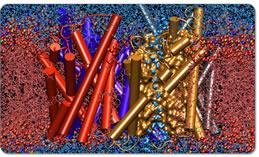
Bigger is better when it comes to computer simulations. So say the editors of Science magazine who chose a computer simulation of a cell membrane by U of I researchers as their visualization challenge winner for 2004. The simulation was recognized for its record-setting size and scientific insight.
The simulation by U of I computational biophysicists Emad Tajkhorshid and Klaus Schulten is one of the largest of its kind, involving more than 100,000 atoms, which enabled the researchers to solve a mystery of how cell membranes discriminate. (The initial simulation was completed in 2002 and, at the time, set a record for its size.)
The simulation shows how a crucial class of proteins called aquaporin are able to transport large volumes of water molecules across the cell walls-up to a billion molecules a second-yet keep out even smaller molecules, like protons. According to the simulation, the secret lies in the way water molecules flip-flop halfway through the channel. By leading with their hydrogen atoms instead of oxygen, the water molecules do not conduct protons, which are hydrogen ions.
Aquaporin is found in all living things. Plants have 35 different proteins of this type. Mammals, including humans, have 10, with many of them in the kidney, brain, and lens of the eye. When working correctly, says Schulten, the transport of water between plant cells lets flowers bloom and leaves stand sturdily, for example. In mammals, the machinery processes water efficiently to help maintain optimum health. A breakdown in human kidneys, the busiest water-handling organ with 400 liters being pumped through daily, leads to diabetes insipidus, in which water is not reabsorbed and abnormally large volumes of dilute urine are produced. Breakdowns in other organs can lead to loss of hearing and cataracts.