They say beauty is in the eye of the beholder. So is savagery, according to recent research at the University of Illinois. Historically, indigenous peoples have been depicted as everything from peace-loving islanders to murderous brutes, depending on their relationship with colonial powers.
Robert Tierney, a professor of East Asian languages and cultures and comparative and world literature, explores the theme of savagery in Japanese colonial literature during the country’s rise and fall as an imperial power throughout the late 19th and 20th centuries. He finds that the descriptions attributed to colonized people varied with the phase of Japan’s expansion as a colonial empire.
In the mid-19th century, Japan ended 250 years of isolationism as it reopened its borders and modernized. Mimicking 19th-century European empires, Japan also aggressively strove to acquire colonies. From the late 19th century, images of exotic South Seas islands and native “savages” captured Japanese writers’ imaginations as efforts grew to whet people’s appetites for conquest and assimilation.
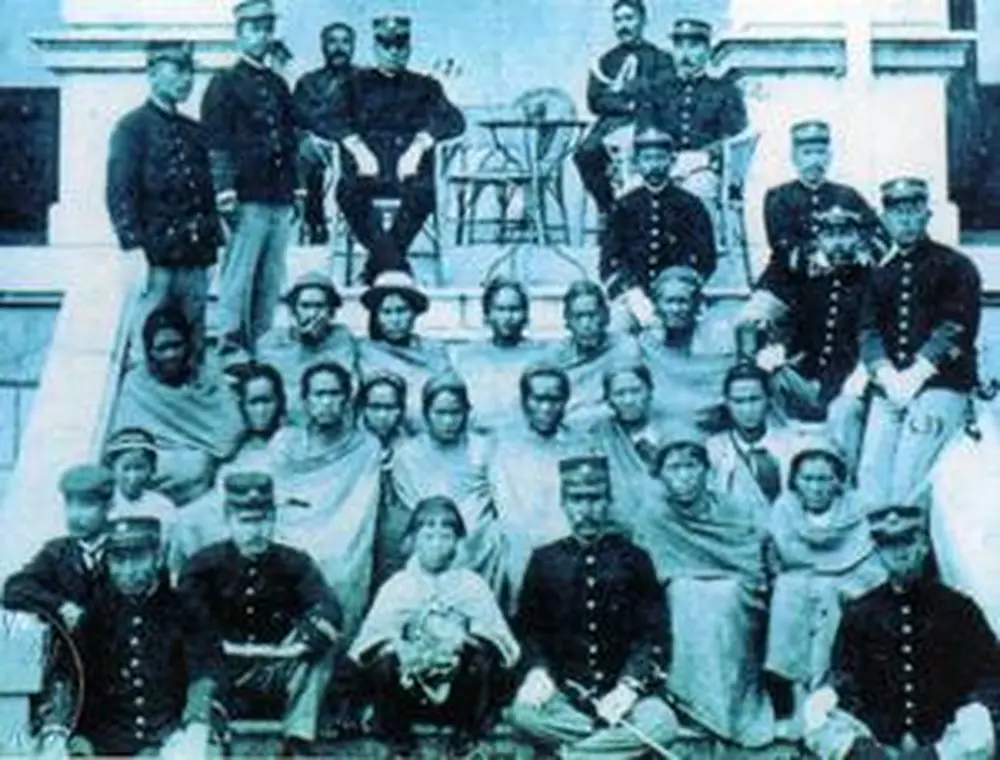
For example, largely misleading depictions of Taiwanese aborigines as “headhunters” in need of the civilizing influence of Japanese colonizers were common in the country’s literature. A centuries-old Japanese folktale, “Momotarõ,” about a tiny boy born from a peach who grows up and conquers an island of ogres, was employed as propaganda to rally people behind the colonization of the South Seas, according to Tierney.
However, as Japanese writers became critical of Japan’s expansionist policies during the country’s colonial period, new interpretations of “Momotarõ” arose that transformed the protagonist from a conquering hero to a villainous ruler and invader—and likewise recast the ogres as peace-loving islanders.
After the colonies were liberated at the end of World War II, and the Japanese empire disappeared, Japanese writers struggled to come to terms with the empire’s history of aggressive imperialism and the horrors of the war. As a result, postwar authors sought to redefine the theme of savagery.
Cannibalism—on the part of Japanese colonizers—began to emerge frequently in Japanese literature after World War II, appearing in the plots of three major antiwar and humanistic novels. Also, war memoirs by Japanese military officers and aborigines who fought alongside them contained factual accounts of Japanese soldiers descending into barbarism and consuming their dead, while the South Seas natives were depicted as embodying noble qualities such as patriotism, valor, and self-sacrifice that pre-war literature had attributed solely to the Japanese colonizers.
Furthermore, for decades after World War II, Japan’s rich vein of literary works from its colonial period were repressed, disowned by the writers and largely forgotten by scholars as the Japanese sought to dissociate themselves from what they perceived as a shameful past and focused on rebuilding their country after the war.
“If you look at pre-World War II maps of the Japanese empire, it encompasses all of Korea, great parts of China, parts of southeast Asia, Taiwan, and Micronesia,” Tierney says. “Japan was devastated after World War II, and the borders got redefined to just the main islands of Japan. Koreans and Chinese will say that Japanese history books whitewash the colonial period or Japanese aggression. Somehow this shrinking of Japan and this rethinking of what is Japanese, which takes place after the war, tends to exclude the empire.”