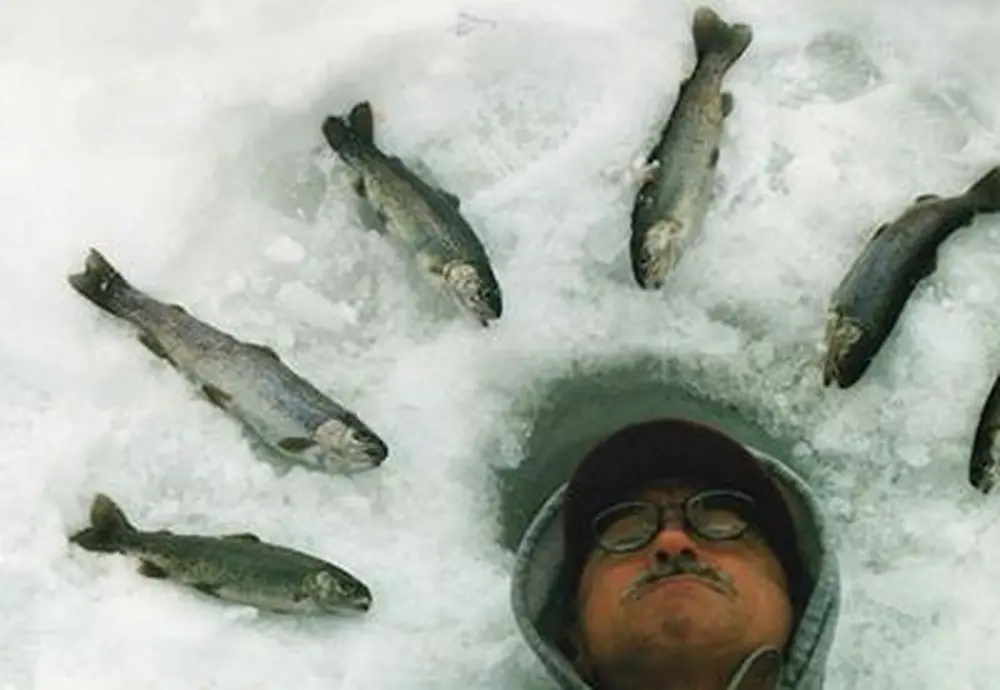
When Ron McFarland arrived at the University of Illinois in the 1960s, the Floridian looked at the landscape around him—“uncompromising flatness” and “great country for soybeans and corn” were terms that came to mind—and, as he recalls, “my heart sank like a two-ounce sinker in a still pond.” For an avid fisherman, the outlook was bleak.
He was a graduate student in the Department of English, however, which, fortunately for him, placed him in the orbit of renowned department secretary Mary Kay Peer, for whom a lounge in the English Building is now named. She knew a few people. Hearing of McFarland’s plight, she reeled in a fishing partner he would never forget: Marcus Goldman.
It turns out there are fish in east central Illinois, and Goldman, a retired professor of English from Illinois, knew the streams better than anybody. For the next couple of years, McFarland spent much of his time on the Sangamon, Kaskaskia, and other nearby waterways “fishing with a legend,” as he later recalled.
The memories of his old friend were so meaningful that McFarland has written an essay about his experiences with Goldman (1894-1984) in the May 2014 issue of Gray’s Sporting Journal, a highly regarded literary publication out of Georgia devoted to outdoor recreation.
It’s no small feat for a writer to land an essay in Gray’s, but then again, McFarland, a professor of English at the University of Idaho, author of some 20 books, and the original “writer-in-residence” for Idaho, has a way with words. His essay takes the readers on a thoughtful, pleasant ride back to days of streams, carp, lessons in knot-tying, and journeys in his ’63 Dodge Dart with a kind and interesting man who has lingered in McFarland’s memory ever since.
“When I wasn’t working toward my doctorate, or playing rugby, or listening on the radio as the Cubs fell into their famous September Swoon of ’69, I devoted my energies to fishing murky streams of East Central Illinois,” McFarland writes in the nearly 4,000-word essay. “Dr. Goldman was a pleasant, collegial man, a gentleman and scholar of the old school, who had completed his master’s at Illinois in 1917 before he went off to war....”
Born in Ohio, McFarland spent much of his childhood in Florida and earned degrees at Florida State University before arriving at Illinois in 1967. In 1970, doctorate in hand, he accepted a position as an assistant professor of English at the University of Idaho, in Moscow—pronounced with a long “o” at the end—which he says was a “classically nice” place to raise a family (he has three children). He thought he’d return east after four or five years, but he’s spent most of his career there until now.
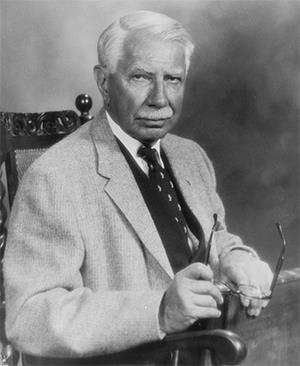
Goldman, who earned both his master’s and doctoral degrees at the University of Illinois, was a veteran of both world wars, having served in the American Field Service Ambulance Unit during World War I, once surviving a gas attack, and training military attachés and observers in World War II. Immediately after the first war, he studied in Paris on a scholarship grant from the American Field Service, and met writers such as James Joyce, Stephen Vincent Benet, and Gertrude Stein.
Goldman returned to the U.S. with his wife, Olive, and joined the faculty at Illinois in 1926. He officially retired in 1962.
It was a few years after Goldman’s retirement, then, that he and McFarland crossed paths. Goldman had been hobbled by a stroke, McFarland recalls, but his mind was sharp and he had been taking notes on fishing in East Central Illinois for more than 40 years. Goldman was an “absolutely ethical angler,” McFarland says, who lived by the rule that if a fish was big enough to take the bait, it should not be thrown back.
“Like me, Dr. Goldman was a rather small man, and he sometimes walked with a cane,” McFarland wrote in his essay. “He sported a white moustache that very likely served as the inspiration for the moustache that would bedeck my face for the next 30 years or so.”
They talked about everything, McFarland says, with Goldman regarding his fishing partner as a “bright, young lad” who should be hired as faculty at Illinois. Academia had changed since Goldman was young, however, and people generally were not hired as faculty at their alma mater. McFarland moved out west to Idaho, and he never saw his fishing companion again.
Goldman’s impression was everlasting, however, and McFarland says one of his greatest gifts was a book by Goldman called In Praise of Little Fishes. These days, McFarland wonders if he’s ever lived up to the inscription that Goldman wrote for him, but he treasures it nonetheless.
“For Ronald McFarland,” Goldman wrote, “a truly Waltonian angler, courteous, considerate, and erudite, with gratitude for his companionship on many expeditions to Eastern Illinois and Western Indiana streams. Marcus Selden Goldman, Urbana, Illinois, August 4, 1977.”