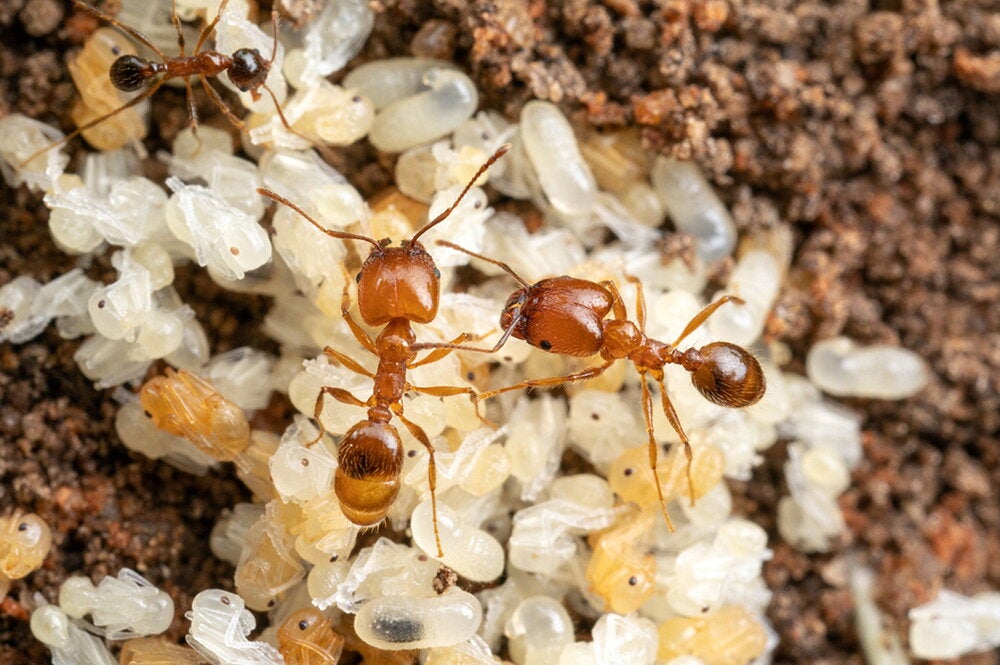
The Spanish galleons that ruled the seas some 500 years ago were carrying more than gold, silk, and guns as they circled the globe. They also carried with them colonies of fire ants that exist to this day.
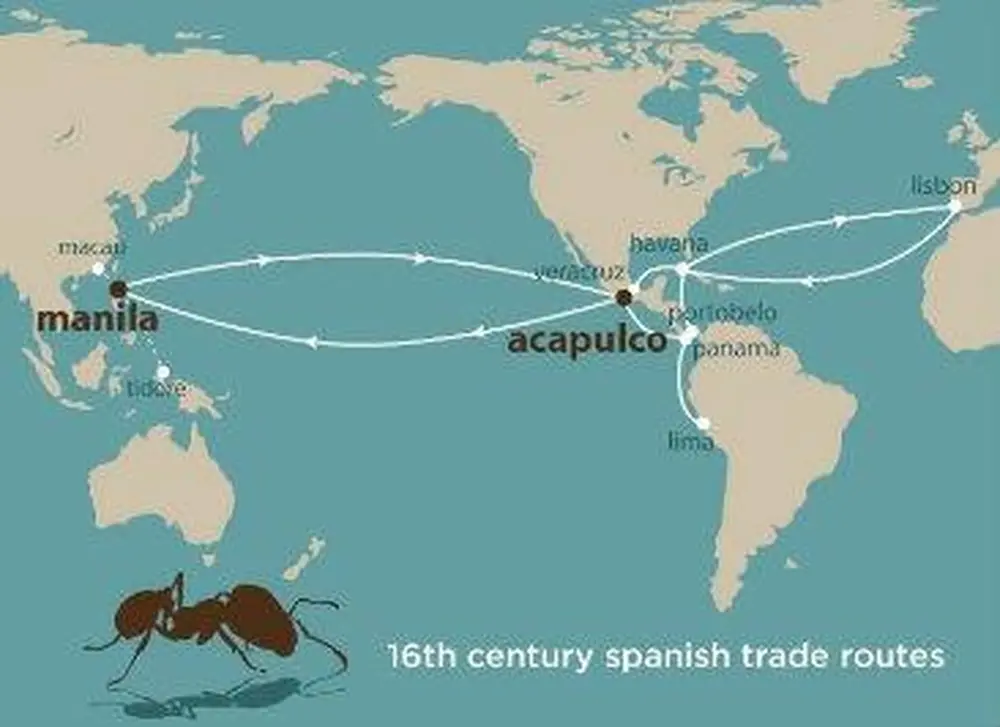
A study at the University of Illinois, reported in the journal Molecular Ecology, reveals that 16th-century Spanish galleons shuttled tropical fire ants (Solenopsis geminata) from Acapulco, Mexico, across the Pacific to the Philippines, and from there to other parts of the world. Today, the ant species is found in virtually all tropical regions, including in Africa, the Americas, Australia, India, and Southeast Asia.
They are the first ant species known to travel the globe by sea.
“A lot of these ships, particularly if they were going somewhere to pick up commerce, would fill their ballast with soil and then they would dump the soil out in a new port and replace it with cargo,” says Andrew Suarez, entomology professor and animal biology department head, and author on the study. “They were unknowingly moving huge numbers of organisms in the ballast soil.”
The ants remain a major problem today, costing millions of dollars annually to control as they infest human and natural habitats.
Suarez conducted the study with several others, including former Illinois postdoctoral researcher Dietrich Gotzek and others at the U.S. Department of Agriculture and the University of Vermont. The researchers analyzed the genomes of tropical fire ants from 192 locales, looking at patterns of genetic diversity. The team also analyzed the trading patterns of Spanish sailing vessels going to and from the New World in the mid-1600s.
“If you look at the records, you look at the history, you look at the old trading routes and you look at the genetics, it all paints this picture that this was one of the first global invasions, and it coincided with what could be the first global trade pattern of the Spanish,” Suarez said. “The ants from the introduced areas in the Old World are genetically most similar to ants from southwestern Mexico, suggesting that their source population came from this region.”
The researchers were able to date the ants’ invasion of the Old World to the 16th century. At this time, the Spanish had just established a regular trade route between Acapulco and Manila, Philippines, not only setting up the first trade route across the Pacific Ocean but also effectively globalizing commerce.
“Acapulco was a big stopping point for the Spanish,” Suarez says.
“From there, Spanish galleons brought silver to Manila, which served as a hub for trade with China,” the authors wrote.
The researchers hypothesized that the original ant population would have the highest level of genetic diversity and that any ants taken from that original population to a new environment would have a subset of that original variability.
And that is what they found.
“There was this very clear pattern where there was the most genetic diversity in the New World, where it’s native, and then you see these stepping stones of nested subsets of diversity as you move away from the New World into the Old World,” Suarez says. And the pattern of genetic changes over time “always overlaps the timing of when the Spanish trade was going on,” he adds.
“Our research highlights the importance of historical trade routes in setting up current distributions of pest species,” says Gotzek, who conducted the genetic analyses. “It also establishes the utility of using genetic data to reveal such patterns.”