
A new artificial intelligence-powered tool can help researchers determine how well an enzyme fits with a desired target, helping them find the best enzyme and substrate combination for applications from catalysis to medicine to manufacturing.
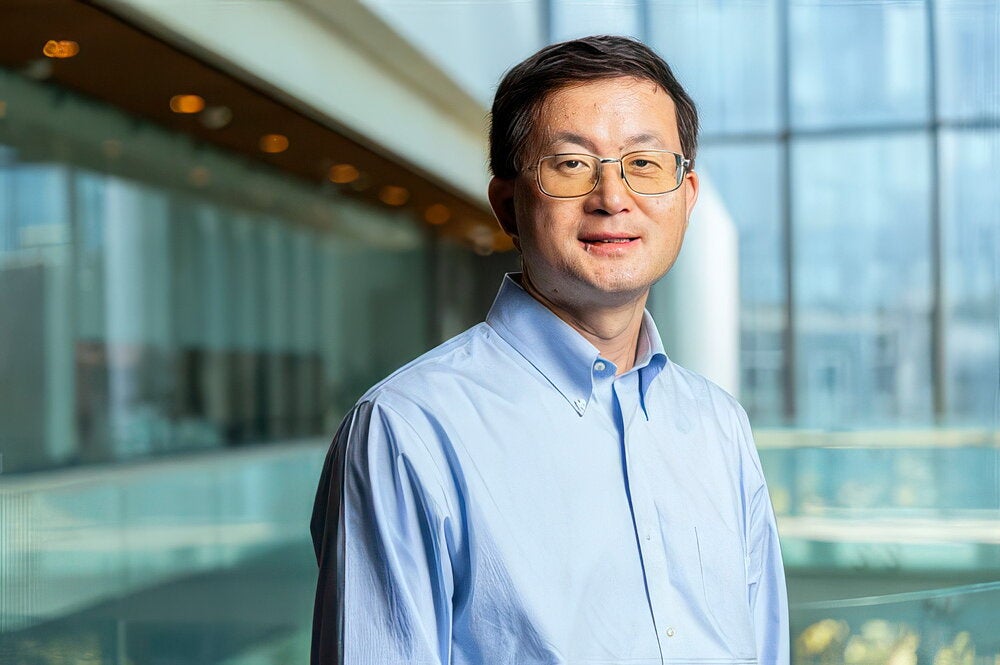
Led by Huimin Zhao, a professor of chemical and biomolecular engineering, the researchers developed EZSpecificity using new enzyme-substrate pair data and a new machine learning algorithm. They have made the tool freely available online and published their results in the journal Nature.
“If we want a certain product using an enzyme, we want to use the best enzyme and substrate combination,” said Zhao, who also is the director of the NSF Molecule Maker Lab Institute and of the NSF iBioFoundry at the U of I. “EZSpecificity is an AI model that can analyze an enzyme sequence and then predict which substrate best can fit into that enzyme. It is highly complementary to the CLEAN AI model that we developed to predict an enzyme’s function from its sequence more than two years ago.”
Enzymes are large proteins that catalyze molecular reactions. They have pocket-like regions that target molecules, called substrates, fit into. How well an enzyme and substrate fit is called specificity. The typical analogy for enzyme-substrate interaction is a lock and key: Only the right key will open the lock. However, enzyme function is not that simple, Zhao said.
“It is challenging to figure out the best combination because the pocket is not static,” he said. “The enzyme actually changes conformation when it interacts with the substrate. It is more of an induced fit. And some enzymes are promiscuous and can catalyze different types of reactions. That makes it very hard to predict. That’s why we need a machine learning model and experimental data that really prove which pairing will work best.”
While other enzyme specificity models have been introduced, they are limited in accuracy and in the types of enzymatic reactions they can predict.
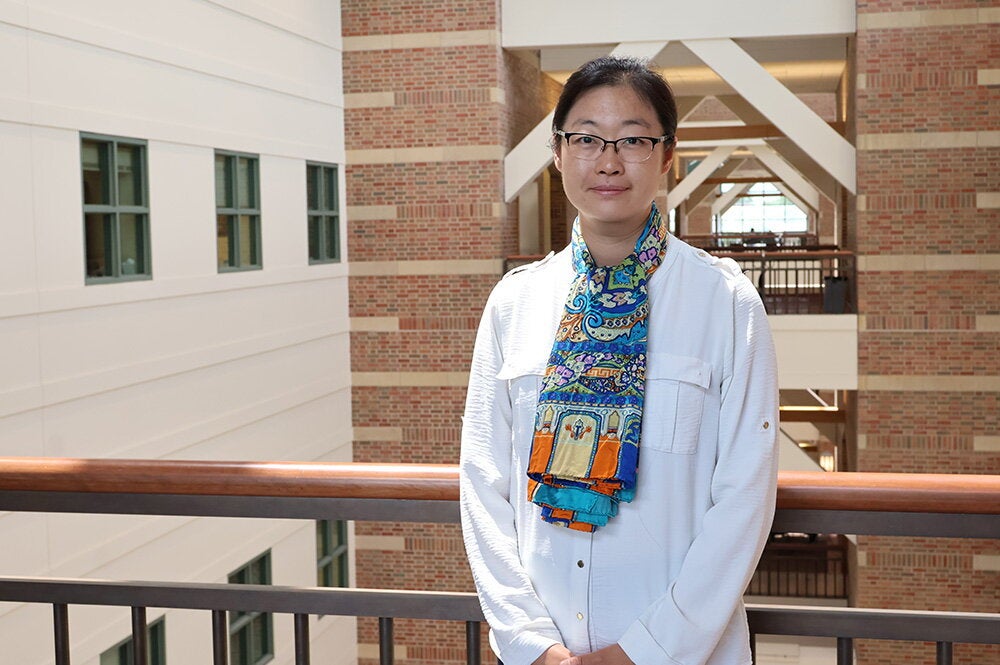
Zhao’s group realized that to improve AI’s ability to predict specificity, they needed to improve and expand the dataset that the machine learning model drew from. They partnered with the group led by Diwakar Shukla, a U of I professor of chemical and biomolecular engineering. Shukla’s group performed docking studies for different classes of enzymes to create a large database containing information about not only an enzyme’s sequence and structure, but also how enzymes of various classes conform around different types of substrates.
“Experiments that capture how enzymes interact with their substrates are often slow and complex, so we ran extensive docking simulations to complement and expand on the existing experimental data,” Shukla said. “We zoomed in on the atomic-level interactions between enzymes and their substrates. Millions of docking calculations provided us this missing piece of the puzzle to build a highly accurate enzyme specificity predictor.”
The researchers then tested EZSpecificity side-by-side with ESP, the current leading model, in four scenarios designed to mimic real-world applications. EZSpecificity outperformed ESP in all scenarios. Finally, the researchers experimentally validated EZSpecificity by looking at eight halogenase enzymes, a class that has not been well characterized but is increasingly used to make bioactive molecules, and 78 substrates. EZSpecificity achieved 91.7% accuracy for its top pairing predictions, while ESP only displayed 58.3% accuracy.
“I cannot say it works for every enzyme, but for certain enzymes, we showed that EZSpecificity works very well indeed,” Zhao said. “We want to make this tool available to others, so we developed a user interface. Researchers now can enter the substrate and the protein sequence, and then they can use our tool to predict whether that substrate can work well or not.”
Next, the researchers plan to expand their AI tools to analyze enzyme selectivity, which indicates whether an enzyme has a preference for a certain site on a substrate, to help rule out enzymes with off-target effects. They also plan to continue to refine EZSpecificity with more experimental data.
The U.S. National Science Foundation supported this work through the Molecule Maker Lab Institute. Zhao also is affiliated with the Carl R. Woese Institute for Genomic Biology at the U. of I. and the Department of Energy Center for Advanced Bioenergy and Bioproducts Innovation.