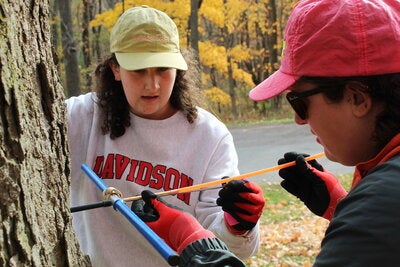
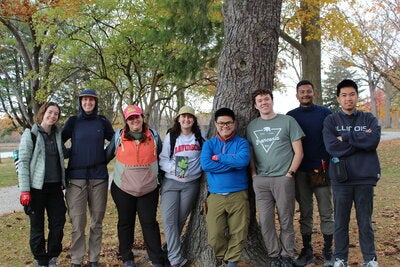
Geology can take many forms, from the study of rocks and minerals to the living records preserved in trees. At Homer Lake Forest Preserve, graduate students from the Department of Earth Science & Environmental Change spent a November morning extracting tree-core samples from oaks and maples as part of “Tree Rings and Climate,” a graduate-level special topics course offered this past semester as Geology 593. Using increment borers, they removed narrow cylinders of wood—samples no thicker than a pencil, yet rich with annual records that allow geoscientists to study environmental and climate change over time.
Special topics courses under the Geology 593 umbrella vary by semester, allowing faculty to design focused, hands-on tracks around emerging areas of Earth science for graduate students. This iteration focused on dendrochronology—the study of tree rings—and their use in reconstructing past environmental and climate conditions.
“I think tree rings are cool,” said professor Hưng Nguyễn, “I’ve always wanted to have students explore tree rings, and it can be useful for students besides my own.”
Nguyễn designed the course to guide students through the entire scientific process, from field sampling to climate reconstruction. “Students were able to go through the whole process,” he said. The course combined fieldwork, laboratory analysis, and data-driven projects, allowing students to collect, process, and analyze their own samples, ultimately using them to reconstruct past climate conditions.
Environmental archives
At the core of the class was the idea that trees are more than biological organisms—they are environmental archives. “Trees are time machines,” Nguyễn said. “The wood will record anything that the trees experience in an environment. That can be temperature, moisture, fire, insects, volcanic eruptions, glacial activity—anything that happened around the environment of the tree.”
That concept places dendrochronology firmly within Earth science. “As Earth scientists, we always look for evidence,” Nguyễn said. “The layers of rocks tell you what happened on Earth in the past millions of years; the rings of trees tell us what’s happened in the past hundreds or thousands of years.”
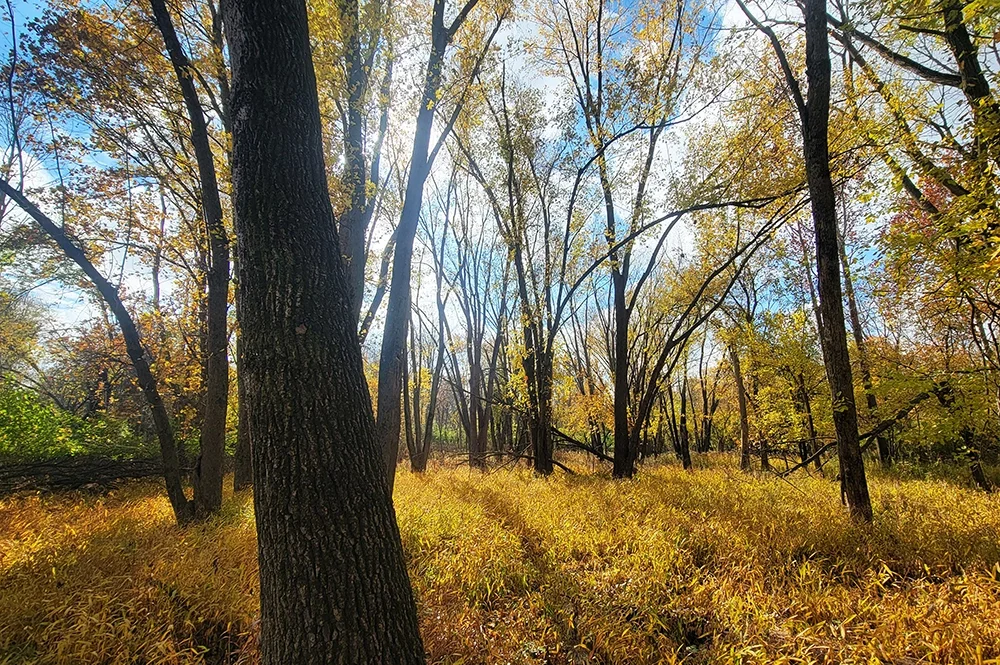
At Homer Lake, students targeted species including white oak, burr oak, cottonwood, and silver maple. The site itself was chosen for both accessibility and scientific value. Homer Lake lies just half an hour away from campus, and the forest offers an opportunity to study how trees respond to a sudden change in water level and hydrologic setting due to the construction of the dam and the lake itself.
“It’s a mutually beneficial relationship,” Nguyễn said. “We get access to the beautiful forest to do science, and we can provide the preserve with expertise.” As part of the collaboration, Nguyễn’s lab also conducted a public outreach event at the preserve.
From forest to data
For students, the field experience brought classroom concepts into sharp focus. “You can learn the theory and how to sample, but you have to do it in order to feel it,” Nguyễn said. “It’s a whole different experience… It’s always wonderful when a student pulls out a core for the first time.”
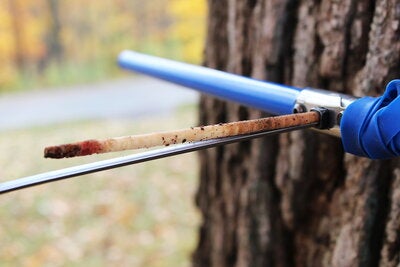
To core a tree, researchers will use an increment borer and place it on the tree at chest height, perpendicular to the trunk. The borer will then be turned clockwise until it passes the center of the tree, or the full length of the borer is reached. An extractor is then inserted into the end of the borer, which pulls the core out of the borer. The core is then placed in a straw for transport, and the borer is retracted from the tree by turning counterclockwise. Because tree growth can be asymmetric, researchers typically take two or three samples from different sides of each tree.
Student Aabhash Bhattarai said the power of tree rings lies in how measurable patterns can be tied to climate variables. “By looking at the ring widths, we can estimate with some statistical principles about how the width relates to what the temperature or what precipitation was like in the past,” he said.
For students Katieanne Peterson and Sabrina Hinz, the course offered both practical skills and a new perspective on environmental research. Peterson noted that many students were drawn to the class because it offered something entirely new. “For some of the students who are not in Hưng’s lab, they were interested in the topic because they hadn’t ever done tree rings before and wanted to learn more about it,” she said.
Hinz said the course provided a strong foundation in data analysis. “It was a great introduction for me to learn everything you can do with it—how to use statistics and perform data analysis,” she said. “It made me feel more confident now going into my research.”
Learning beyond the classroom
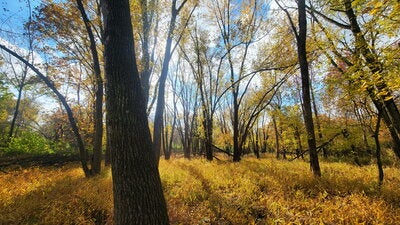
The field trip itself stood out as a highlight. Peterson recalled that their sampling plan evolved once they arrived. “We’d discussed some areas we wanted to sample in, but we pulled in and went, ‘Oh wait, these trees kind of look cool. We’ll start here instead,’” she said. “We didn’t follow our plan, but I think that’s part of what made it such a fun day.”
For Hinz, collecting nearly 20 samples over the course of the day deepened her understanding of the science. “It gives you an appreciation for how time-consuming it is to do these types of studies,” Hinz said. “When you’re reading other people’s studies, and they have 50 samples, you really understand what that means.”
Long after the samples are measured and analyzed, the experience will linger. For Peterson, it was the chance to learn outside the classroom. “It was great to engage with your classmates outside of a class setting,” she said. Hinz echoed that sentiment. “There’s always something that could be cool or a new research project,” she said. “And it’s an experience that not a lot of other majors get to have.”