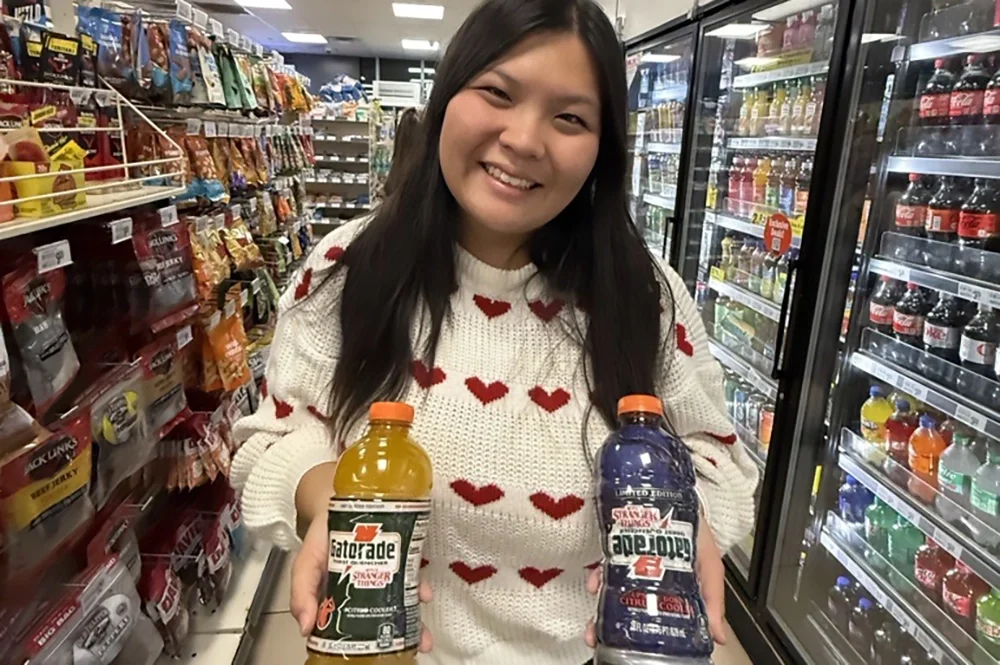
On store shelves across the country last fall, a bright orange sports drink with a retro label and a black sports drink with an upside-down label began appearing alongside the usual rows of Gatorade bottles. For fans of Netflix’s Stranger Things, the limited-edition Citrus Coolers offered a nostalgic throwback to the 1980s, the era when the wildly popular show took place. For LAS alum Cathy Li, it was a landmark moment in her new career.
Cathy (BS, ’24, chemical and biomolecular engineering), was behind the revival of the classic drink as she helped bring the Citrus Coolers from concept to production as part of PepsiCo’s Gatorade research and development team in New York.
For Cathy, seeing the drink appear in stores was a moment that connected years of engineering education with the real-world impact of her work.
“It was really rewarding to see the product on shelves,” Cathy said. “Knowing that I had a hand in creating it and helping put it out there was really exciting.”
During her undergraduate years, she completed a co-op program during one semester and studied abroad—experiences that broadened both her perspective and her professional interests, she said.
The combination of coursework and hands-on experiences eventually led her to PepsiCo, where she first interned during the summer of 2023 before returning full time after graduation.
Chemistry and engineering at a massive scale
Shortly after moving to New York City, Cathy, a native of Champaign, joined PepsiCo as a research and development associate engineer working within the company’s Gatorade portfolio. The role places her at the intersection of chemistry, engineering, and product innovation.
“My role is sometimes called a commercialization engineer,” Cathy said. “I help make sure the products we’re developing can actually be produced at a large scale.”
The portfolio she works on includes several major beverage brands, including Gatorade, Gatorlyte, Propel, Aquafina, and Muscle Milk. Within that team, Cathy supports projects focused on new product innovations and experimental formulations.
The process of developing a new beverage is far more complex than simply choosing a flavor. Ideas often begin with marketing teams or consumer insights, which are then passed to research and development teams to determine whether they can become viable products.
From there, Cathy and her colleagues begin testing.
Early development typically starts in laboratory settings, where small batches of a new beverage are created and evaluated. Researchers test how ingredients interact, whether the formula remains stable, and how the product performs under different conditions.
“I’ll sometimes take a new product and test it at a benchtop scale in the lab first,” said Cathy, referring to a scale that ranges in size from a couple of liters to 50 liters.
If the formula proves promising, the drink moves into the next phase: a pilot plant that simulates real manufacturing conditions. There, engineers test whether the beverage can be produced in larger batches (250-300 gallons) while maintaining consistent quality.
Only after passing those stages does the product move into full-scale production at processing facilities, which can produce 500 bottles per minute.
The work requires frequent collaboration between engineers and food scientists, whose expertise focuses more heavily on flavor chemistry and formulation.
“Food scientists focus on making sure the formula itself works and tastes right,” Cathy said. “Then we work together on things like stability and making sure it can actually be produced consistently.”
Many of the problem-solving techniques she uses in this process stem directly from concepts taught in chemical engineering courses at Illinois.
“A lot of chemical engineering is about optimization,” Cathy said. “It’s about taking something and making sure it works efficiently at different scales.” Those principles became especially important during Cathy’s first major project after joining the Gatorade team: the Stranger Things Citrus Cooler collaboration.
5,000 bottles gone in seconds
The limited-edition drink marked Gatorade’s first partnership with Netflix. To align with the retro setting of Stranger Things, the team chose to revive Citrus Cooler, a flavor originally introduced in the 1980s when Gatorade was expanding its early product lineup. Citrus Cooler was rumored to have been a favorite of basketball legend Michael Jordan. As for the upside-down label, it was chosen to represent The Upside Down, a dark, alternate dimension in the show.
“The flavor we released was actually a legacy formula from the 1980s,” Cathy said. “It was one of the original flavors, but people hadn’t seen it in a long time.”
The project immediately stood out to Cathy because of the show’s massive fan base.
“When I first heard about it, I was super excited,” she said. “Stranger Things has such a big following.”
Working alongside a food scientist partner, Cathy helped evaluate the beverage’s stability and ensured the revived formula could meet modern production standards. The team tested how the drink would look on shelves, whether the formula remained stable over time and whether it could be produced reliably at manufacturing scale.
Once those tests were complete, Cathy traveled with colleagues to oversee large-scale production runs before the product was released to retailers.
The collaboration also introduced another nostalgic element: Gatorade packaged in glass bottles, a style that echoed older versions of the drink and aligned with the retro aesthetic of the series. It was a limited online offering, but they were so popular that all 5,000 bottles sold out within seconds and the website crashed.
“People were really excited to see that come back,” Cathy said.
While the Stranger Things collaboration served as a personal milestone, it also helped her better understand the broader impact of product development and the complex network of teams involved in bringing a beverage to market.
“It definitely helped me understand what research and development really looks like,” Cathy said.
Today, Cathy continues to work on new beverage innovations within PepsiCo’s hydration portfolio. However, the drinks she is developing now may not appear in stores for several years.
“A lot of our projects are planned far in advance,” she said. “Some of the things I’m working on now might release around 2027.”
While she cannot reveal details about those future products, she hinted that new flavors and limited offerings are already in development.
“There are definitely some fun and exciting flavors coming,” Cathy said.
Looking back at her time at Illinois, Cathy credits the university’s many resources with helping her prepare for her career.
“The University of Illinois offers so many opportunities,” she said. “Career fairs, research opportunities, and student organizations can all help you build skills and expand your network.”
Her advice for current chemical engineering students is to take advantage of those opportunities while they can.
“Don’t be afraid to try new things,” Cathy said. “Exploring different opportunities on campus can help you discover what you’re interested in and give you experiences that really help during interviews and in your career.”