
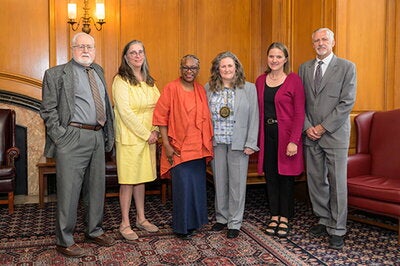
Family, colleagues, students, and friends gathered to celebrate Tigga Kingston on Tuesday, March 31 at the Illini Union as she became the inaugural Shelford-Pitelka-Batzli Professor in Mammalian Ecology. This endowed position recognizes excellence in research, teaching, and global leadership in the field.
Kingston’s research has focused on one of ecology’s central questions: how such extraordinary diversity can coexist, particularly among bats, which number more than 1,500 species worldwide. Her work spans decades of field research in Southeast Asia, where dozens of bat species can inhabit a single forest. Kingston’s research examines the ecological and evolutionary mechanisms that make coexistence possible.
“A fact that captures something essential about Tigga is that in 2023, a newly discovered species of bat was named Hipposideros kingstonae in her honor. When scientists name a species after you, it is because your contributions to a field have become inseparable from the field itself. That is who we are celebrating,” said Becky Fuller, head of the Department of Evolution, Ecology, and Behavior (EEB).
Over time, Kingston’s research expanded beyond foundational ecological questions to address the effects of habitat loss and environmental change. As forests have been transformed by human activity, Kingston has investigated which species can and cannot persist in altered landscapes, helping inform conservation strategies with real-world implications.

Her work also took on added urgency within the realm of global health. As a leading expert on bat ecology and bat-human interactions, Kingston became an important voice during the COVID-19 pandemic, advocating for evidence-based approaches to conservation and public understanding. Her message was simple: protecting bat populations and protecting human health are deeply interconnected. As the pandemic continued, this message resonated globally.
Beyond her research, Kingston has built international networks that support collaboration across the field. She founded the Southeast Asian Bat Conservation Research Unit and helped establish global partnerships that connect scientists, conservationists, and institutions working to understand and protect bat diversity.
“Tigga's work exemplifies the kind of impactful, integrative science that we strive to support within the School of Integrative Biology and the College of Liberal Arts & Sciences,” said Carla Cáceres, director of the School of Integrative Biology.
The professorship, made possible by the generosity of George Batzli, honors a distinguished legacy of ecological scholarship at Illinois. This investiture connects Victor Shelford—founder of modern ecology and a pioneer of ecological research at Illinois—with Frank Pitelka, a leading expert on Arctic tundra ecosystems and long-term lemming population studies, and Batzli himself, uniting generations of field-based research and discovery.
Batzli dedicated his career to ecology and the study of small mammal populations. After completing his doctoral work at the University of California, Berkeley, Batzli joined the University of Illinois faculty in 1971. He taught and mentored students for more than three decades, while also building a research program focused on the population dynamics and nutritional ecology of small mammals, particularly voles and lemmings. Later in his career, Batzli went on to receive the Merriam Award from the American Society of Mammalogists in recognition of his distinguished achievements.
“George’s long-term commitment to supporting faculty excellence began as a faculty member and later department head, and it continues to enrich our community in profound ways,” said Venetria K. Patton, Harry E. Preble Dean of the College of Liberal Arts & Sciences.
Through leadership roles as chair of the ecology program and department head of ecology, ethology, and evolution (now EEB), he helped guide ecological research and education at Illinois and within the life sciences. In establishing the Shelford-Pitelka-Batzli Professorship in Mammalian Ecology, Batzli has chosen to honor the impressive scholarly lineage that shaped his career.
“To continue the rich tradition of education and research in evolutionary, ecological and behavioral biology at the University of Illinois, I decided to endow a named professorship. With the appointment of Tigga Kingston as the first holder, I think we're off to a great start,” said Batzli.
Accepting the professorship, Kingston described the honor as both a recognition and a responsibility. She spoke about the challenges facing mammalian biodiversity in an era of rapid environmental change and emphasized the importance of training future generations of scientists. “We cannot solve the challenges facing mammalian biodiversity without a new generation of students,” Kingston said, underscoring her commitment to mentorship and global collaboration.
As the inaugural holder of the Shelford-Pitelka-Batzli Professorship in Mammalian Ecology, Kingston carries forward a legacy of ecological research rooted in careful observation, rigorous fieldwork, and a deep understanding of how organisms interact with their environments. With this new role, she is poised to continue leadership in the field while helping shape its future.