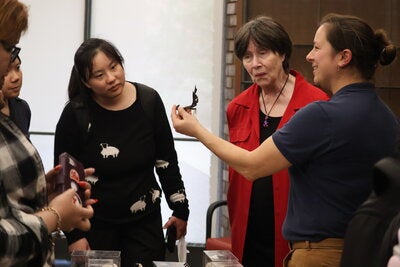
As humans, we rarely ponder life through the perspective of a non-human, but what happens if we try to see the world through the eyes of a bird, a squirrel, or an opossum? Anthropology professor Jane Desmond offers this question to her graduate course, “Living in Multi-Species Worlds.”
“What difference would it make if we really embraced this notion in our disciplines, that we live and always have been living in multi-species worlds?” Desmond asked.
Desmond has worked in a wide range of subject areas, starting in modern dance, then transitioning to American cultural studies, which eventually led to examining animal ethics and relationships between humans and non-human animals. She continued with animal studies when she came to the U of I College of LAS.
Now, she holds an affiliate faculty appointment at the College of Veterinary Medicine, and she directs the Human-Animal Studies Initiative at Illinois through the Center for Advanced Study. The graduate course is just one part of this campus-wide initiative Desmond was invited to develop.
“Each year, [the CAS] has a different thematic initiative,” Desmond said. “They invite a faculty member to design something that will be of interest across the whole campus.”
Desmond came up with the “Living in Multi-Species Worlds” theme. From there, she was invited to design a special graduate course based on that theme.
CAS 587/ANTH 515 is an interdisciplinary graduate seminar posing questions for students to consider how they think about the lives of other species. Instead of viewing them as animals living in a human world, all creatures can be viewed as living together in a multi-species world.
Camellia Paul, a first-year PhD student in comparative and world literature, said she saw the class as a good fit for her research with owls.
“One major takeaway has been learning to decenter the human — not just conceptually, but methodologically,” Paul said. “It’s one thing to say that humans aren’t the center of the world; it’s another to actually try to study the world from a biocentric perspective.”
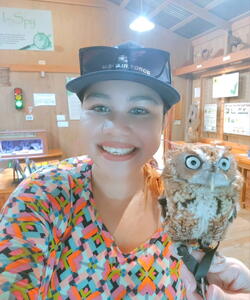
Paul’s research deals with “owlscapes,” a term she uses to describe how owls are represented in media from different cultures.
“I’m interested in how species like owls are misunderstood, marginalized, or even vilified through folklore, and how those narratives intersect with real ecological consequences,” she said.
For example, when non-human creatures are viewed as existing in a separate world, it can create a sense of conflict between humans and non-humans. It becomes an us-versus-them battle for resources, which usually results in a loss for the non-humans. That’s something Paul brings up in her first academic book chapter.
“I actively look out for classes and events at U of I on environmental humanities, ecocriticism, and multi-species interactions, but Professor Desmond’s framing of the ‘more-than-human’ world pushes that thinking further, especially by asking us to rethink what counts as knowledge, method, and even perception,” Paul said.
She also said she was drawn to the experimental structure of the course. Desmond described the course as a “mix between a studio, a lab, and a conventional graduate seminar.” She was grateful that the CAS allowed her to have this sort of hybrid class structure.
“It can be challenging, but I think this is a group that has really signed on and said, ‘We’re in,’” Desmond said.
Emma Truong is a first-year PhD English student. They study environmental humanities, looking at human and non-human interactions.
“I feel like within academia, people always talk about the importance of being there and interacting with real things in real life, but it always comes up as sort of a footnote to engaging with traditional texts and literature,” Truong said. “I feel like Professor Desmond prioritizes this sort of embodied and very personal and effective interaction.”
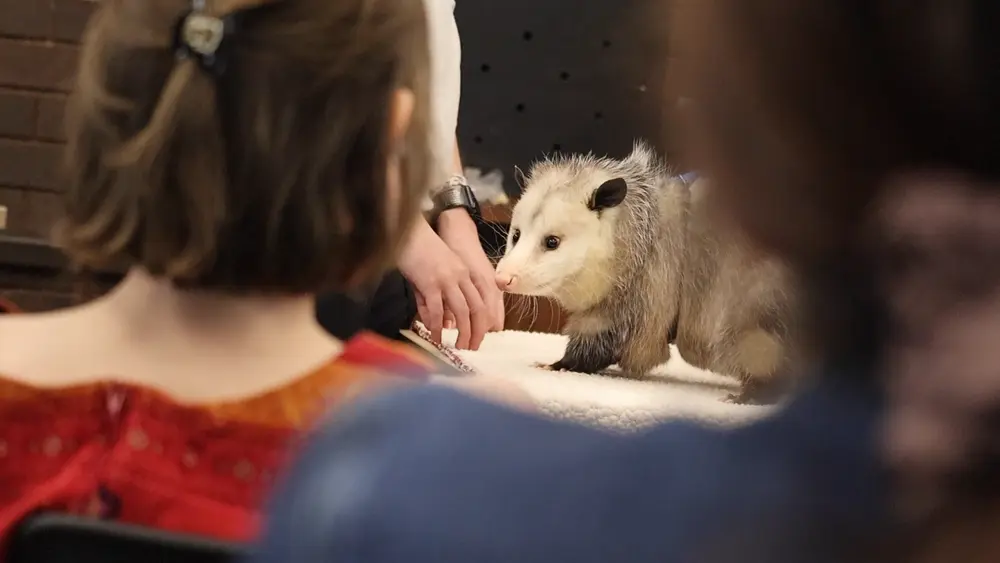
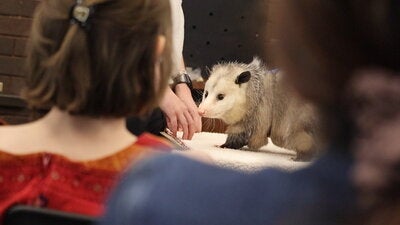
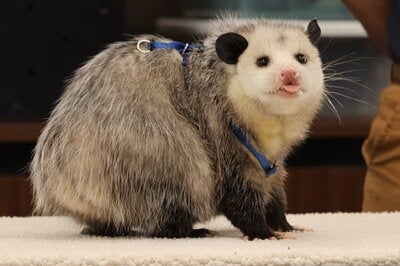
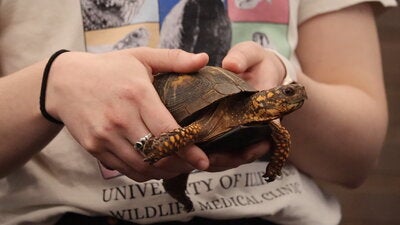
One Friday, the class met with some of the College of Veterinary Medicine ambassador animals, including Ruby the red-tailed hawk, Whittington the Eastern screech owl, Hazel the Eastern box turtle, and Pesto the Virginia opossum.
The ambassador animals were originally brought into Wildlife Medical Clinic for care, but they were unable to be released due to physical or behavioral issues. The clinic thus uses them for education and outreach, like teaching Demond’s class about local wildlife and rehabilitation efforts.
“I have found whenever there is an animal in the same space, there’s an electric attention,” Desmond said.
This was just one of many field trips the class has taken in Desmond’s “exploratory laboratory.” The class visited museums and symposiums and brought in presenters from various fields of study.
“These movements keep the material alive, and help make ideas more embodied,” Paul said. “We are not just understanding concepts intellectually, but sensing them, testing them, sometimes even struggling with them in real time.”
The class represents a wide range of disciplines. There are students from English, history, dance, sociology, East Asian languages and literatures, German studies, and art history all there to see the world from a different perspective.
“We all had to do a presentation on a piece of theoretical or fictional work in class,” Truong said. “I did mine with a history major, and that was super interesting to hear her talk about the way animals are perceived in her field. I feel like oftentimes we get really tunnel-visioned about how we ‘should’ approach our subject.”
“The class actively builds on those differences,” Paul said. “For instance, someone might approach a topic through ethnography, while another might respond through visual art or narrative writing. Instead of resolving those approaches into one framework, the course holds them together.”
This comes with its own challenges, though.
“Graduate students have really high expectations of themselves,” Desmond said. “You know there’s a lot to learn because it’s going to take you many years. At the same time, you’re often worried about what you don’t know.”
In interdisciplinary work, this can be more of a concern. Desmond’s class has students from numerous different disciplines.
“We will not have the same shared bibliography,” Desmond said.
Therefore, students have to be willing to say they’ve never heard of something before. Desmond wrote in the class syllabus, “Be prepared to ‘fail’ — that is — become comfortable with an exploratory mindset that tries something with no guarantee of a ‘successful’ outcome. ‘Success’ lies not in the product but in the process of learning, questioning, and refashioning.”
Desmond said a way she has tried to make students comfortable with this challenge is by having students lead discussions amongst themselves. She acknowledges that there isn’t necessarily one correct answer for the questions they are taking on; there is room for interpretation and different approaches from different disciplines.
“That’s important because the kinds of problems we’re dealing with — climate crisis, species extinction, human-animal relations — can’t really be addressed within a single discipline,” Paul said. “They require multiple ways and approaches of knowing.”
Though Desmond acknowledges that humans cannot fully understand what it is like to live as a non-human animal, she and her students clearly see the value in making the effort. The question, what does it mean to live in a multi-species world, does not have a single correct answer. But the act of starting from a different perspective can bring new ways of thinking to complicated issues like those Paul listed.