
At 16 years old, Nina Cohn was navigating loss and a future she never expected to face.
In 1970, Cohn lost both of her parents within months of each other, her mother after a prolonged battle with cancer and her father from a sudden heart attack. Still in high school, she was suddenly responsible for making decisions that would shape the rest of her life. Rather than stall under the weight of uncertainty, Cohn accelerated. She graduated high school early and, one year later, enrolled at the University of Illinois Urbana-Champaign.
This time was transformative.
At Illinois, she learned to be her own advocate, met her husband William Porter (who transferred to the Urbana campus to finish his studies), and encountered a level of diversity and various backgrounds that reshaped how she saw the world. It was an environment that challenged her assumptions and expanded her curiosity through exposure to the humanities. She initially studied psychology before transitioning into the Department of Biochemistry, where her connection to the humanities remained central. For Cohn, subjects like language, literature, and culture were essential to understanding what it means to be human.
“All these elements of the university guided me toward a more creative approach to life, where everything you do and say counts,” she explained.
At the time, Social Security survivor benefits provided financial support to students who had lost their parents, allowing them to continue their education beyond the age of 18. That assistance made it possible for Cohn to stay engaged in her studies.
It also left a lasting impression.
Cohn came to recognize that many students with similar ambition and potential lacked the financial means to pursue higher education. After graduation, she worked in the Roger Adams Laboratory in the biochemistry department as a research assistant. Two years later, Cohn received an inheritance from her parents. With the choice of how to use it, she made a decision rooted in both gratitude and purpose.
She donated 90% of the inheritance to the College of Liberal Arts & Sciences to establish the Clarence and Pauline Cohn Memorial Scholarship, honoring her parents while investing in future generations.
“This was a time that I finally grieved the loss of my parents,” she said. “I realized how much I had become the person they had brought into this world. I wanted to honor them for who they were. I could do this because my college experience at a big sprawling university like the U of I gave me the confidence I could make my way successfully in the world at large without entitlements beyond the education.”
Her vision for the scholarship was clear: Expand access to higher education by covering the cost of tuition and fees (at the time), particularly within the humanities, and remove barriers for students who might otherwise be unable to pursue their interests.
“I felt it was a great privilege to have money for college, regardless of its sources,” she said. “In fact, I felt so strongly about the need to fund higher education based on my own experience, I thought there was a need to expand eligibility, not limit it.”
The scholarship also reflects the values instilled by Cohn’s parents. Both were children of immigrants who fled the pogroms in Russia and went on to build careers as biochemists at Michael Reese Hospital in Chicago. Their work unfolded in a diverse professional environment, reinforcing a belief in equity, opportunity, and the importance of supporting others.
“My parents were interested in a culture that gave all people equal footing,” Cohn explained.
Decades later, that belief continues to drive students to pursue their passions. The scholarship has supported dozens of students, including Lily Carter, an LAS graduate who teaches English in South Korea with the EPIK program. For Carter (BA, ’25, East Asian languages and cultures and linguistics), the funding meant more than financial relief—it provided the freedom to pursue a path of curiosity.
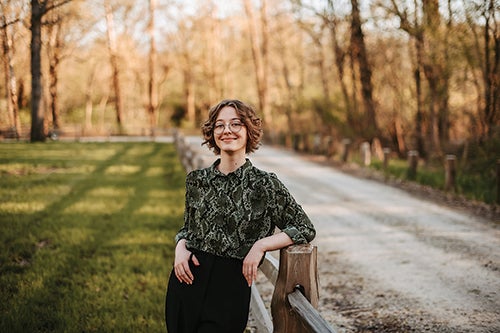
Carter grew up in a single-income home with a twin sister, and the prospect of paying for two college educations weighed heavily on her family.
“When I received my financial aid letter my entire family started jumping for joy in our kitchen,” she said. “It’s one of my most joyous family memories.”
In the letter Carter learned she would receive the Cohn memorial scholarship each year of her education. Instead of balancing coursework with the demands of a full-time job, she was empowered to focus on developing her language skills and preparing for a career in teaching.
“Without the scholarship I likely wouldn’t have been able to study what I did and how I did,” Carter said. “It was encouraging to have this funding that supports the liberal arts. I didn’t have to worry about how my experience was different from someone who had a different financial situation.”
Nearly 50 years later, Cohn’s story is one of loss, but also of intention.
“I have had a varied career myself and my education has given me the skills to be brave, be flexible, to think critically, to continue learning, and to be prepared for the ever-changing landscape of the future,” Cohn said. “I hope this scholarship will help other people to do the same thing.”
Editor's note: This story first appeared in the Spring 2026 issue of The Quadrangle.