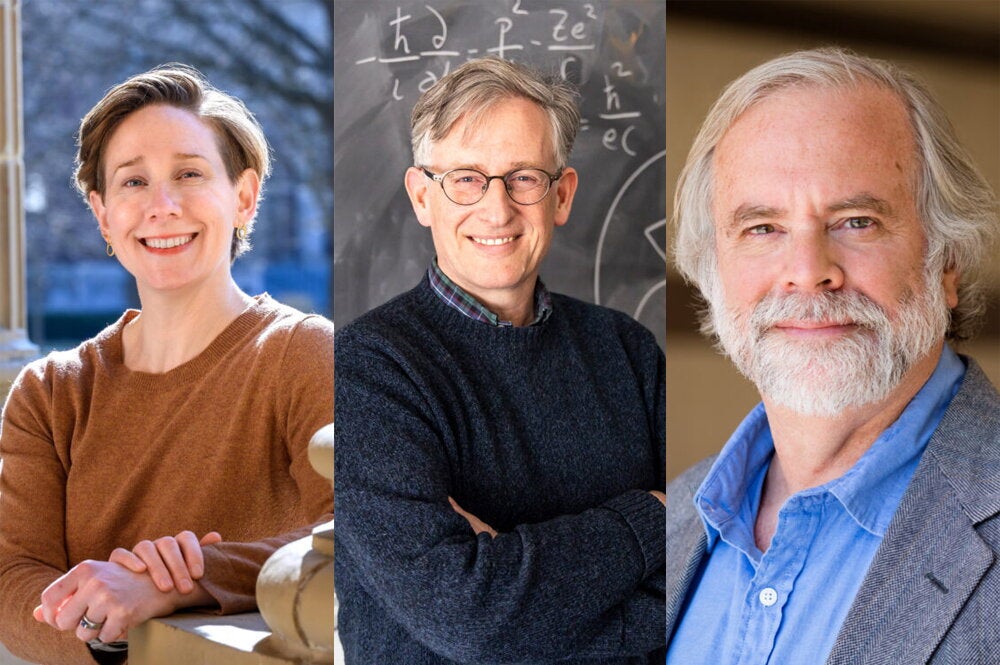

Psychology and neuroscience professor Kara Federmeier directs the Cognition and Brain Lab and co-leads the Illinois Language and Literacy Initiative at the Beckman Institute. She studies how the brain derives meaning from words — a complex process that can be observed through measuring the electrical activity in the brain. As a person reads or listens to speech, their brain translates those sights or sounds into something meaningful. It takes place in milliseconds.
Federmeier delivered the annual College of LAS Dean’s Distinguished Lecture in March. She answered some questions for us afterward.
What initially made you want to pursue this area of research?
I got interested in the brain at a young age, for kind of a sad reason. I had a younger brother who was diagnosed with a brain tumor and had to undergo a lot of treatments, including some that led him to have language processing problems like aphasia.
I was in late middle school and high school when this was unfolding, and I was really struck by how little we know about language in the brain and the cognitive consequences that are going to follow brain damage. Of course, since that time — this was in the ’80s — we have learned a lot, but it’s still very mysterious.
I did my undergraduate work at the U of I as a biology major. There wasn’t a program of study like neuroscience or cognitive neuroscience at the time, so I took a little bit of psychology, but mostly biology classes, and then tried to figure out where to land in graduate school.
I went to a talk that was held by Emanuel Donchin, one of the faculty members at the time in the psychology department here. He was talking about recording brain electrical activity, and he mentioned that there were responses the brain made to language and meaning. I found this so fascinating that I got up the courage to approach him after the talk to ask where I could go to study that.
He said, “Oh, well, if you want to study language and the brain, you have to go to San Diego and work with Marta Kutas.” I ended up going to UCSD for grad school, and that got me started on the pathway of trying to understand the brain and language — and meaning processing more generally.
Some of your work shows that the brain makes predictions when it is comprehending language. What’s the motive for that? Does that take up more energy? Is there a trade-off there?
Some of the obvious benefits to predicting are that you’re ready in advance so you have an easier time processing, and it might help you deal with the rapid pace of language. Also, if the environment is noisy, the combination of a prediction with that degraded signal may be enough to let you understand. People kind of get a feeling for that when they’re processing in a second language that they’re not as fluent in. It’s harder to predict, but if you at least have an idea of what somebody might say, then you can say, “A-ha, yes, I’m getting words that are consistent with what I thought, so I think things are going okay.”
There’s a strong argument that prediction is sometimes really important for learning. That’s one of the ways the system can train itself, because little kids don’t get a lot of explicit training for language learning. We don’t say, “No, that’s not what that word means. It means this.” Children have to kind of pick it up, and one way to pick it up naturally is to guess what’s coming up next and then find out if your guess was right or wrong.
All of those are potential benefits of predictions. But the downside is that it does cost resources, and it can lead you astray. We have some data in college students, who tend to do a lot of predicting, showing that they misremember hearing or seeing what they predicted instead of what we presented to them. Also, when they get what they’re predicting, we see that they aren’t processing very thoroughly, so they’re not actually encoding it very well.
Many people are interested in how large language models (LLMs) like ChatGPT or Gemini “think” versus how our brains think. How are they similar or different?
For years, one argument that I’ve been making is that comprehension is “weirder” than you might think. Understanding the meaning of a word is not very much like looking it up in the dictionary and finding that one well-learned meaning. It’s this really messy process where all kinds of associated stuff is getting activated at once – in parallel. You’re partially looking up meanings of other words that have similar sounds or letters, you’re looking up all kinds of information that is associated with the word, and each time you access the meaning of a word it’s a bit idiosyncratic.
Large language models are similar in some ways, in that they are using these massive databases of statistical information that they have picked up about patterns in language. So they are also not “looking up” meaning in a dictionary-like way. However, to function the way they do, LLMs have been given more experience with language than is literally humanly possible across the lifespan and they can search through all that information rapidly. Comparatively, humans’ memory capacity is much more limited. Certainly, we can’t search through it the same way that LLMs do. But there’s a similarity in doing a lot of parallel processing, and maybe in just grabbing the statistics and running with it. That does have a feel of some of the things we’ve been arguing are also true for humans at these initial perceptual and comprehension stages. That’s been interesting.
Do you think that looking at how an LLM “learns” and how those processes work could help us understand ourselves better, or is it too different?
It’s kind of a “yes” and a “no.” There’ve been arguments for decades. “How do kids learn language? They don’t get feedback. They can’t possibly just learn it by absorbing all the statistics.” What LLMs have done is say maybe they can.
On the flip side, there are properties of these models that highlight ways in which human brains remain mysterious and amazing. These large language models are doing what they’re doing, but with amounts of training and input that are not even humanly possible. So the fact that humans can do some of the same stuff without having that level of training tells us something. It either tells us something about the importance of maybe nonlinguistic input for helping us learn about how the world works, or it tells us that there’s something about the developmental process that actually guides training in a way that makes it more efficient.
Efficiency is another thing. It’s hard to do direct comparisons of how much electrical activity an LLM takes versus the brain, but no matter how you do it, the brain is way, way, way more efficient energetically at doing all of this complex processing compared to large language models. From a physiological perspective, there’s this really intriguing question of how do biological systems do this without consuming the kind of energy that it takes to run things like LLMs?
We’re learning both about the ways in which we’re different and cool, as well as the ways in which maybe there’s some principles to take and kind of apply back to understand the brain.
Do you agree with the saying that the brain is “the final frontier”?
I do. I mean, I’m sure there are other fields that you could make that argument about too, but I always tell students, “How could you not be fascinated by how the brain works and how we think?” This is a little bit of a cliché, but since we understand everything through our brains, it sort of seems like understanding the brain is, in that sense, trying to understand how we understand anything.
Editor's note: This story first appeared in the Spring 2026 issue of The Quadrangle.