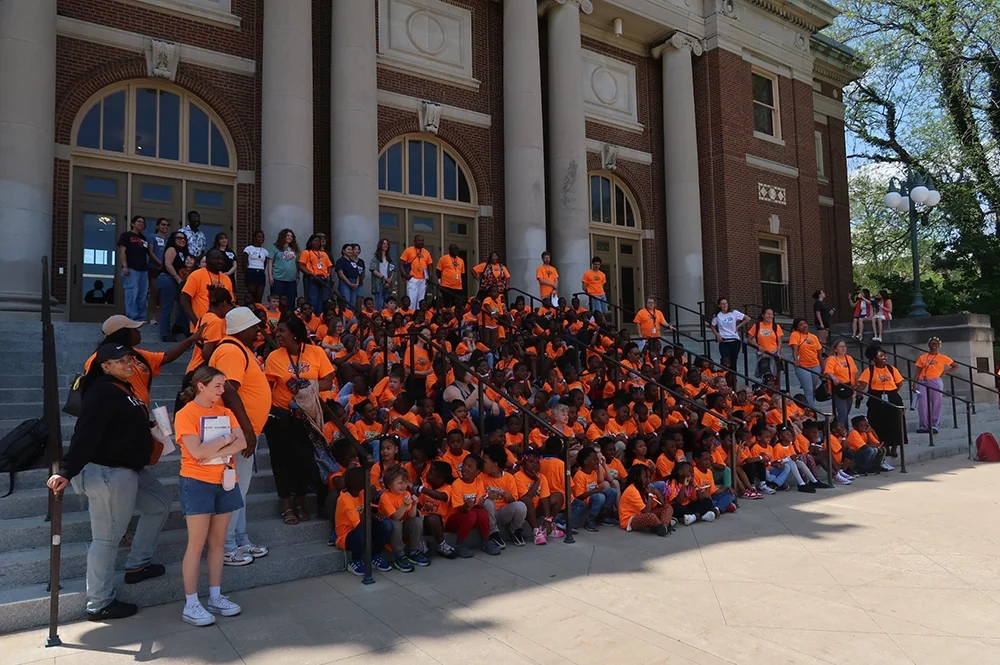
Laughter echoed through the halls of the University of Illinois as children waved tiny flags, danced to French music, and explored campus buildings during the inaugural FrancoFun Kids@U of I event. For many of the children, it was their first time stepping onto a university campus. For organizers, it was the realization of a long-held dream centered on language, culture, and belonging.
The event brought together students enrolled in French dual language immersion programs at Stratton Academy of the Arts in Champaign and Yankee Ridge in Urbana. Throughout the day, children from the two schools rotated through activities designed to immerse them in the Francophone world. They watched French cartoons, explored geography through maps and passports, and learned dances set to French music.
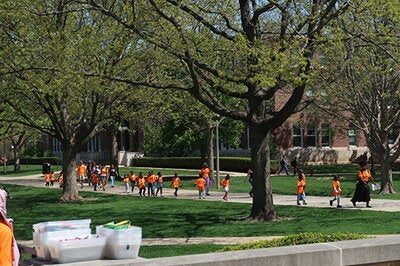
For teacher Danielle Mallett (BS, ’17, elementary education: French), who has worked in the dual language program since its earliest years, the event represented more than just a field trip.
“Sometimes you have ideas for so long and you do not know how to execute them,” she said. “To finally see it come to fruition is really exciting.”
Mallett explained that one of the goals was to unite students from both districts, who rarely have opportunities to interact despite sharing similar educational experiences. She also wanted children to experience French culture in a broader way.
“France is not the only place where French is spoken,” she said. “There are African countries, Canada, and so many other places. We wanted them to see that.”
That global perspective was reflected in the makeup of the student body itself. Many of the children come from Congolese families, where French and Lingala are spoken at home. The classrooms combine native French speakers with students learning the language for the first time, creating a bilingual environment rooted in both academics and cultural exchange.
The event also accentuated the growing Francophone community in Central Illinois, something organizers say often goes unnoticed.
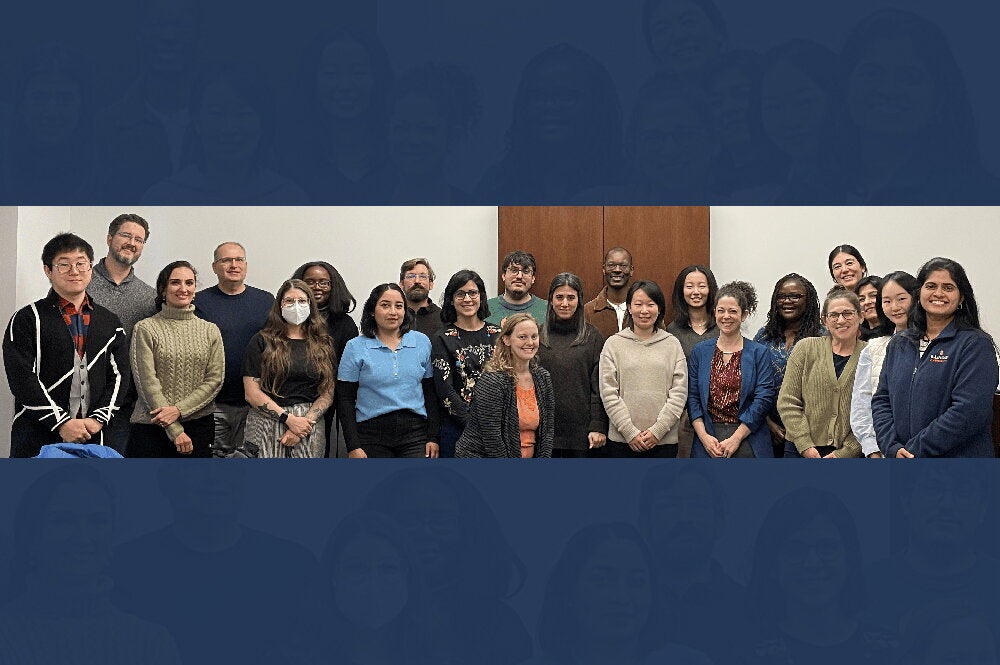
“We actually have thousands of French speaking families in the community,” said Aurore Mroz, a professor of French at the university who organized the event alongside colleagues Nora Stoppino, professor of French and Italian, and Felisa Reynolds, professor of French. “A lot of people do not realize that.”
Mroz emphasized that French in the area is not limited to connections with France. Many local French speaking families come from Central and West Africa, regions where French serves as a major language of education and public life. She noted that the event intentionally showcased the diversity of the Francophone world through activities featuring flags and cultures from multiple continents.
“French is not just the Eiffel Tower in France,” Mroz said. “It is spoken across the world.”
For Mroz, the day carried another important purpose. Beyond celebrating language and culture, she hoped the students would begin to see themselves as future college students.
“The idea is to plant that seed in them,” she said. “This campus belongs to you too.”
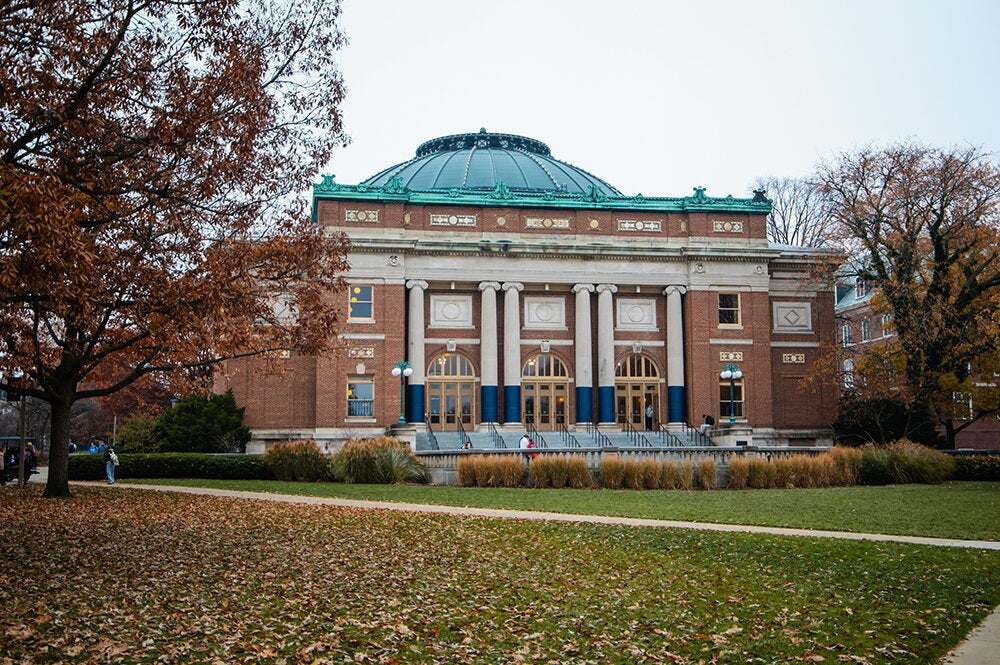
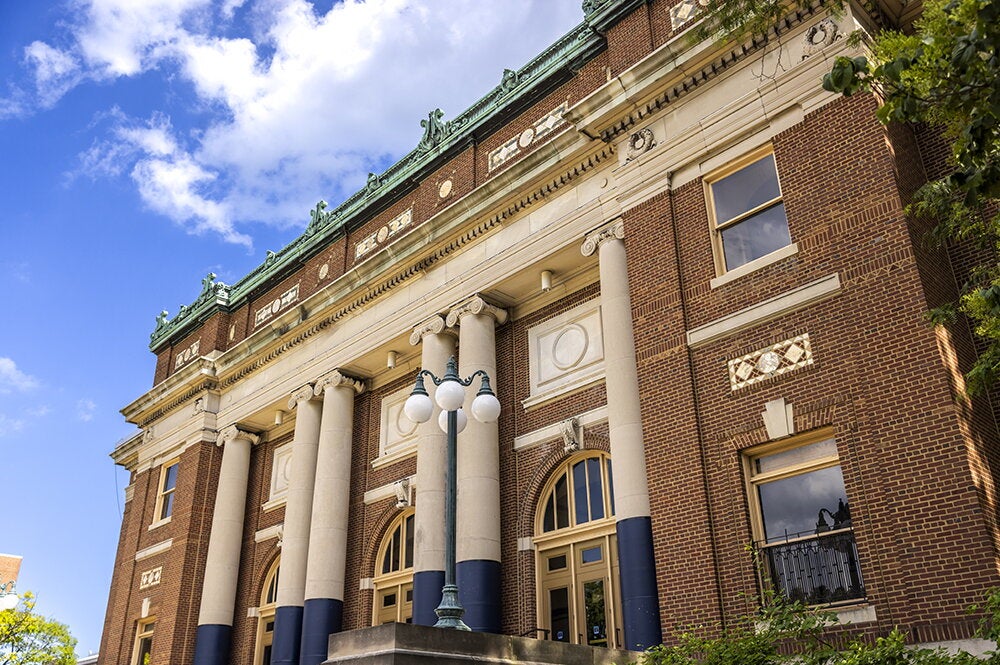
Throughout the event, students wandered through university buildings with wide eyed curiosity. Some stopped to stare at the Foellinger Auditorium, a campus landmark that many were seeing for the first time. Others excitedly practiced French phrases with classmates and volunteers. Mroz described the atmosphere as “beautiful chaos.”
“I do not want to live in a world that is completely quiet,” she said. “Kids make noise. That means joy.”
The event also became an opportunity for advocacy. Organizers expressed concern about the future of French language education in the community, especially after recent cuts affecting local middle school French programs.
“When we’re told that there’s no interest in French, I don’t understand that because we have, as you could see, 200 kids. That’s the next generation,” Mroz said. “These are not retirees in their eighties who want to take French as a hobby. These are our kids.”
She stressed that language learning is not simply about conversational ability, but about literacy, identity, and future opportunity.
“It’s so very important for them to maintain that French, not just in a spoken manner for leisure, but really literacy skills, so that they can be fully proficient and capitalize on their language and identity as they grow as adults,” she said. “We want them to have the entire Francophone world open for them, not just the good old USA.”
Mroz also described the event itself as a reflection of inclusion and collaboration across campus.
“When we include kids, we include 200 of them and 50 volunteers, and that’s inclusivity in action,” she said. “We have physicists, historians, psychologists, all connected one way or another to French. It’s actually a force that’s very much under the radar.”
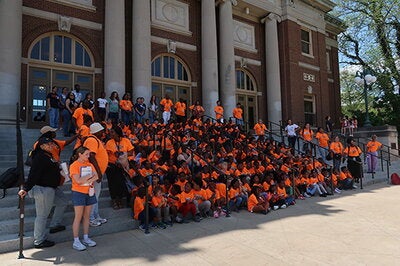
For many students, the event celebrated multilingualism as a strength rather than an obstacle. Mroz said she recently visited local classrooms and was amazed by the level of academic work students complete in multiple languages.
“Those kids are doing science in English and in French. They’re doing social studies in English and in French,” she said. “And for those at Yankee Ridge, they’re also surrounded with Spanish speakers. They’re pretty much on the pathway to trilingualism before the age of eight. I think this is fantastic. We should encourage that.”
She argued that multilingual education strengthens critical thinking and cultural understanding in ways that extend far beyond the classroom.
“You don’t get that from monolingualism because when you get multilingual, you are much more attuned to nuances because of intercultural and interlinguistic differences between languages,” Mroz said. “In English you have two different words for lemons. In French we say yellow lemons and green lemons. It adds richness.”
She added that research has shown multilingualism strengthens neurological pathways connected to reasoning and learning across subjects.
“The pathways you develop with language then apply exponentially to other domains and topics,” she said.
Organizers repeatedly stressed that language learning cannot be separated from identity. For many students, French is not simply a school subject but part of their home lives, families, and communities.
“I think people should not have to cut off one part of their identity because society is not set up for it,” Mroz said. “We should make room for everything and for everybody.”
Teachers and organizers already hope to expand FrancoFun Kids@U of I into a yearly tradition. Future plans include inviting more schools, adding middle school participation, and potentially turning the event into a full day experience.
By the end of the morning, children left campus clutching play passports, maps, and memories from a day spent immersed in language and culture. But organizers believe the most important thing the children carried home was something less tangible: the feeling that they belong.
“This is inclusivity in action,” Mroz said. “When kids feel welcome, they believe they can go far.”