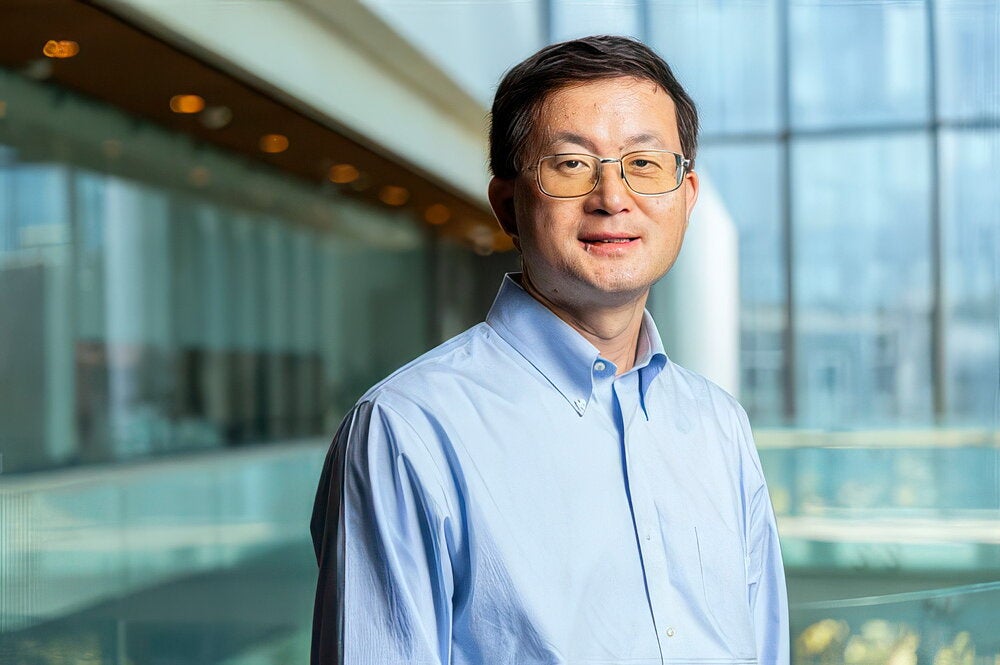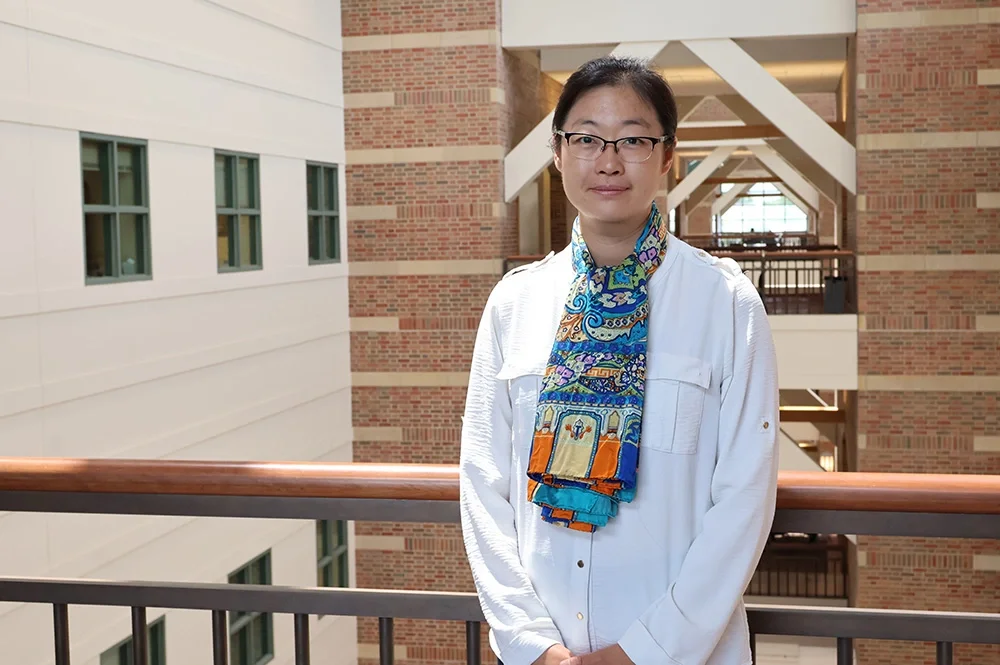
Ying Diao is a professor in chemical and biomolecular engineering, the co-chair of Molecular Science and Engineering at the Beckman Institute, and the recipient of numerous awards and honors, including Presidential Early Career Awards for Scientists and Engineers in 2025.
Her research at Stanford University dealt with printed electronics. In her time at the University of Illinois, she has explored that world further, including creating devices that can help plants grow in space.
The Diao research group, started in 2015, takes a multidisciplinary approach to studying molecular assembly processes. Molecular sciences, directed assembly, polymer processing, additive manufacturing, and device engineering all play into this research, which can be found on the publications page of the group website.
Diao now studies how chirality — asymmetry in molecules and physical structures — might be able to make electronics more energy-efficient.
The inspiration comes from the natural world, where chirality allows plants to perform photosynthesis with near-perfect energy efficiency and might help our brains to operate at supercomputer levels without anywhere near as much energy wasted as heat.
Diao shared how she ended up researching this topic, what chiral electronics are, and what impact they could have in the future.
Could you describe your journey to your current area of research? Is this where you always thought you’d end up, or has your career taken some surprising turns?
Definitely quite some turns. We started here in 2015, focusing on additive manufacturing of functional polymers, and we have transitioned a few times. In 2020, we received major funding from NASA, and we started working on developing wearable electronics for plants so that we can facilitate growth of vegetables in outer space for extraterrestrial agriculture.
More recently, we pivoted from electronics for plants to plant-inspired electronics, owing to a serendipitous discovery. That’s a whole new world where more than half of my group has been focusing on.
What are chiral electronics?
Right now, the electronics we use in our computers, phones, watches — those are metal wires, which conduct electricity in a highly ineffective fashion. It wastes a lot of energy because the electrons would move around, collide with each other, collide with the wire walls, and bounce back and forth. That actually wastes a lot of energy that dissipates as heat. There is a reason why data centers cost a huge amount of energy and require extensive heat management. A lot of electricity becomes heat.
We don’t usually think about electronics in plant leaves, but actually, there are molecules that conduct charges, and those processes are far more efficient. For example, our brains’ computational capacity is comparable to a supercomputer, but it requires only 20 watts of energy. And our brains do not heat up like the supercomputing systems.
It’s speculated that one of the reasons why the efficiency is so high is because the molecules involved in transfer charges are chiral, and chirality can help control the quantum states of the electrons — for example how it spins or swirls around. If the electrons all spin the same way, they don’t tend to backscatter, so the wasted heat problem can possibly be mitigated.
So in terms of the data centers, you could be saving energy within the electronics, while also avoiding the need for cooling them down as much?
Exactly. You wouldn’t require extensive amounts of water to cool these data centers.
How far along is the research?
We are frankly still at a very fundamental level. Even this idea of using chirality to control the electron spin has been controversial. Not everybody is on the same page. I think we still need to do extensive research to show that this concept is real, or maybe there’s an alternative hypothesis that we should think about.
Although the fundamental physics is not fully pinned down yet, we have already shown that there are a lot of benefits of chirality in real electronic systems. We recently have taken chiral semiconducting polymers and made them into solar cells. We show that the chiral solar cells are more stable compared to the achiral versions. Also, when we turn the semiconducting polymers into conducting polymers so that they can conduct electrons much faster, we show that this process is much more efficient when the polymers are chiral.
What do you think the long-term future might look like if this works?
There are several really exciting technologies that chiral electronics can enable. It may enable new computing approaches. The next generation of computers will definitely leverage electronic spin. We can think about spintronics, which is a major application domain. There, you can use spin to carry out logic operations rather than electrons. With chiral materials, we can envision a highly efficient conversion between charge and spin, which is needed for inputting spins and readout spins from these devices.
We can also think about next-generation neuromorphic computers — computers that mimic the brain architecture, where logic operation and the memory is at the same location. Right now, in our computers, the computing and memory are separate, and the electrons have to be shuttled around between these two units. That is not very energy efficient. With chirality, we can potentially control the spin. It requires far less energy to control the spin state versus the energy required to move the charge around, so potentially, we can think about more energy-efficient neuromorphic computers using this approach.
Would chiral electronics be used in your average consumer computers, or is it more for other technology?
It’ll probably be a different domain. The chiral materials we’re looking at are from hydrocarbons. Although they have unique properties such as chirality and the ability to conduct both electrons and ions, they have some inherent limitations. For example, the speed of computing. How fast the charge can ultimately move is limited compared to silicon and conventional semiconductors.
We can mainly think about where these materials excel. For example, stretchable devices, flexible devices, transparent devices, and energy storage devices. You can think about it in clothing, or on the skin, or interface with the brain. Bioelectronics is a major area for these kinds of materials. So, I think there will be a different market, not really changing how our computers will look.
What do you want the general public to know about your research?
Our research is more like a chimera; we are some unlikely combinations of topics. Our work combines chirality, which is a central topic in chemistry; electronics, which is hardcore materials science; and processing and printing these devices, which is a chemical engineering thing. We’re at an intersection of these disciplines.
At this day and age, it’s still hard to do interdisciplinary research. Many times, people would like you to fit in a box perfectly, but we don’t fit. We’re a misfit. But I think it’s at these intersections that new ideas come out.
It really requires some courage to do this research. Oftentimes it’s challenging to publish because the journals have their own territories, and we need to show how we can fit in, but we’re neither pure chemistry, nor materials science, nor chemical engineering. We’re all of the above. It’s been quite a journey to traverse the boundary of all these disciplines.
We’re grateful we’re in Beckman, where interdisciplinary research is really valued. I think there are a lot of elements in the research enterprise that still are not designed for such interdisciplinary research. Funding agencies, journals — they really want you to fit in this domain specifically. It’s been a challenging journey, but I hope it’ll be fulfilling.