
When Liam Flood (BS, ’20, chemical and biomolecular engineering) first toured the University of Illinois as a high school student, he heard plenty of campus legends about Altgeld Hall.
There was the story about staircases that go nowhere. Not true, he later learned. There was the claim that the building was based on a castle in Germany. Also false. There was even a myth that Altgeld Hall was one of several Illinois castles that could fit together like puzzle pieces.

But one fact from that tour stayed with him because it was real: inside Altgeld Hall, there were bells. Better yet, students played them.
That passing comment eventually led Flood, a class of 2020 U of I graduate who studied chemical engineering, into a long relationship with one of campus’s most recognizable sounds. It also led him to write “The History of the Altgeld Chimes and Bellringing Culture at the University of Illinois Urbana-Champaign,” a 91-page thesis that traces the chimes from the university’s first chapel bell in 1873 to the dedication of the Altgeld Chimes in 1920.
Drawing on extensive archival research, the publication follows the people who preserved and expanded the tradition over the next century. It also explores periods of neglect, restoration, renovation, and renewed community engagement, including the 2020 Chimes Centennial and the bells’ removal and reinstallation during the Altgeld Hall renovation. For Flood, the project became a way to document the history of the instrument, the culture of chimesplayers and the role of bellringing in campus memory at Illinois.
“I wrote it for the university,” Flood said. “I know that everyone at the university cares a lot about the Altgeld Chimes.”

Flood did not begin college expecting bells to shape his life. After graduating from Illinois, he moved to Washington, D.C., where he worked at a credit card company for five years. Then he quit his job and moved to Belgium to study at a carillon school. A carillon is a large musical bell instrument, similar in spirit to the Altgeld Chimes, but usually larger and more complex.
His path to Belgium started in Altgeld Hall.
During his freshman year, in February 2017, Flood remembered the bells he had heard about on his campus tour and decided to visit the tower. At the time, chimesplayers were giving public tours. He watched a player perform the noon concert and immediately wanted in.
“It was everything I wanted it to be, and more,” Flood said.
He joined the group that plays the Altgeld Chimes, but soon after, access to the tower was shut down because of safety concerns. The pause lasted about a year. In May 2018, near the end of his sophomore year, he learned that players could return. From then until graduation, he played constantly, sometimes hurrying out of class early so he could make it to Altgeld in time to play during the 10 minute passing period.
Although Flood had tried several instruments throughout his life, none had stuck. The chimes were different.
“I had experimented with musical instruments because I wanted to do something with music,” Flood said. “I tried many of them, but I just didn’t like them. But the Altgeld Chimes were finally one that I was like, this is awesome. This is a cool musical instrument.”
That enthusiasm later turned into historical curiosity. As the Altgeld Chimes approached their 100th anniversary, Flood and other players knew the instrument was old and beloved. But they realized they knew very little about what had happened in its early decades.
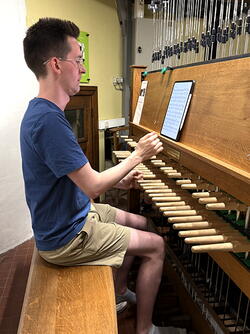
“We knew that the Altgeld Chimes were almost 100 years old, and we knew that people played it for a long time,” he said. “But we didn’t really know anything that happened in 1920 or 1930 or 1940. We didn’t know anything that was going on during that period. And I wanted to know.”
So he started digging.
Much of his research came from the Illinois Digital Newspaper Collections, a university run database of digitized newspapers from across the state. He searched the Daily Illini archives for mentions of the chimes and found more than 1,500 newspaper articles spanning more than a century.
The timing helped. He discovered the database in early 2020, just before the pandemic disrupted the rest of his senior year. With classes suddenly changed and campus life upended, he spent months reading old newspaper articles, building an annotated bibliography and piecing together the story of the bells.
But he knew newspapers alone were not enough. Old articles could contain typos, mistakes and contradictions. To strengthen the project, he visited university archives, searched records from the physical plant department and contacted former chimesplayers, including some who had played in the 1970s and early 2000s.
The result was remarkable, as it illustrates the history of five known bell instruments at the university, and became a reminder that campus traditions do not preserve themselves.
One of the most surprising stories he found came from the 1950s, when the Altgeld Chimes were in poor condition and could no longer be played. At one point, the University of Illinois Foundation considered selling the bells and replacing them with a newer electronic bell imitation.
That plan might have succeeded if not for Victor Cullin, a member of the class of 1920 who had helped drive the original effort to purchase the chimes. When Cullin learned the university was considering selling them, he objected strongly. In a letter, he argued that the bells were meant to remain in the tower for another century or more. The university ultimately kept the chimes.
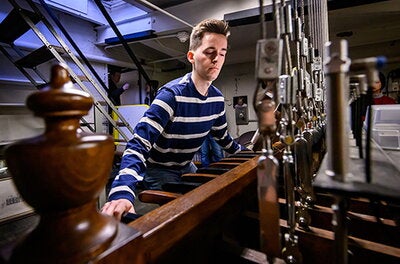
For Flood, that moment was a warning. Something that now feels permanent nearly disappeared decades ago. “We almost lost something that we nowadays see as super important,” he said.
He also found lighter and more surprising pieces of history. In the 1920s, when radio was still new, the university experimented with broadcasting chime concerts so alumni could hear the bells even when they were away from campus. By the 1930s, students were performing chime and organ duets over university radio, pairing the Altgeld Chimes with an organ in Smith Hall.
That image stayed with him: students tuning in to hear bells from Altgeld and an organ from across campus playing together on the radio.
“It’s super cool,” Flood said. “I never would have thought that was going on in the 1930s at the university.”
The people behind the chimes also became central to the story. One figure Flood believes deserves more recognition is Alice Loretta Madden, the first woman to play the Altgeld Chimes in the 1930s. In the 1920s, when the Marching Illini managed the chimes, audition notices explicitly said women were not welcome to apply because the instrument was considered too physically demanding.
Madden proved otherwise. “She somehow convinced the men around her that she was capable of playing the chimes,” Flood said.
Another important figure is Albert Marien, one of the longest serving chimesplayers in university history. Marien played from 1958 to 1994 and became a major source of continuity for the instrument. But Flood said Marien’s influence extended beyond Altgeld Hall. He also led a long campaign to bring a larger bell instrument to campus, which eventually helped make the bells in the McFarland Memorial Bell Tower possible.
The nearly 60-year combined presence of Marien and Sue Wood, Flood wrote, who followed Marien as chimesmaster and served in the role from 1995 to 2016 (and who had played the chimes since the early 1970s), "was a source of stability that the chime had never seen before, and it allowed a culture supported by generations of short-lived student volunteers to flourish."
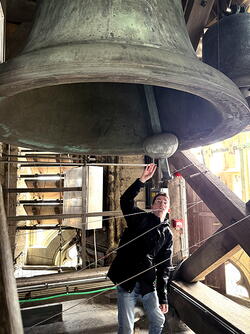
To Flood, stories like those show why the history needed to be written down. U of I has had a long culture of bell ringing, from the Altgeld Chimes to the bell in the Illini Union to the McFarland tower on the South Quad. But some parts of that culture have faded, and others were almost lost.
“This history is really important,” Flood said. “This culture is really cool. It’s really unique. It’s part of the university's history. And it takes concerted effort to keep it alive.”
His hope is that the Altgeld Chimes will return as a daily part of campus life after recent tower renovations. He also hopes the university will think more broadly about its bells, including the Illini Union bell and the McFarland tower, which is currently played by computer rather than by human performers.
In his ideal future, the university would make the McFarland instrument playable by people, the way carillons are played at other major universities. He sees that as part of a larger effort to recognize bell music as more than background noise.
“There are musical bells, and we have a ton of them on campus,” Flood said. “It’s a cool part of our culture and history.” They are evidence of generations of students, alumni and staff who decided the bells were worth keeping.
Now, through his research, he is trying to make sure the next generation knows that too.