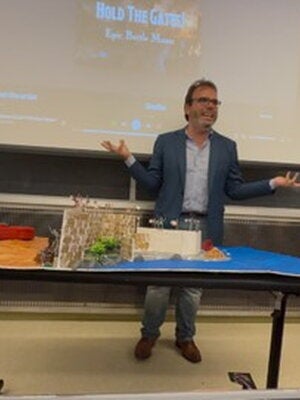
What I hope students took away most is a sense of historical empathy. World War II forced millions into impossible situations and understanding those choices helps us think more clearly about our own world. I also hope they learned that big events are made up of smaller, personal stories—and that examining those stories leads to deeper, more meaningful historical insights.
Semesters offered: Spring 2025, Spring 2026
Course developer: Stefan Djordjevic, Associate Director of Undergraduate Programs, History; teaching in LAS for 6 years
How would you describe the course to someone unfamiliar with the subject?
This class is for anyone who wants to understand how a global catastrophe unfolded (and how it could have been avoided)—and why its consequences are still with us. We move at a pace that welcomes beginners, but we don’t shy away from the tough questions about violence, nationalism, racism, and survival. It's a journey into some of the most horrible moments of modern history, but also one which offers moments of true heroism and grace under quite literal fire. The course is a mix of "big" narratives and vivid human portraits across all levels of society, the kind that I hope stick with students long after the exam.
What made you want to create this course?
I designed this course because students often come in with scattered images of World War II—D-Day here, Hiroshima there—but little sense of how the whole story fits together. I wanted to build a space where we could connect those moments and explore the experiences of people far beyond the usual spotlight. I wanted to communicate the sheer immensity of this moment in history: empires collapsing, societies mobilizing totally, individuals making impossible choices. My goal was to create a class that is accessible, honest about the violence, and deeply human.
Additionally, the war continues to cast such a powerful shadow over the world today that if we want to understand ongoing tensions between China, Korea, and Japan in the Pacific, the nature of American international commitments and institutions like NATO, or the insidious "logic" behind Putin's invasion of Ukraine, we must do so by studying the events of the Second World War.
Were there any challenges you faced while designing or teaching the course? How did you overcome it?
One of the biggest challenges was balancing the sheer scale and complexity of World War II with the needs of a 200-level gen ed course and audience. The war spanned continents, ideologies, and human experiences, and it’s easy to overwhelm students with detail. To overcome that, I focused on building a clear narrative framework—identifying a few essential themes and using them to anchor each lecture. Another challenge was addressing the war’s violence in a way that was honest but not gratuitous. I approached this by pairing big-picture analysis with personal stories, which helped safeguard students from falling into the trap of seeing the millions of lives brutally lost as a mere "statistic." Finally, I had to find a middle-ground behind ensuring that the course was accessible to students who had not studied the War previously while still having enough surprises for the World War II "buffs" in the class!
Now that you've offered the course at least once, what do you hope students took away from it the most?
What I hope students took away most is a sense of historical empathy. World War II forced millions into impossible situations and understanding those choices helps us think more clearly about our own world. I also hope they learned that big events are made up of smaller, personal stories—and that examining those stories leads to deeper, more meaningful historical insights.
Ultimately, I hope students recognized the conflict’s complexity, its human cost, and its enduring relevance. If the course helped students think more critically—about propaganda, leadership, fear, prejudice, resilience—then they’ve gained tools that matter far beyond this topic.
View more new course spotlights from LAS Educational Excellence.