Guidance for Teaching Evaluation Writers

Last updated 10/2/26

The following information is for faculty who are writing a Teaching Evaluation Statement for the promotion and tenure review of another faculty member.

This page contains the following sections:

  1. Instructions for the Teaching Evaluation Statement
  2. A few things to notice in the instructions
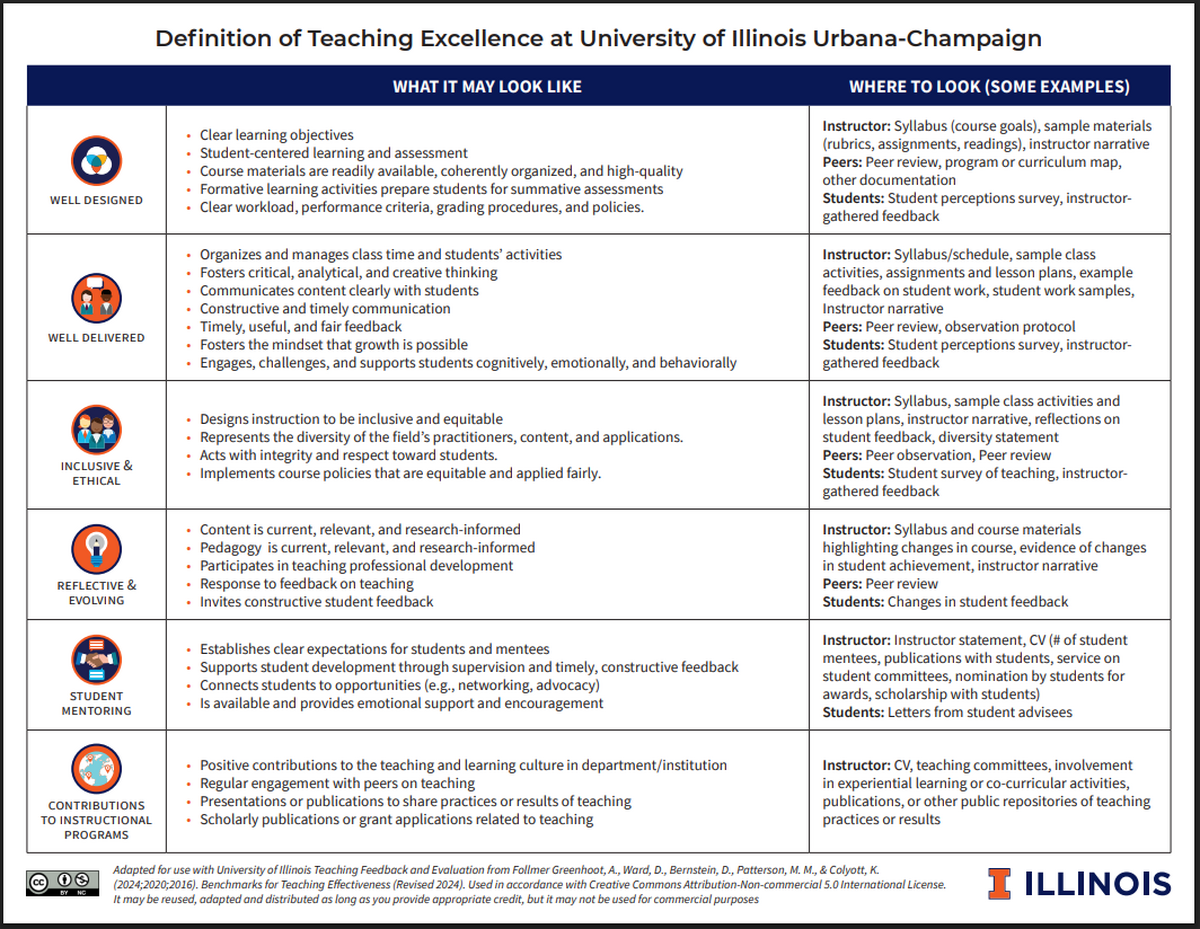
  3. Dimensions of teaching excellence
  4. Getting started on the Teaching Evaluation Statement
  5. Types of evidence that can be used
  6. Sample LAS Teaching Evaluation Statements

Title
Instructions for the Teaching Evaluation Statement

Start here by reviewing the prompt instructions and questions that are required in the Teaching Evaluation Statement.


A few things to notice in the instructions

Writers should highlight the dimensions of teaching excellence.

Writers must "provide a short discussion of each criterion: well-designed; well-delivered; inclusive and ethical; reflective and evolving." These criteria should be explicitly named and supported with evidence in order to fulfill the prompt.

Writers should provide a holistic evaluation.

Writers should draw on "multi-criteria data". Evidence should be presented from the three threads: 1) instructor's documents, 2) peer and unit feedback, and 3) student feedback. The instructor is prompted to provide more and a greater variety of evidence ("other supporting documents") and narrative than in the past, which is referred to as a "teaching portfolio".

Writers should highlight teaching engagement over time.

Writers should highlight "multi-year data," whether "the candidate improved," and what areas are "sustained" excellence. Writers may be limited in how much they're able to demonstrate this based on the evidence that they've received, but this is impactful in making the letter compelling.

Title
Getting started on the Teaching Evaluation Statement

Organizing the evidence

As you're reviewing the instructor's dossier, start organizing the evidence using a table. The idea is two-fold:

  1. Highlight and provide explicit evidence for each of the dimensions of teaching excellence as a throughline or framework for your outline;
  2. Synthesize different sources of evidence (i.e., instructor documents vs. peer feedback vs. student feedback) for each dimension as much as the evidence allows.

As you add notes to the table, focus on including multi-year examples over time and highlighting sustained areas of excellence, improvements over time, and challenges and suggestions.

Recommended table to organize evidence before writing
FocusInstructor evidencePeer evidenceStudent evidence
Dimension: Well designed   
Dimension: Well delivered   
Dimension: Inclusive & ethical   
Dimension: Reflective & evolving   
Other impacts: Student mentoring & supervision   
Other impacts: Contributions to instructional & curricular programs   

Title
Types of evidence that can be used

We've already stated that there are 3 main sources for evidence that should be synthesized in the Teaching Evaluation Statement:

  1. Instructor documents
  2. Peer and unit feedback
  3. Student feedback

The types of evidence that can be used can now go beyond traditional documents: 1) instructor's teaching philosophy statement; 2) peer's classroom observation report; 3) longitudinal report of student feedback scores. 

Instructors are prompted to be more intentional (and maybe more creative?) in cultivating examples of their teaching excellence. A wide variety of examples are permitted.

Units are expected to provide peer feedback on both course delivery and course design and may provide peer feedback on materials in addition to classroom observations.

The longitudinal report of student feedback scores is no longer required. Instructors must provide evidence of student feedback, but they may also provide focused results with narrative or demonstrate how student feedback has been implemented.

See a list of examples of evidence from the Office of the Provost (click on the image to auto-download the PDF and view full-text):

Image
Screenshot of Sources of Data PDF
Caption
Screenshot of "Sources of (Teaching) Data" PDF from the Office of the Provost

Note: The origin of this PDF is the Holistic Teaching Feedback and Evaluation (Provost) page, called "Sources of Data".

Sample LAS Teaching Evaluation Statements

Restricted access to LAS EOs; if you do not have access, please reach out to your EO to provide you with a copy and do not redistribute.

For a Tenure-Track Faculty

Example of a successful teaching evaluation statement for an LAS tenure-track faculty member in AY25-26

For a Specialized Faculty

Example of a successful teaching evaluation statement for an LAS specialized faculty member in AY25-26