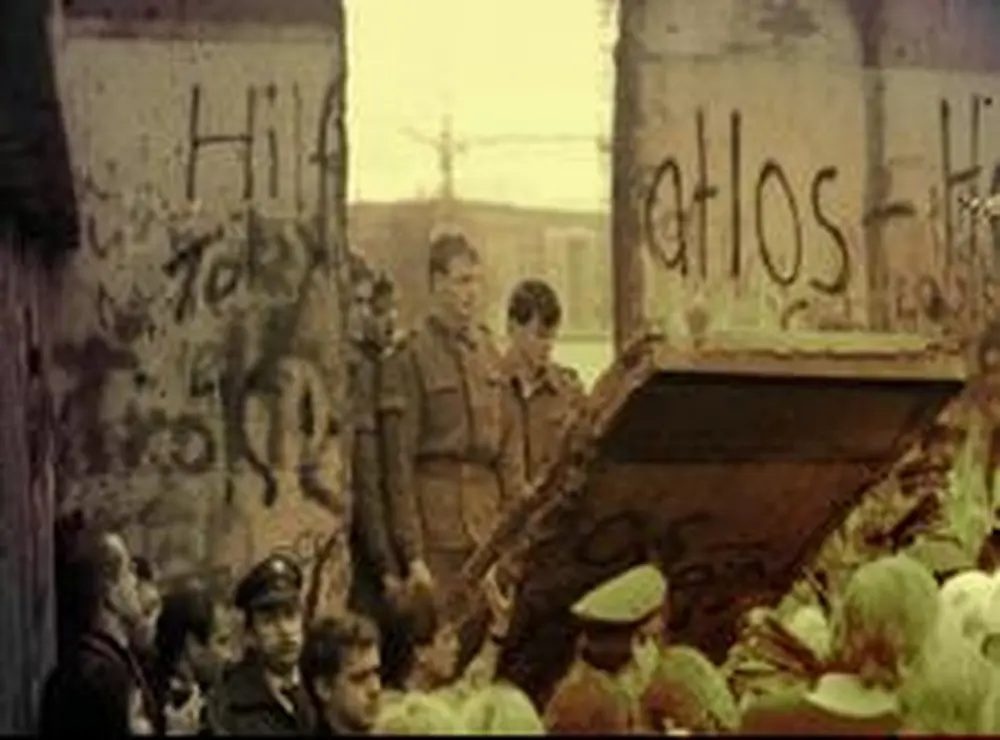
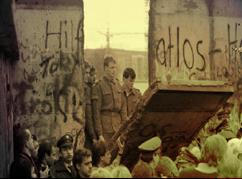
Prior to 1989 you rarely saw photos of the Berlin Wall’s east face. There were plenty of pictures of the western side, what with all the graffiti and Pink Floyd lyrics splayed across it, but the opposite side rarely made the news. For one thing, people who could actually see the east side were forbidden to photograph it.
But there was another reason just as simple, says Anke Pinkert, former East Berliner and Germanic Languages and Literatures professor at the U of I. To East Berliners, the wall wasn’t worth noting. She saw it every day when she walked to grade school. It was entirely normal; a fact of life. You can imagine, then, the feeling when it came down.
In the lightning-fast turn of events, Pinkert first learned of the “collapse” of the wall when she turned on the TV the morning of November 10, 1989, and saw people passing through it. In a “splinter of a second,” she says, everything had changed.
“I knew with every fiber of my being that everything that had existed up to that point was something that now needed to be questioned,” Pinkert says, in a faculty roundtable discussion, “Remembering 1989: Fall of the Berlin Wall,” on the 20th anniversary of the event. “That was an experience like we only have when either we give birth or experience someone’s death.”
That mixed imagery is no mistake. One thing clear from the discussion—attended by more than 200 people in the Illini Union and organized by U of I's European Union Center—is that despite widespread Western media portrayals of the wall’s collapse as a triumph of freedom, there are Eastern Europeans who recall how the results muted their way of life, which, in many ways, was as meaningful and vibrant as you’d find anywhere.
Panelist Zsuzsa Gille, professor of sociology, was a Hungarian dissident and protestor who left her home country shortly before the wall fell. Living in Hungary she was an environmentalist inspired by people such as Martin Luther King Jr. and Ghandi. Underground rock bands and alternative theater “made her life complete,” she says.
“Really, the 1980s for me was a vibrant decade, as if society had awakened from a long hibernation,” she says.
What bothers her most about post-1989 commentary, she says, isn’t how the West congratulates itself for the change that swept Europe, but how East Europe is portrayed as a static place largely without innovation or hope.
“These arguments betray either ignorance of what was going on in the society in the 1980s or a malicious arrogance towards movements that do not meet Western leftist or liberal standards of civil initiative,” Gille says.
Pinkert calls what happened after 1989 a missed opportunity.
“I talk about this transformation not as a revolution but rather a courageous civic act,” she says. “What happened after the fall of the wall...is that a West German system of capitalism and democracy was put into place in East Germany but there was no dialogue about (an alternative that would blend positive aspects of both sides).”
There’s no dispute that it was a life-changing moment, however, including for some people in the West. Panelist Ed Kolodziej, professor emeritus of political science and director of the Center for Global Studies, says he stayed up all night watching coverage of the wall’s collapse and soon traveled to see it for himself (he brought pieces of the wall to the discussion).
“Up until this time I thought I was teaching something worth teaching,” he says. “And it became clearly evident to me that at best I only marginally understood what the heck was going on in the world. This led to a transformation in my own scholarship and research.”
Further to the east, in the Soviet Union, change was already afoot when the wall came down, says panelist Diane Koenker, professor of history who spent part of 1989 in Moscow. Mikhail Gorbachev, then president of the USSR and general secretary of the Soviet Communist Party, was implementing reforms such as Glasnost, Perestroika, and democratization. Banished books were reappearing, historical archives were more accessible, and voters were tossing Communist party leaders from office in droves, she says (though the nation also faced dire shortages of food and goods).
But change there has been unsteady. In Moscow, Koenker says, “openness remains fragile,” with new laws appearing on state secrets and historians accused of filling blank spots in Soviet history with “unpatriotic slime.” Foreign scholars are still viewed with suspicion, and capitalism and democracy are not firmly entrenched.
Thus the events of 1989, Koekner adds, are still ambiguous and open-ended.