For the past five years, Barbara Wilson has kept on her office wall a photo of Lincoln Hall—the “old” Lincoln Hall, that is, pre-renovation—given to her by the Department of Communication when she left there to work in the Office of the Provost. In it, a person is making his way back to the iconic building through the snow.
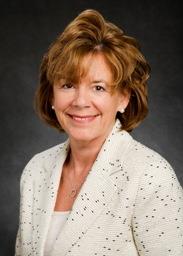
Call the image symbolic if you want, but Wilson, too, is heading back to Lincoln Hall. This time she’s arriving not as a new professor, as she did when she arrived on campus in 2000, but to occupy an office on the second floor as the new Harry E. Preble Dean of the College of Liberal Arts and Sciences.
Wilson’s career in academia has constantly evolved since she earned her doctoral degree in communication from the University of Wisconsin-Madison in 1985. Yet she has a way of coming back to her roots.
“I’m supposed to say, ‘I look forward to serving in this pivotal campus role,’” she said when she accepted the dean’s post back in May, “and while that’s true, it really feels more like I’m coming home. I have spent my academic career supporting and celebrating the merits of a liberal arts education at a major research university, and I can’t wait to continue doing that as dean.”
Wilson grew up in Appleton, Wisc., a paper mill town of about 75,000 people some 20 miles southwest of Green Bay. Along with her doctoral degree, she earned her bachelor’s and master’s degrees at the University of Wisconsin-Madison, where The Wizard of Oz played a role in sparking an extensive career in studying the effects of media on children.
As a child, she explains, watching the classic 1939 film was an annual tradition in her house. The movie both fascinated and terrified her, and later, in graduate school, when a professor received a grant from the National Institutes of Health to study media and fear, she felt moved to join the project.
“It resonated with me,” she says. Her interest bloomed, and she has since authored and co-authored more than 100 publications on the topic, including the book Children, Adolescents, and the Media, and three book volumes of the National Television Violence Study. She co-edited the Handbook of Children, Media, and Development, and has served as a research consultant for several groups, including Nickelodeon, Discovery Channel Pictures, the Centers for Disease Control and Prevention, and the National Association of Television Program Executives.
After graduate school, Wilson was an assistant professor at the University of Louisville before taking a faculty position in communication at the University of California at Santa Barbara. For eight years she served as director of graduate studies for the university’s Department of Communication, and had concluded that she would spend the rest of career in California. Then David Swanson came knocking.
Swanson (who passed away in 2004) was head of the well-respected Department of Communication at Illinois. He met Wilson at a conference and suggested she think about coming to Illinois.
“Many conversations later I was thinking seriously about it,” she says. “My husband [John Lammers] was also a tenured faculty member in communication at Santa Barbara, and so we weren’t going to leave for Illinois unless there were opportunities for both of us. And David Swanson really made it happen.”
So how did Swanson lure Wilson, her husband, and their two daughters (Isabel and Grace) away from sunny Santa Barbara? There were a few selling points. One was Illinois’ strong reputation in communication studies. Another was Illinois’ massive library. Yet another was that in Santa Barbara, Wilson was feeling pulled away from her scholarly work by administrative duties. Swanson, however, promised that if she came to Illinois, she could devote all her time to teaching and research.
The irony of that, of course, does not escape Wilson as she recently recalled that story in the administrative offices of Swanlund Hall. She recalls how, a few months after arriving at Illinois, she was working on a deadline to complete a book when one day Swanson knocked on her door.
“He came in and shut my door and said, ‘I promise you I didn’t recruit you here because of this, but I have an opportunity to go and work in the provost’s office and I’m just not going to feel comfortable doing this unless we can get an experienced person like you to lead this department,’” Wilson recalls, with a laugh.
After some thought, Wilson agreed to consider the position—provided she first had time to finish her book—and in 2002 she became department head. She left the Department of Communication in 2009 to serve as vice provost for academic affairs in Swanlund Hall. In 2012, she was named executive vice provost for faculty and academic affairs.
Among her accomplishments in the provost’s office are enhancing leadership training programs for department heads and chairs, providing support for mid-career faculty, creating the Office of Undergraduate Research, and enhancing the Targets of Opportunity Program to increase the hiring of faculty from underrepresented groups.
“No task has been too large or too difficult for Barb,” said Ilesanmi Adesida, vice chancellor for academic affairs and provost of the University of Illinois, announcing Wilson’s return to the College of LAS as dean. “She has successfully tackled every project that has been assigned to her and shown a remarkable ability to pivot to a broad range of responsibilities.”
There was another reason Wilson left California for Illinois. The University of Illinois reminded her of what she thought an ideal university should be.
“I was born and raised in the Big 10, if you will,” Wilson says. “My sense of what a university is and ought to be is very much influenced by the Big 10, and being in California I missed a lot of that. Coming back to a large public research institution with a land-grant mission, with a full array of athletics and with the diversity that Illinois provides was enticing to me.”
As dean, she’s well aware of the challenges ahead, from strengthening academic programs to attracting new students and renovating aging buildings. Wilson, however, feels ready for the task given her wide array of experiences, from the departmental level to the campuswide perspective she gained in the provost’s office. She now even has the perspective of a parent.
A couple years ago, her oldest daughter, Isabel, was debating between attending the University of Illinois and her mother’s alma mater, the University of Wisconsin-Madison. She had been admitted to both. She’d visited both several times. The deadline loomed. Then, on a Friday morning, Wilson recalls, she got a text from her daughter.
“I woke up this morning, and I’m feeling like an Illini,” Isabel wrote.
Wilson couldn’t have been more pleased.