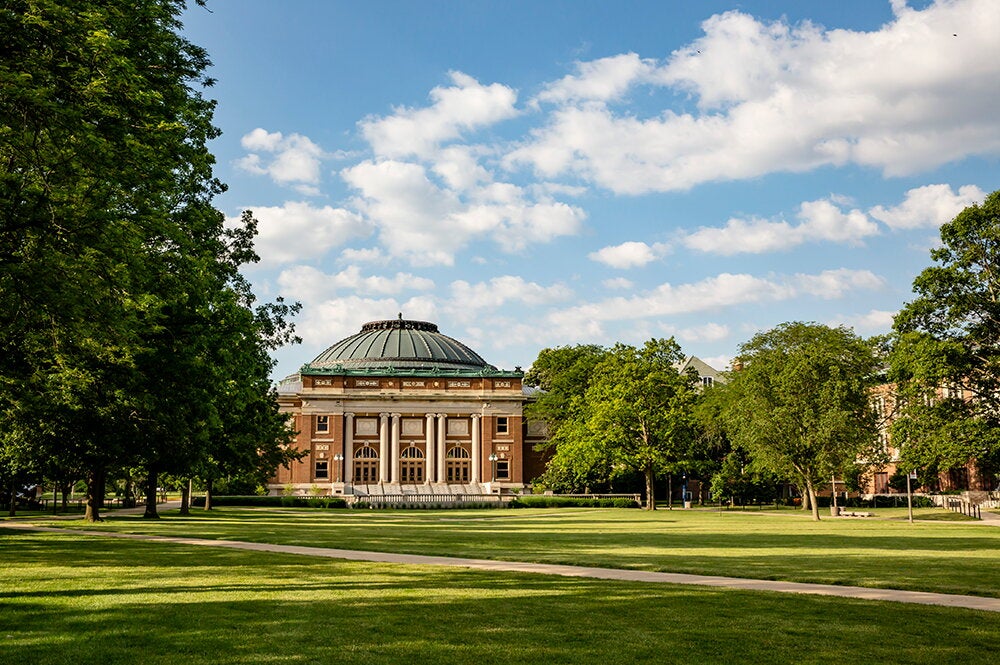
The oldest person on the University of Illinois campus hails from Alaska and can be found in Davenport Hall, but don’t expect him to be roaming the Quad anytime soon.
This particular man is over 10,300 years old.
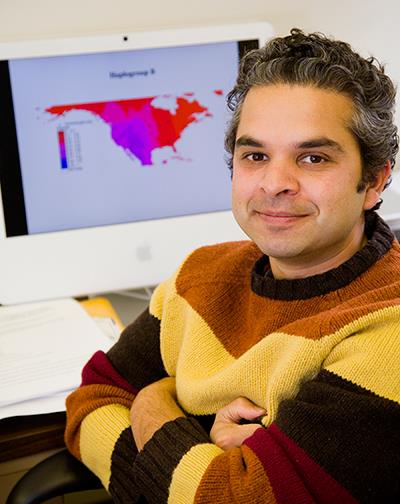
Actually, only a few bones and teeth remain of this individual, but it’s enough to extract ancient DNA and make important connections to Native Americans today, says Ripan Malhi, LAS professor of anthropology. What’s more, he is only one of many ancient individuals whose DNA is being studied on the U of I campus.
Malhi’s lab recently found a direct ancestral link between ancient human remains near Prince Rupert, British Columbia, and the Tsimshian Nation living in the region today. The lab focuses on the Americas, using DNA from both ancient and living people as a window into the past to track population movements and infer when a particular group diverged from another group.
For instance, it is believed that ancient populations reached the Americas roughly 16,000 years ago by crossing a land bridge created by glaciers between northeast Asia and Alaska. Malhi coordinated a team of 21 researchers from five countries, and they studied close to 600 living Native Americans and almost 4,000 individuals living in northeast Asia.
They found that the two groups were closely related. However, slight genomic differences between the groups led him to infer that people from Asia were isolated in Beringia for a few thousand years before they eventually migrated into the Americas at the end of the last glacial maximum period. Beringia is the name of an area that encompassed the once-existent land bridge, plus parts of Alaska and northeast Asia.
Handling ancient DNA is tricky, Malhi explains, because there is always a risk of contamination, such as living human DNA sloughing off of a person’s hand and mixing with ancient DNA. To prevent this problem, the ancient bones and teeth stored in Davenport Hall are taken to the Institute for Genomic Biology, where they are extracted in a “clean room.”
Researchers first enter an anteroom in the ancient DNA lab, where they suit up in an outfit that covers them from head to foot—like something out of a science fiction movie. The ancient DNA room is pressurized in such a way that when scientists enter, air can flow out but no contaminated air can flow in.
Malhi brings extensive experience in DNA extraction; before coming to Illinois, he founded Trace Genetics, a company that focused on DNA genetic ancestry analysis and forensic DNA analysis. In one forensic case, they used DNA analysis to match skulls to skeletons looted from a burial site.
Today, Malhi’s Illinois team operates well-established archaeological sites in California and British Columbia, but they are also developing new sites in Guatemala, Mexico, and Illinois. In British Columbia, he says they recently sequenced the “exomes” of both living and ancient individuals in the hopes of finding out how the genomes might have changed after European contact in the 1700s. (Exomes are the actual coding part of a genome.)
In addition to extracting ancient DNA from bones and teeth, Malhi says they pull DNA from “coprolites”—fossilized feces.
“This is interesting because not only can you get the DNA from the person who made the coprolite, but you can get information about the plants and animals that person was eating,” he says.
In Illinois, one of Malhi’s students, Kelsey Witt, is even studying the ancient bones of dogs in the St. Louis region. “When Native Americans moved, they likely brought their dogs with them, so we can use dogs as a proxy for human movement,” Malhi says.
Working with the ancient remains of dogs also avoids some of the sensitive issues involved with handling human remains.
Malhi’s lab always works in cooperation with Native Americans that seek genetic information about their ancestors. And by working together, the lab can ensure that ancient remains are treated with respect. One of the most moving experiences, he says, was near Kamloops, British Columbia, where the Native Americans invited him to the reburial ceremony for two individuals found in the same grave dating back roughly 5,000 years.
“It was a powerful experience,” he says. “It really showed how much people care for the remains of their ancestors.”
According to Malhi, “It’s a very sensitive issue because there is a history of researchers going to these communities, collecting samples, and then leaving, never reporting the results to them.”
Malhi has been actively trying to change the strained relationships of the past by organizing an annual summer workshop in genomics for about a dozen Native Americans from across the continent. The first two workshops were held on the Illinois campus, but this summer’s event was held at the University of Texas in Austin.
“The idea is to teach individuals from these communities to be able to do this kind of analysis,” he says. “We have sessions on extracting and analyzing DNA, and on the social, legal, and ethical implications of genomic research. This is the best way to resolve the past issue of outsiders coming in and taking advantage of them.”