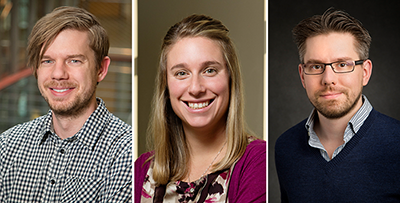
Two professors in the College of LAS are recipients of 2015 Sloan Research Fellowships from the Alfred P. Sloan Foundation.
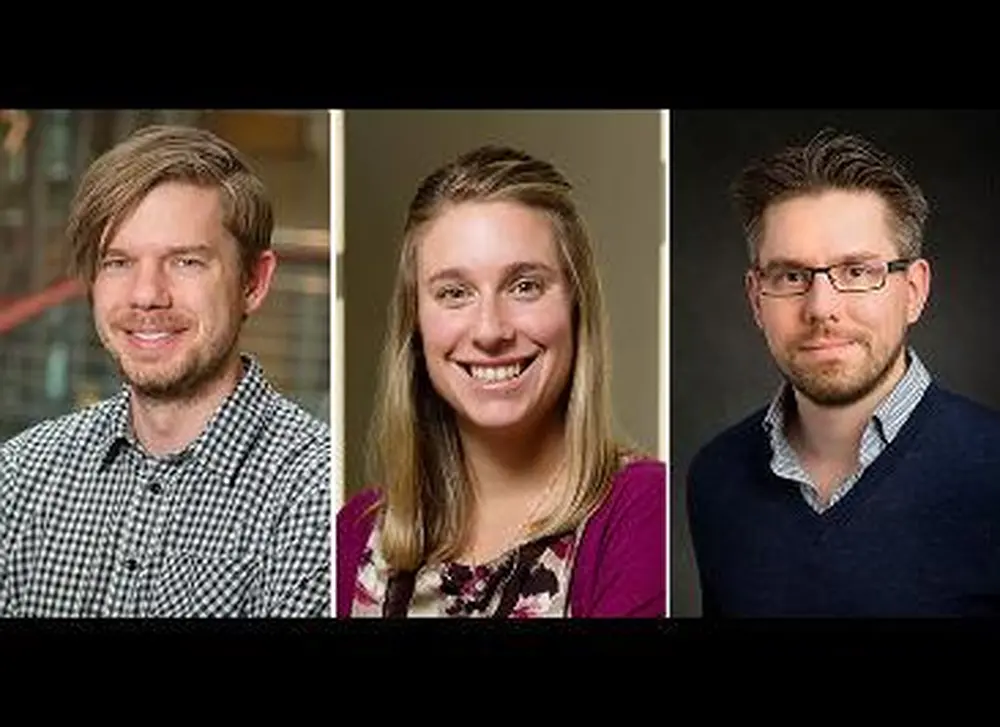
Alison Fout, a professor of chemistry, and Ryan Foley, a professor of astronomy and of physics, are among 127 other career scientists and scholars from 57 universities chosen for the fellowship. The two-year program awards the fellows $50,000 to pursue their choice of research topics.
A third professor from the U of I, Thomas Kuhlman, a professor of physics, was also chosen for the fellowship.
Fout’s research focuses on addressing environmental, biological, and energy problems by designing transition metal complexes and catalysts to understand the activation and transformation of greenhouse gases into novel compounds.
She earned her doctorate from Indiana University in 2009, and was the 2010 recipient of the American Chemical Society Division of Inorganic Chemistry Young Investigator Award for her research at Indiana. Prior to coming to Illinois in 2012, she held a postdoctoral position at Harvard University. Fout received a 2014 National Science Foundation CAREER award.
Foley, a professor of astronomy and of physics, studies exploding stars and other celestial transient objects. He discovered and characterized a peculiar class of exploding stars, Type Iax supernovae, which gained widespread fame when one was first spotted by 14 year-old Caroline Moore, of New York, who became the youngest person to ever spot a supernova.
Foley also uses Type Ia supernovae, more abundant and homogenous cousins of Type Iax supernovae, to measure the expansion and investigate the content of the universe. Foley uses more than a dozen telescopes around the world and in space, including the Hubble Space Telescope, to improve our knowledge of the universe.
Foley earned his doctorate in astrophysics from the University of California at Berkeley in 2008. Prior to coming to Illinois in 2013, he held a Clay postdoctoral fellowship at the Harvard-Smithsonian Center for Astrophysics.
Kuhlman works at the intersection of theoretical physics and molecular microbiology, particularly studying gene expression in E. coli. He observes interactions of proteins with DNA in living bacterial cells, and then uses these theoretical models in further experiments.