When you think of a laboratory, you may think of test tubes, chemistry or some other kind of science. You might also think of teamwork, solving problems and testing solutions. Could there be such a lab for history?
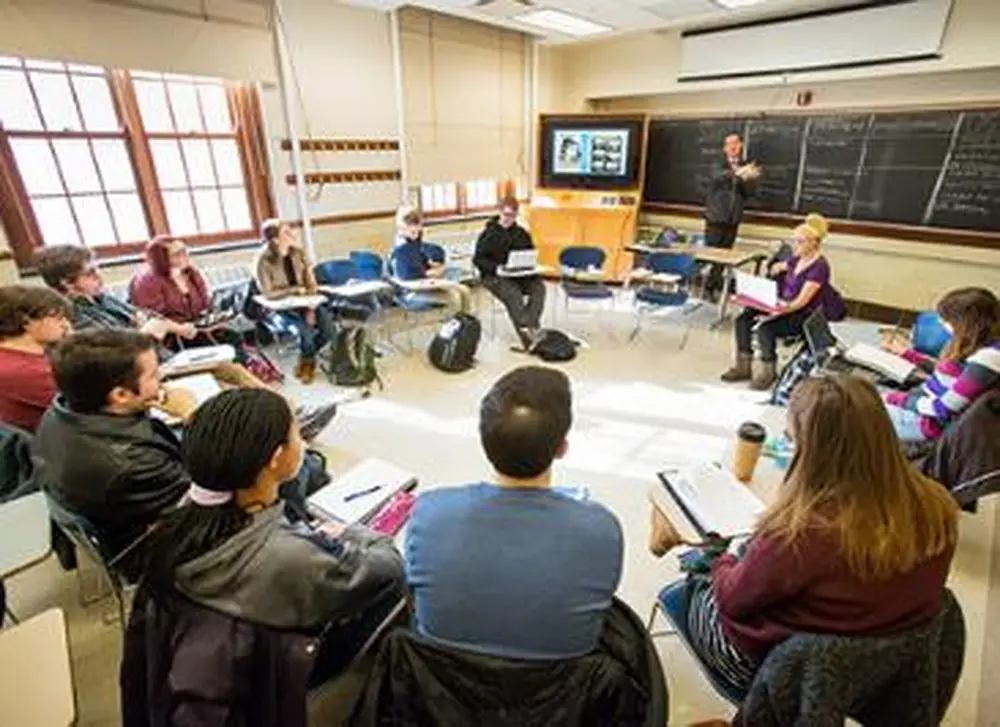
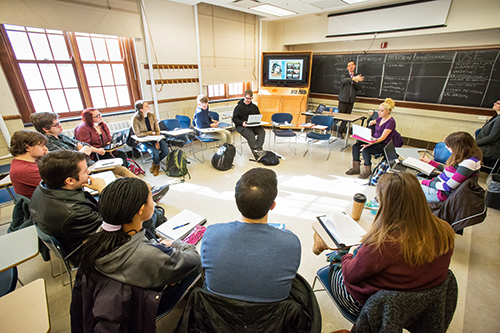
Some faculty and students at Illinois are working on one. It’s called SourceLab. The problem they’re addressing is one of history in the digital age, when millions of historical images, videos, sounds, texts and other artifacts go online daily.
They are “tidbits of history that normally are just plastered on the Internet,” said Alex Villanueva, a junior majoring in history from Plattsburgh, New York, and a student in the first SourceLab class last spring.
Such an item may be compelling, dramatic and tempting to use and cite, according to Russian history professor John Randolph, who has guided SourceLab’s creation. But its origins may be sketchy. Is it genuine or fake? Who created it and why? Was it buried in a trunk or widely seen?
The goal of SourceLab is to take a few of those tidbits, per requests from faculty and other “clients,” and make them into reliable historical sources. The goal is not mass digitization or to simply “get it out there,” Randolph said, but to get it “ready for history.”
For the students involved, that can mean research in the library and online, but also other digging and education. Villanueva’s project was to track down information on a short black-and-white film on YouTube. It showed maimed World War I soldiers being fitted with “new faces,” or prosthetic masks, in a Paris studio run by an American sculptor, Anna Coleman Ladd. It has now been viewed on YouTube over 80,000 times.
Among the questions: Who filmed it? Who owned it? Did they have permission to use it? What was the context for Ladd’s work?
Villanueva and his partner on the project, Alison Marcotte, a journalism major from Elmhurst, Ill., who graduated last May, contacted the Smithsonian Magazine, which had used the video with a story. That inquiry led them to the National Museum of Health and Medicine, where they found the original in the museum’s archives.
In the process, they also learned a lot about copyright law and digital publishing, talked to historians about the film and its context, and found a supplemental source, a 1917 article “The Men With New Faces.” Their project became the first prototype edition of SourceLab, and it’s already been cited in a book and used in a class.
“Probably the most important thing for the student researcher is learning about authenticity,” Villanueva said. “Probably the biggest benefit (of SourceLab) is having the opportunity to get published in the digital humanities, to get experience in the digital humanities… I think it’s made me a more well-rounded history major for the 21st century.”
For Marcotte, there was value in the hands-on nature of the project. “I definitely learn by actively participating rather than passively listening,” she said.
Immersing herself in the video and its background also gave her a different perspective on the subject matter. “It made me really think about who Anna Coleman Ladd was, how the soldiers must have felt, and how her work affected them, rather than just thinking about history in terms of events and dates on a timeline.”
Randolph said SourceLab grew out of discussions over several years about creating such a lab-type practical experience for history. He thinks this fits the bill. “They have the experience of working with and for other people, and they have a sense that what they’re doing has meaning to other people, and therefore they need to do it right.” They also learned a variety of career-related skills along the way, he said.
SourceLab also teaches essentials at the core of the discipline, valuable in their own right, Randolph said. “How do we know what we know about the past?… The study of sources, thinking about those things we use to build a bridge into the past, that’s the basis of history.”