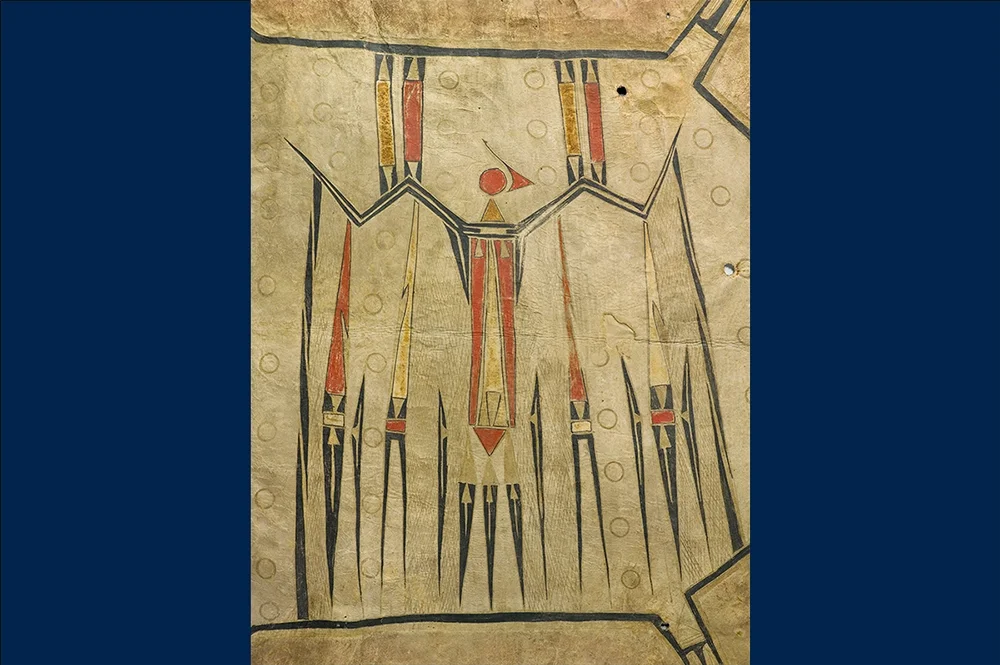
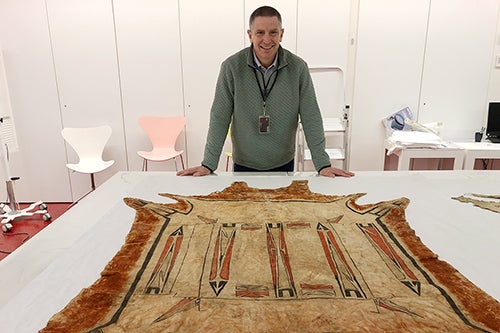
Stunning robes created more than 300 years ago by Inohka, or “Illinois people” — Native American tribes whose homelands include Illinois — will be on public display at a special exhibition at the Palace of Versailles in France that opens this month. The exhibition will include one of the most famous existing hide paintings from the 18th century — a robe featuring an iconic image of a thunderbeing, or thunderbird, painted in shades of red, yellow and black.
The robes are the focus of a collaborative project led by University of Illinois Urbana-Champaign history professor Robert Morrissey, along with citizens of the Miami and Peoria Nations. The project has been working for the past five years to reconnect the tribes with the robes and their hide painting tradition.
The “Reclaiming Stories: (Re)connecting Indigenous Painted Hides to Communities through Collaborative Conversations” project — funded by a grant from Humanities Without Walls, a research consortium based at the U of I’s Humanities Research Institute and supported by the Mellon Foundation — is supporting a trip by Morrissey, the other project collaborators and tribal citizens to the exhibition opening on Nov. 23. Two partners on the Reclaiming Stories project — George Ironstrack, a Miami Tribe citizen and the assistant director of the Myaamia Center at Miami University of Ohio, and Elizabeth Ellis, a Peoria Tribe citizen and a history professor at Princeton University — are consultants on the exhibition.
“When we do historical work on the distant past, finding ways to make that history relatable is often a big challenge,” Morrissey said. “One great thing with an exhibition like this and a place like Versailles is you are surrounded by a built environment and this material culture that really helps enable a certain kind of time travel and reconnection to that past. I think it will be very special to see it all together in that way. Not in a collections room in the basement of a museum, but in a salon at Versailles where it’s much easier to imagine what people of the 18th century were experiencing and how they were encountering one another across these great differences.”
The robes are in the collection of the Musée du quai Branly-Jacques Chirac in Paris. That museum partnered with Versailles on the exhibition, which runs through May 3, 2026. It will include information about the Indigenous people of the Mississippi Valley in the 18th century and their way of life, the founding of Louisiana by the French and their close ties with Indigenous allies, and a diplomatic visit to France in 1725 by several Native American chiefs.
While the Versailles exhibition tells the story of Native American tribes throughout the Mississippi Valley, it has a particular focus on those in Illinois, Morrissey said.
“It’s emphasizing Illinois in a special way. Nobody gives this region or these tribes the pride of place they deserve. This will be centering them,” he said.
The exhibition coincides with the 300th anniversary of the 1725 diplomatic visit to France by Chicagou, a chief of the Michigamea, a group later incorporated into the Peoria Nation, and one of the most important 18th-century tribal leaders in the Midwest. Chicagou and four other chiefs visited Paris, Versailles and the Château de Fontainebleau. On Nov. 25, 1725, they met Louis XV at Fontainebleau and hunted with him. The tribal members’ visit to France this month will include participating in an anniversary commemoration at Fontainebleau of the chiefs’ visit.
“We’ve learned so much as we’ve been doing this project over five years about that delegation and what they did,” Morrissey said. “To be in Fontainebleau in November, precisely at that anniversary, and imagine what that experience was for those travelers and what it means for the delegation in 2025 to reconnect with parts of that heritage is powerful.”
The Reclaiming Stories project supported three previous visits to Paris by tribal representatives who are partners on the project. They researched the robes at the Paris museum, visited Fontainebleau and learned more about the chiefs’ 1725 visit there. The project also supported summer workshops on the hide painting, hide tanning and tattooing traditions of the tribes.
“The Reclaiming Stories project has been instrumental in allowing the Peoria Tribe to reconnect with these beautiful and powerful pieces of our history,” Ellis said. “We are deeply grateful to Professor Morrissey and to the University of Illinois for supporting this important work. It is my hope that this model for collaboration sets a new norm for innovative and ethical research work with tribal nations.”
Morrissey said the work of the project is different from standard academic work, which often results in a journal article or book.
“This work has a much more tangible and present-day impact for these communities,” Morrissey said. “That is the real achievement of this work — not just academic study but putting it in service of these cultural revitalization efforts. It’s work that involves a lot of collaboration and travel and organization, and it’s amazing to come to a certain waypoint and take stock of everything we’ve done together, not just to study these old art traditions but to bring them back and revitalize them for people in those communities today.”
Morrissey said the project may seek a second grant with the goal of bringing the painted robes to the U.S. for an exhibition that will be curated by Peoria and Miami tribal members and focus on their histories and traditions.