LAS chemists helped make dessert as we know it
Dave Evensen
January 4, 2017


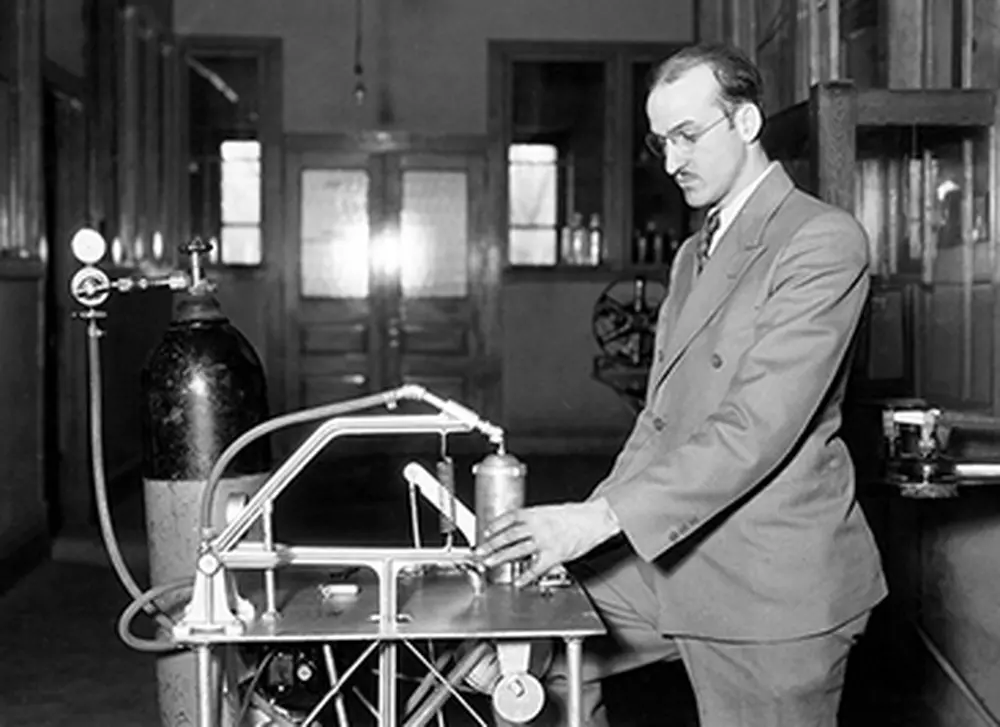
Charles Getz demonstrates his instant whip cream machine at Illinois in the early 1930s. (Image courtesy of University of Illinois Archives.)

Just in time to put those New Year’s resolutions to the test, Thursday is National Whipped Cream Day—a date that’s particularly sweet at Illinois.

While the day falls on the birthday of the late Aaron “Bunny” Lapin, who founded Reddi-wip, a big dollop of credit for one of the most popular dessert toppings goes to Charles Getz (BS, ’32; MS, ’34; PhD, ’38; chemistry), who was a graduate student at Illinois during the Great Depression when he discovered that milk infused with pressurized carbon dioxide began to foam.

Getz was researching food preservation at the time, but he sensed more tasty potential in the foaming milk. Working with chemistry professor George Frederick Smith, Getz experimented with pressurized gas on cream and determined that nitrous oxide was ideal for the process, as carbon dioxide created a bitter taste.

The result? “Portable” whipped cream. Getz patented the method, which Smith, with help from his brothers, used to develop a product called Instantwhip, the first aerosol whipped cream, in 1933. The product, of course, proved successful in restaurants, ice cream shops, and soda fountains, and it became the foundation of Instantwhip Foods, which still operates out of Columbus, Ohio.


Read article: Team simulates a living cell that grows and divides
Team simulates a living cell that grows and divides
 By simulating the life cycle of a minimal bacterial cell — from DNA replication to protein translation to metabolism and cell division — scientists have opened a new frontier of computer vision into the essential processes of life.The researchers, led by...
Read article: Empowering teaching for today's world
Empowering teaching for today's world
 Following a successful launch, the LAS Academy for Educational Excellence looks forward to continuing its New Faculty Teaching Program to...
Read article: Shrinking the carbon footprint of chemical manufacturing with lasers, solar radiation
Shrinking the carbon footprint of chemical manufacturing with lasers, solar radiation
 Researchers have found a way to use solar energy to power a key chemical reaction that drives many manufacturing industries. This new method can significantly reduce the energy required to run these operations, eliminate harsh oxidizing byproducts, and minimize carbon emissions.Olefin...