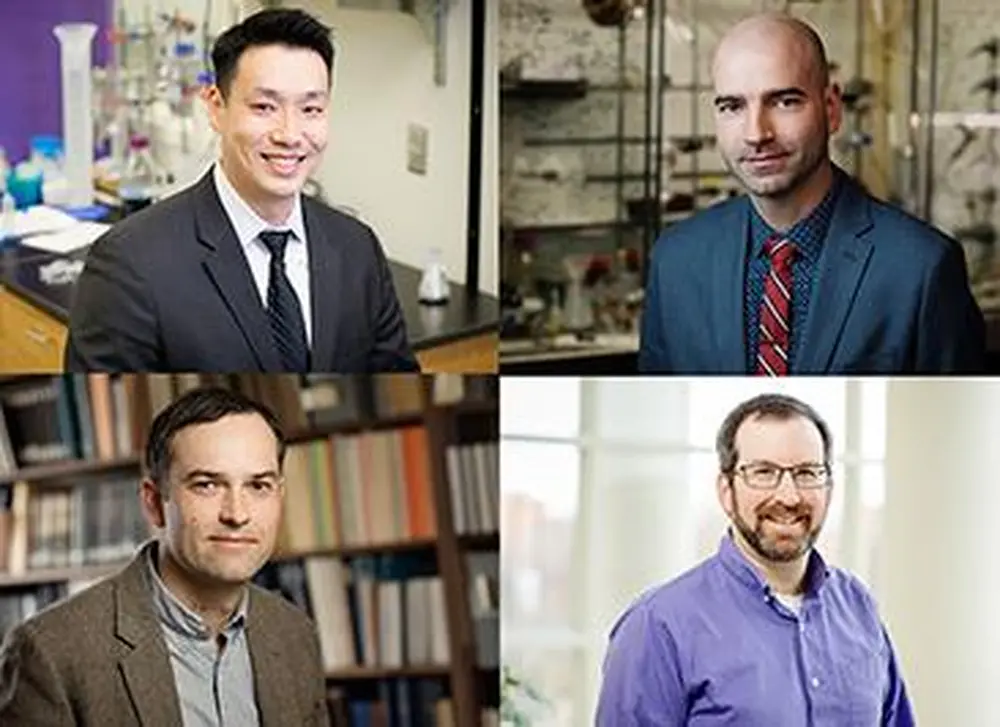
Four researchers from the College of Liberal Arts & Sciences are recipients of 2017 Sloan Research Fellowships from the Alfred P. Sloan Foundation. According to the foundation, the awards “honor early career scholars whose achievements mark them as the next generation of scientific leaders.” Awardees receive $60,000 to be used as they wish to further their research.
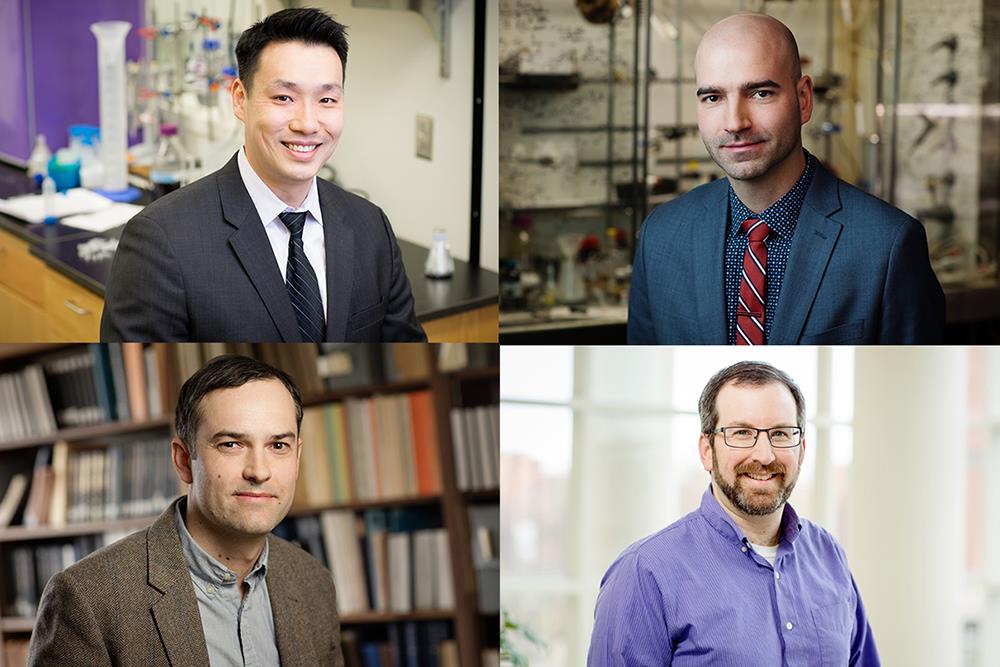
This year’s Illinois recipients are astronomy professor Joaquin Vieira and chemistry professors Jefferson Chan, David Sarlah, and Josh Vura-Weis.
Vieira, a graduate of the University of California, Los Angeles, received his Ph.D. from the University of Chicago and joined the Illinois faculty in 2013. He is an observational cosmologist who builds telescopes and cameras to study the cosmic microwave background and the evolution of the universe.
Chan, a graduate of the University of British Columbia who received his Ph.D. from Simon Fraser University, joined the Illinois faculty in 2014. His research focuses on the development of chemical probes for the early diagnosis of cancer. He uses photoacoustic imaging as a noninvasive method to study malignancy and metastasis in the body’s organs and tissues.
Sarlah, who received his Ph.D. from the Scripps Research Institute, joined the Illinois faculty in 2014. His research involves the chemical synthesis of biologically active natural products and the development of novel methods with applications towards chemical biology, materials science and medicine.
Vura-Weis, a graduate of Stanford University, received his Ph.D. from Northwestern University and joined the Illinois faculty in 2013. He uses advanced laser techniques to study the excited-state electronic and vibrational dynamics of inorganic and organometallic systems.