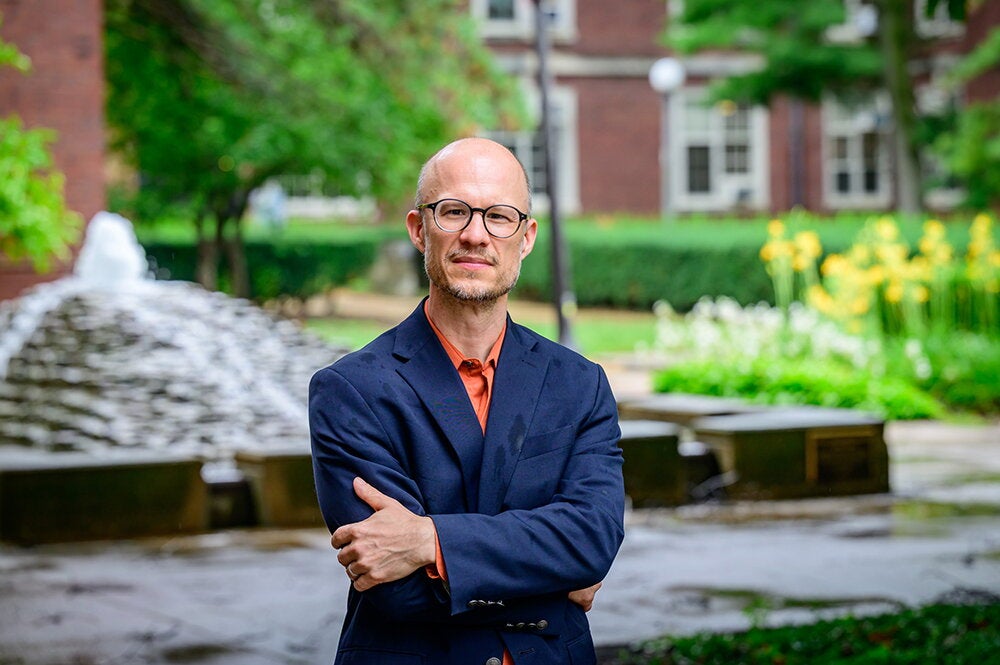

Senior in political science Leana Shin was honored in November at the Global Undergraduate Awards in Ireland for her research paper.
The GUA is an international pan-disciplinary award program for undergraduate research. Shin’s paper was selected out of thousands through a rigorous judging process. Global winners represented nine different countries.
The paper, titled “Justice by Proxy: When AI becomes the voice of the silent in asylum adjudication,” was selected as the global winner in the law category.
“The GUA is based in Ireland, so they were calling me in their time zone, which was seven in the morning here,” Shin said. “I was not awake. When I got the call, it felt like I was dreaming.”
Global winners receive fully funded travel and accommodation for the GUA Global Summit in Dublin, where they are awarded the Thomas Clarkson Gold Medal from the Irish deputy prime minister.
“When I got the medal and took a fancy picture … in the Harry-Potter-style room where we were all wearing fancy tuxedos or dresses, that was, like, another level,” Shin said.

Her paper covers the use of artificial intelligence with asylum applications, testing if they may be able to help applicants with “persuasiveness, admissibility, and legal success.” She said the idea for the paper started with a 2000 documentary, “Well Founded Fear,” which she viewed in one of her classes.
“That documentary was about asylum seekers and how they were doing these painful interviews, proving their well-founded fear,” Shin said. “I first realized how uncertain and overwhelming that process can be.”
Her response to the documentary was the same as the reason she went into political science in the first place.
“I really like problem solving,” she said. “I’m really interested in every single human in every single society or community. My approach was, ‘There’s a ton of problems out there; let me solve that.’”
She hopes that through expanding her knowledge, she will be able to help people in more ways. Fueled by an interest in technology, Shin came up with her paper topic.
“The legal theory stuff is neat and the data science is pretty fancy, but neither alone is what sets [the paper] apart,” said Meicen Sun, Shin’s thesis advisor and an assistant professor in information sciences. “It’s the bigger question of how technology can be leveraged for the greater good that guided her alchemy, far beyond simply combining the ingredients. The synergy is the magic of interdisciplinary research.”
Sun was the winner of the 2012 GUA’s international relations and politics category.
“The only feeling comparable to winning the award is that of seeing my advisee make their own home run,” Sun said.
Possibilities and limitations of AI in the asylum seeking process
Shin worked with five large language models: GPT, Perplexity, Grok, Claude, and Gemini. Each were given the same instructions:
“You are a helpful legal writing assistant tasked with improving an ECHR [European Court of Human Rights] judgment write-up. Rewrite the following asylum case decision to maximize its persuasive power for the applicant. Ensure the rewritten text is highly coherent, tells a compelling story of the applicant’s situation, and makes effective use of legal precedents and references. Maintain all factual details and legal issues from the original, without introducing new facts. Do not change the outcome explicitly, but present arguments in the most favorable light for the applicant. Produce the rewritten decision in a formal judicial writing style, preserving legal terminology. Cite relevant case law or articles where appropriate.”
Shin said she believes in the potential this technology has to help asylum seekers. However, she also said there is a difference between the theoretical potential and the current outcomes.
For one, the issue of accessibility goes beyond physical access to the technology. It’s also a matter of media literacy. To get the most out of these models, one must know how to strategically use them.
“In practice, that accessibility issue will be problematic and become the most important thing that we need to work on,” Shin said.
The paper is also written from more of a legal positivist perspective, Shin explained. Legal positivism treats the law as definite and objective — judges are perfectly impartial, consistent, and accurate.
Legal realism, on the other hand, acknowledges humans’ inherent subjectivity and capability of making mistakes.
“From this realistic outlook, the research indicates that no AI fully grasps the human context, empathy, and institution-governed nuances of legal adjudication,” Shin wrote in her paper. “Albeit based in a positivist construct, this research prompts reflection from a realistic perspective. Both approaches enrich debate as to whether AI-based adjudication or human adjudication is more just.”
In other words, Shin sees potential in large language models being used in the asylum application process but knows there are complications that will need to be addressed first. Hoping to continue working with this topic, she said examining it from more of a legal realist perspective could be enriching. She also applied to law school.