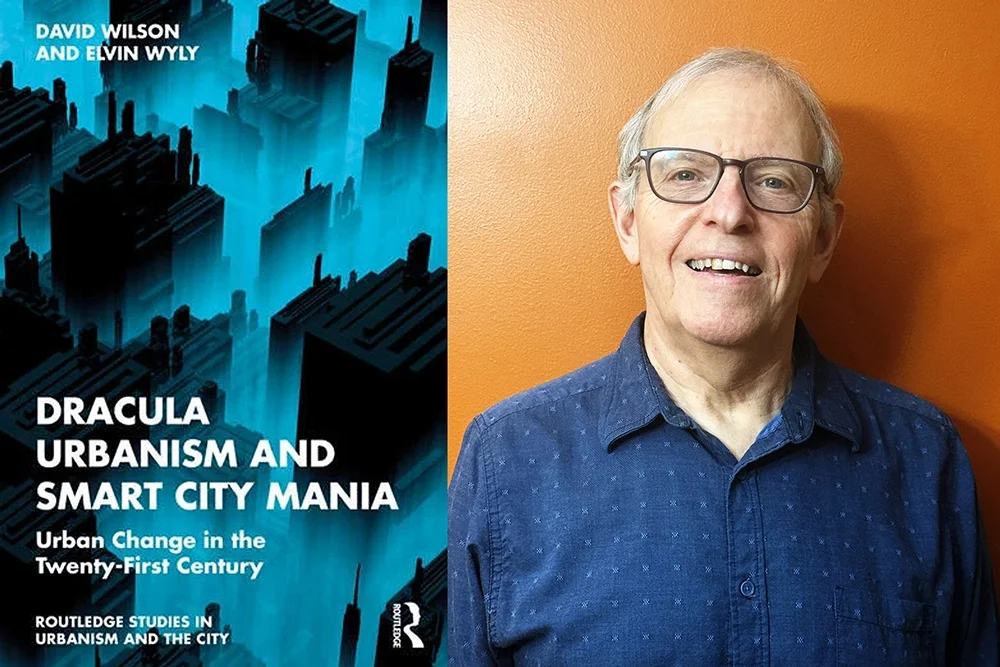
City development is increasingly associated with creating “smart cities” that use technology for managing city services, home construction and attracting resources. But those strategies come with negative consequences to a city’s poor residents, said David Wilson, a professor of geography and geographic information science.
Wilson is a critical urban geographer whose research interests are political economies, city growth and how policies create gentrified neighborhoods and poverty communities. He used Dracula as a metaphor to explore the dark side of smart city development in his new book “Dracula Urbanism and Smart City Mania: Urban Change in the Twenty-First Century.” The book is co-written with Elvin Wyly, a geography professor at the University of British Columbia.
Many geographers are using monster metaphors “to help understand the complicated nature of how cities are developing and redeveloping,” Wilson said. “There is so much extolling the virtues of what smart cities can deliver. It’s a very politically contrived kind of narrative. We’re interested in unearthing the underbelly of smart city development.”
Smart city development started with a focus on infrastructure and transportation networks and how technology could be used to minimize climate change, he said. But more recently, smart city development is linked to real estate development ― creating smart neighborhoods and communities through technologies such as street surveillance strategies to protect residents and smart construction that allows the control of the environment of homes or buildings through an app.
Wilson said this has led to what he calls the “real estate state,” or the growing connection between government and real estate interests.
“Governments more and more believe that economic development should pivot around real estate growth and development. That means growing gentrified neighborhoods and creative class communities and trying to bring in new populations of upwardly mobile professionals and building communities for them,” he said. “The concept of the real estate state looks at government and real estate interests as one powerful institution.”
This view of urban development values private markets and deregulation, and it prioritizes property development and deepening the tax base to eliminate blight and to fuel economic growth. City officials see themselves in global competition with other cities to attract jobs and investment capital, and smart city development is a way to do so, Wilson said.
Such development is executed through gentrification of neighborhoods, revitalizing downtowns, increasing commercial development and building communities for a creative class of professionals.
“The built environment communicates who this city should be for,” he wrote.
Wilson uses Miami and Mexico City as case studies for smart city development practices. He said the dark side of such development is the further fracturing of cities, making divisions between low-income neighborhoods and middle- and upper-class neighborhoods more pronounced and pushing poor residents out of the city under the auspices of economic growth. The poor, particularly immigrants, have their city citizenship questioned because they are identified and imagined as not sufficient contributors to the economy, he said.
“It’s not a conspiracy. It’s a phenomenon of how smart city development is unfolding. It’s simply following the logic of how cities should grow in this day and age,” Wilson said.
The relationship of smart city development to Dracula includes the vampire’s use of gothic decay as a seductive strategy to lure victims, Wilson said. Cities focus on decaying neighborhoods for gentrification because of their low property values and redevelopment costs. Another Dracula parallel is the parasitic relationship between cities and the institutions providing funding for development projects, he said.
Wilson said the repercussions of urban development were apparent decades ago, especially in the U.S. He cites the example of programs in 1980s New York City under then-mayor Rudy Guiliani that targeted the poor.
Today’s development practices are aimed at creating opportunities to attract wealth and resources to cities, rather than directly targeting the poor, but the consequences are similar in punishing the poor, working class, recent immigrants and the homeless populations, Wilson said.
“Seemingly progressive, cosmopolitan urbanism … must be understood as extensions and modifications of decades-deep capitalist inequalities that currently meld into normalized, ritualized protocols of city building,” he wrote.
Additionally, the low-wage workers being pushed out of cities are essential for the service, fast food and tourist economies that proliferate there, he said.
The book also chronicles resistance to gentrification on Chicago’s South Side. Wilson wrote about a blues club in Bronzeville, an area that has been declared a smart district. Properties around the club are being improved and the club’s owner has made changes that include cover charges and serving fine wines and craft beers to the increasing number of patrons from Chicago’s more affluent north side and suburbs and tourists from abroad.
“It’s a mistake to think that people on the ground are a passive force in the face of losing their homes, their blues clubs, what they cherish. Resistance in these cities takes many forms,” Wilson said. In Chicago, “longtime clubbers wanted to keep (the blues club) as a working class African American club.” Their strategy to communicate to the club’s owner their displeasure at the changes was to use humor and sarcasm and lampoon the behavior of the new patrons of the club, he said.
Mexico City has a long history of political activism and there have been protests against the displacement of poor residents in that city, Wilson said.
He said he hopes the book will encourage city planners to become more aware of the consequences of the focus on growth and smart city development on poor residents.