Researchers have found a way to use solar energy to power a key chemical reaction that drives many manufacturing industries. This new method can significantly reduce the energy required to run these operations, eliminate harsh oxidizing byproducts, and minimize carbon emissions.
Olefin epoxidation is not a process many are familiar with, but the epoxide chemicals it produces are the backbone of the textile, plastic, chemical, and pharmaceutical industries. However, the current industry-standard process uses harsh peroxides to facilitate oxidation reactions, which are difficult to dispose of safely and emit carbon dioxide. Water can be used as an oxidant instead of peroxides, but H2O bonds are difficult to break, requiring high-temperature conditions, making it highly energy-intensive and further contributing to CO2 emissions.
A greener alternative could significantly shrink the industry’s carbon footprint.
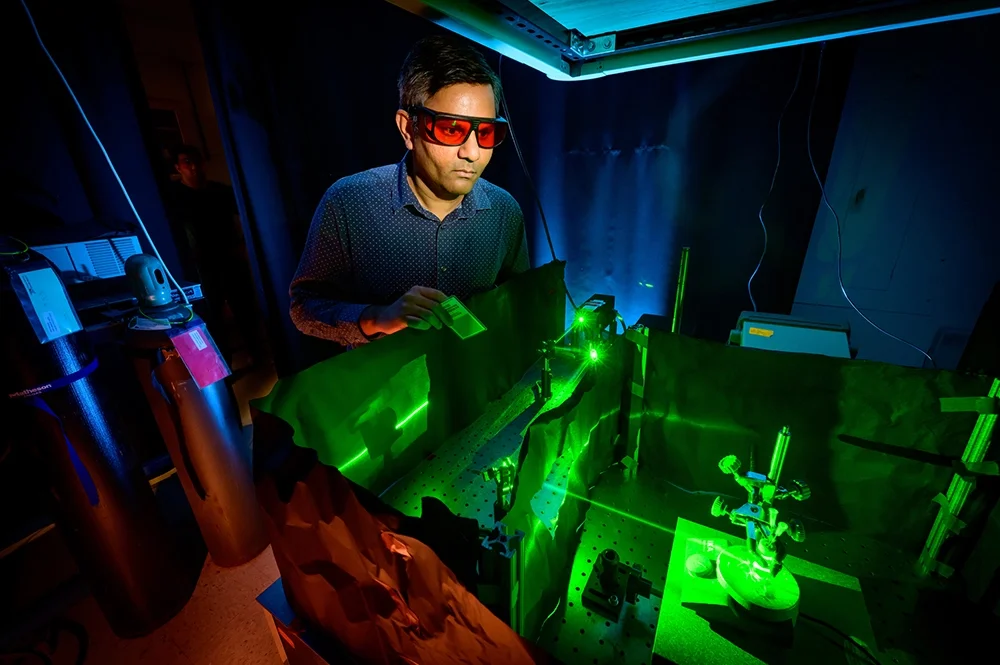
University of Illinois Urbana-Champaign chemistry professor Prashant Jain’s research group is recognized for its work using solar energy as a power source in a process called plasmonic chemistry to help green up industrial processes. Using this process to recycle inorganic carbon dioxide into chemical fuels is one of the group’s hallmarks.
"If successful, we knew that our new methodology could mark a significant advance in both the chemical manufacturing industry and in the study of electrochemistry in general."
“Boosting electrochemistry with light energy, a relatively new concept developed around 2018, was first applied to ammonia synthesis and CO2 reduction with promising results,” Jain said. “The current study is the result of hypothesizing that this technique could apply to industrially relevant epoxidation reactions. If successful, we knew that our new method could mark a significant advance in both the chemical manufacturing industry and in the study of electrochemistry in general.”
The new study, led by Jain, Susana Inés Córdoba de Torresi at the Universidade de São Paulo and George Schatz at Northwestern University, is published in the Journal of the American Chemical Society.
A standout contribution to the new study, led by former Illinois researcher and co-author Lucas Germano, is the use of light-absorbing “antenna” catalysts made from gold nanoparticles and manganese oxide nanowire electrodes. This design combines the power of electricity and energy from visible-light photons to break the H-O-H bonds in water, effectively turning water into an oxidant without requiring high-temperature heating.
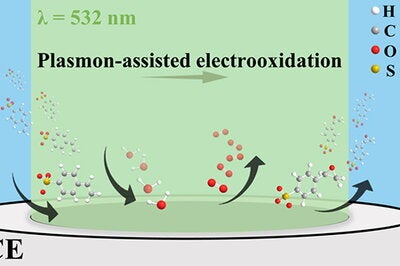
“Visible light photons, supplied by laboratory-scale lasers, are absorbed by these nanoparticles, inducing strong electric fields and energetic charge carriers, which weaken the strong O-H bonds in H2O and the double bond in styrene,” Jain said. “The weakened bonds allow O atoms to be plucked out from H2O and added across the double bond to form an epoxide in a marvelous reaction catalyzed by light.”
Jain said that although their laboratory demonstration offers a solution to an important problem, scaling it up for industry will be challenging. The next steps will be to replace lasers as the main light source with scalable, energy-efficient light sources, to better control light-driven reactions to prevent overoxidation, and to engineer large, light-accessible electrolyzer systems that scale up the activity observed in lab-scale reactors.
The National Science Foundation, São Paulo Research Foundation and the Department of Energy supported this research.
Jain also is affiliated with the Materials Research Laboratory, physics, and the Illinois Quantum Information Science and Technology Center at Illinois.