

Eduardo García-Molina, professor of classics, was introduced to his future career through video games.
“That’s how I got into antiquity,” he said. “It wasn’t through Homer or anything like that. It was playing Rome: Total War.”
Playing this game as a grade-schooler, he learned of the Seleucid Empire. He said it stood out to him because the empire’s roster in the game was extremely powerful and varied.
“Not a lot of people, even in the field of classics and ancient history, know about them,” he said.
The Seleucid Empire was a Greek state during the Hellenistic period. It covered a sizable stretch of land containing what is now Iraq, Iran, Afghanistan, Syria, and Lebanon, but Alexander the Great and the Romans tend to overshadow it in history.
Now, the Seleucid Empire is García-Molina’s primary area of research, and he teaches a course on classical civilization in video games.
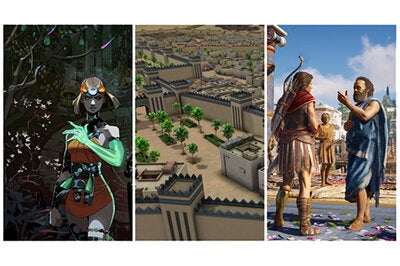
“It’s a media studies class,” García-Molina said. “It’s just like Greek and Rome in film, but a new medium. A more interactive medium. But you still get the same questions. How does this medium portray - antiquity?”
The connection between video games and classical history goes back to the dawn of video gaming, García-Molina explained. One of the first strategy video games was a resource-management game set around 3500 BCE, called The Sumerian Game. Fourth grade teacher Mabel Addis designed it to teach basic economic theory. Released in 1964, it was played on the IBM 7090.
Video games have come a long way since those text-based games. Modern technology allows a whole new level of detail. Addis likely did not need to consider how she would depict ancient Sumerian pottery, or what colors of dye were available, or what the architecture looked like. A modern high-detail game emphasizing an immersive world experience does.

“[Game developers] have to think about these things in the ancient world that you wouldn’t have thought about,” García-Molina said. “People are still shocked when they download Assassin’s Creed and start playing it, that the ancient statues are painted.”
Avery Liams, a sophomore taking the class, said that she’s learned how video games can immerse you in history.
“We do pretty much the same stuff you would in a film studies class, except we actually are more involved because it’s a video game,” she said.
Liams said the class time of 9:30 a.m. might usually dissuade her, but not for this class.
“It’s probably my favorite class this semester,” she said.
When asked if there was anything video games tend to get wrong about ancient civilizations, García-Molina said there are some things he does not necessarily consider “wrong,” but finds interesting.
“It’s really interesting to see how modern expectations of monotheistic religions bleed into how games mechanize how ancient religion worked,” he said. “Ancient religions didn’t work like that. They were polytheistic. It was much more porous, the boundaries between deities.
“This is why, for example, you have the Greeks going into Egypt and seeing Anubis. Who’s this guy? He guides souls to the underworld. That sounds like Hermes. Then, in the Roman period, you get Hermanubis, which is basically the body of Hermes and the head of Anubis.”
García-Molina said the practical or ideological reasons for these discrepancies between what we know about ancient civilization and how a game developer represents them is worth examining.
To get students thinking in detail about the ancient world, the final project for García-Molina’s class is a video game pitch. Students give a presentation on their hypothetical game and write about how they incorporated scholarly evidence into the game design.
“It forces you to think about questions that you wouldn’t think about,” García-Molina said. “That’s the overarching goal of this project and the class.”
Intriguingly, the games students came up with did not fit the typical sorts of video games based in these ancient civilizations, like games where the player is managing an empire or focused on building the best army.
“Students have been mostly interested in the everyday experiences of people, instead of Caesar Simulator 101 or something like that,” García-Molina said.
One student proposed a cooking game where the player serves the Greek gods. García-Molina said they considered the economics and biological sampling of Greece, used ancient Greek recipes, incorporated divine nectar, and even considered how gods who were not native to Greece might want different cuisine.
Another student proposed a game where the player is a clothier in the Persian Empire, incorporating how different regions had different styles, materials, and colors of cloth.
“For example, in Phoenicia, they were well known in antiquity for grinding up this particular type of sea snail, and that’s how you got purple,” García-Molina said. “They became highly specialized and the labor was intensive, so purple had to be imported from that region in Phoenicia.”
Telling the story of everyday people in these ancient civilizations sometimes comes with the challenge of not having good records to study.
“This is one of the incredibly difficult things when studying ancient history, because so much of our sources are written by the elite male class, that we’re kind of blindsided when it comes to narratives about underrepresented groups,” García-Molina said.
Studies suggest video games where the player takes the perspective of a character can increase the empathy the player feels towards the character. When playing a perspective-taking game, the player becomes the character. They move through the world, communicate with others, and make decisions as that character.
As García-Molina put it, “You are a thing in the world itself.”
That level of closeness the medium offers is believed to help players better understand people with different experiences. García-Molina’s students’ focus on the everyday person in ancient civilization — people whose stories were often not told — plays into that same idea.
“You’re not going to get a movie about that,” García-Molina said. “[Christopher Nolan] is not going to direct ‘the plight of the everyday stonecutter.’”
The video game medium also presents some challenges for instruction, though. The course examines a lot of games, and some of those games can be in the higher-cost range. Plus, some games require high-powered PCs to run.
“That was one of the big concerns,” García-Molina said. “How do we expose these students to these games without getting them to purchase them, because we don’t want that. Academic books are already expensive; why add a Steam library to the equation?”
Fortunately, García-Molina said the university has been supportive of getting students the access they need. Game Studies and Design faculty helped with the course creation, and Illinois Computing Services helped with setting up the computers in the Armory lab where the class was held.
“We have a departmental Steam account … and five computers dedicated to having all those games in the computer lab, so students can go whenever they want,” he said. “They can play the games in actuality, alongside me presenting the games in class.”
García-Molina also recommends playthroughs on YouTube and wikis with extensive information on game details. But he can see the students are taking the time to play the games themselves, based on the hours logged in the department Steam account.