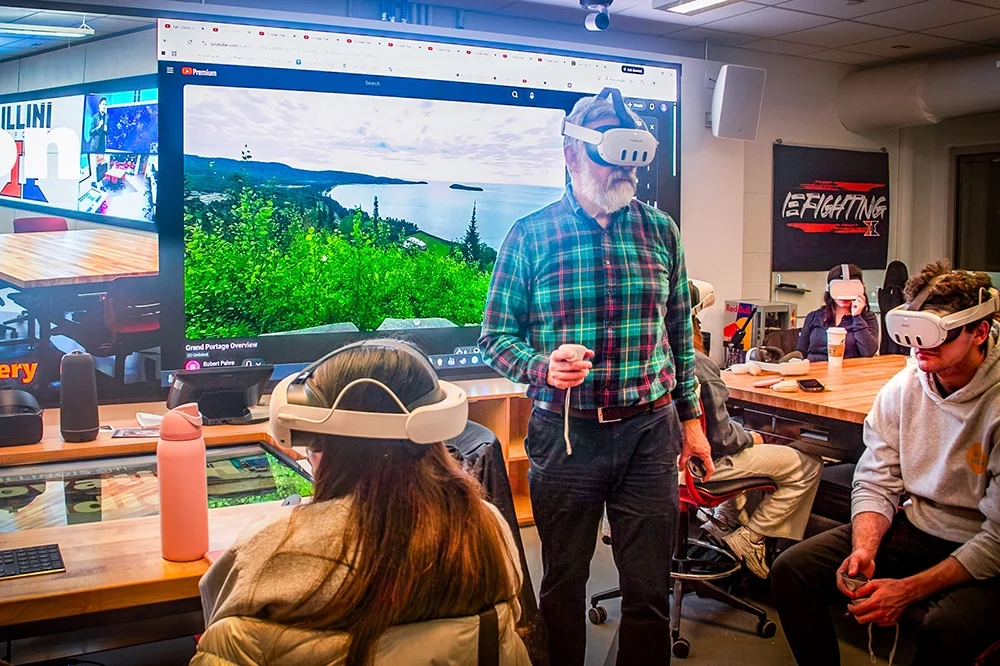
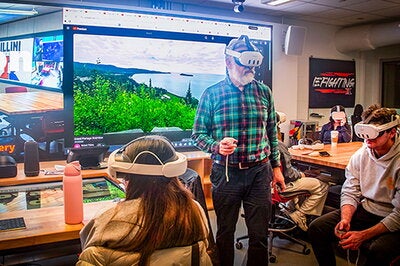
It’s a cold February day in Illinois, but I’m enjoying the view of a backcountry trail in Yellowstone National Park. I see a sunrise over Heart Lake, a lodgepole pine forest, a geyser basin, the yellow leaves of aspen trees above a canyon along the Snake River and views of Mount Sheridan.
I’m experiencing this wilderness while sitting in a studio at the Center for Innovation in Teaching and Learning at the University of Illinois Urbana-Champaign. I’m surrounded by students wearing virtual reality goggles, all of whom are part of political science professor Robert Pahre’s Environmental Politics and Policy class.
Pahre also teaches Politics of the National Parks, and he is currently developing a course on Environmental Politics of the Midwest. He uses VR videos to allow his students to see wilderness sites.
Pahre is an experienced backpacker, and his Politics of the National Parks course previously included an optional summer field trip to Yellowstone National Park. While it was a great experience for students, Pahre recognizes that it limits who can participate. “The trip raises serious accessibility issues,” Pahre says. “Lots of students need to work all summer. Internships don’t let students take time off. Some students have physical limitations that make this impossible too.”
Some of the locations he visits are quite remote. The Yellowstone trail we are watching him hike features Heart Lake and the headwaters of the Snake River. While Heart Lake is eight to 10 miles from his car, we also see his remote campsite that is 25 miles from his car.
“The number of people who are willing to do something like that is very small,” Pahre says, estimating that the remote campsite where he stayed gets a few hundred visitors per year out of Yellowstone’s 4 million annual visitors.
I watch with my VR goggles as Pahre shows how he hangs his food bags from a bear pole suspended high up between two trees. He discusses safety in bear country — how the cooking area at his backcountry campsite is separate from where his tent is set up and why campers should never burn any food in their campfire. There is evidence of two fire pits that have been dug out, presumably by a bear that smelled remnants of food, Pahre says.
When he teaches his online Politics of the National Parks course, which focuses on Yellowstone, he finds that only a handful of his approximately 50 students have ever visited the park. Pahre says that it is hard to explain some political issues that affect the park without his students seeing the park through the videos.
He developed an online course in 2015, with then-doctoral student Audrey Neville and a team from CITL, that included a virtual field trip to Yellowstone, using traditional format videos of wilderness areas with his electronic textbook. Pahre and Neville first tested the effectiveness of using videos through an activity involving Indiana Dunes. Students either went on an in-person field trip to the dunes or watched videos to learn about the dunes. They found that the students scored the same on tests no matter what experience they had. But, Pahre says, visiting a site in person helps develop a stronger emotional connection with the landscape than does seeing it in a video.
Pahre borrowed a VR camera from the University Library when he began experimenting with filming VR videos and adding them to his online Politics of the National Parks class. He filmed the videos on trips to Yellowstone in 2022 and 2023, using a 360-view camera with fisheye lenses that fits in his shirt pocket. He filmed the videos I am watching in the CITL lab during a September 2025 backpacking trip to the park.
Students can watch the videos online and pan to see a 360-view, but they don’t get the full effect of virtual reality without VR goggles. Students get extra credit for attending presentations in the CITL lab and using the goggles to watch the videos. They write about the experience and give Pahre feedback on the videos. For example, he initially didn’t record narration for the videos, but he started to narrate them while filming because students preferred that. He also sometimes films the videos while walking and sometimes while standing still. He’s learning how much motion might make some viewers feel nauseous.
Other professors on campus are using VR in their courses as well. Madhu Viswanathan, an emeritus business professor, developed VR content on subsistence marketplaces in Tanzania, Honduras and India that is used by educators around the world and experienced by thousands of students. The students in political science professor Rana Khoury’s “Forced Migration and Refugees” class visit the CITL lab to virtually tour a refugee camp for Syrians and become immersed in a fictional story about Syrian displacement. Food science and human nutrition professor Toni Gist says she was inspired by Pahre’s videos to partner with universities in Taiwan and Mexico and create videos that help students both at Illinois and in those places learn about each other’s food and culture.
In his Yellowstone videos, Pahre talks about the geology of the region, with volcanoes and glaciers forming the landscape, and the reintroduction of wolves in the park in 1995. He shows where he fords the Snake River, which he crossed multiple times on this trip, and he describes his methods for keeping his boots dry while doing so.
He is currently developing a new online course, Environmental Politics of the Midwest, and creating VR videos for that course. One shows how a timber harvest is conducted in northern Wisconsin and what regrowth will look like after 80 years, looking at a different site in northern Minnesota. He hopes the VR video will generate an emotional response in students similar to what an in-person visit to the site would produce.
“By using what they see on the screen, they can talk about whether that is what they think of as sustainability,” Pahre tells me.
He also has made VR videos that show two industrial harbors in Minnesota’s Iron Range. One shows major scars around a closed harbor while a second shows how an active factory and port work with their town to create a mixed-use landscape that includes a recreational marina and municipal park. He follows that with a VR walk from the historic St. Louis riverport to a spot underneath the Gateway Arch, illustrating how the city and National Park Service have redeveloped an industrial site as an urban national park.
“I show not only remote destinations but familiar urban parks when talking about the environment in the Midwest,” Pahre says.