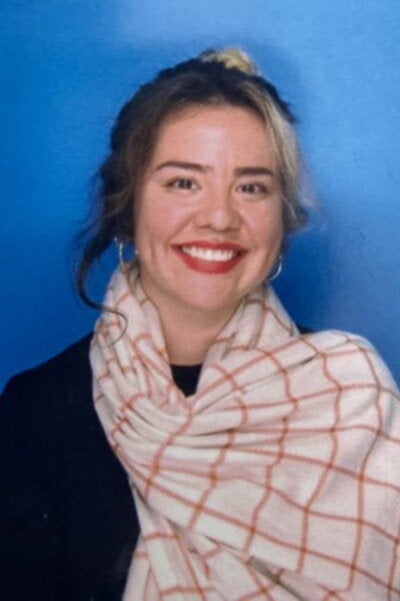
Michelle Patiño-Flores, a sociocultural anthropology doctoral candidate at the College of Liberal Arts & Sciences, works with Black (and) queer artists in Cuba to study their practices of freedom. One medium she uses to tell their stories is photography.
This presents a challenge, however, because public criticism of the government could put her subjects in danger of state violence. Patiño-Flores thus uses creative methods to conceal the identities of her subjects.
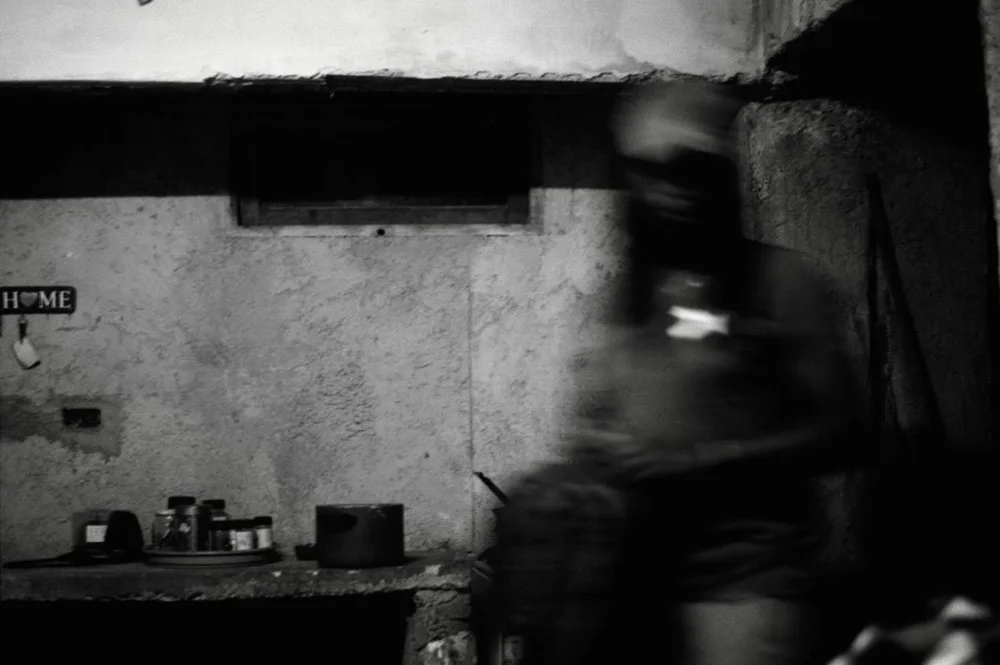
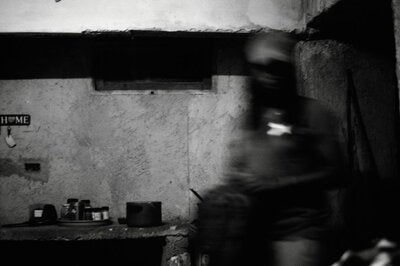
Her photo titled “Visions of Freedom” recently won the Image of Research graduate competition, a contest organized by U of I’s Graduate College and Media Commons. There is a separate competition for graduate and undergraduate students, with the purpose of encouraging students to share their research through creative visuals.
“Visions of Freedom” is a black and white photo of a person in what appears to be a kitchen. The background is still, but the person in the foreground is blurred from motion. This was an intentional move by Patiño-Flores to protect the subject’s anonymity.
Their identity is still preserved for a select few viewers, though. Details like the items in the background of the winning image are recognizable only to those who already know the person. Patiño-Flores protects the anonymity while maintaining the humanity.
“Friends, for example, of my photographed subjects can and do recognize people with relative ease by identifying the items in the picture like a person’s kitchen or a person’s hairstyle,” Patiño-Flores said. “In this way, the photographs are relational since people make meaning out of them by interpellating their friends and kin in them.”
It’s fitting, because freedom is also relational, she said. It takes communal efforts.
“My photographic practice is a kind of solution to the problem of protecting anonymity, and it is also primarily a creative endeavor — a way to express my ideas and feelings in a particular moment in a particular place,” Patiño-Flores said. “The need for my photographs is not to prove things to an audience; they serve my purpose of play, art, and a specific ethical standpoint.”
The style Patiño-Flores uses here emerged from her “wasted” frames when doing photography on film with a broken light meter. With limited rolls of film, she had to be precise with her exposure estimations and be thoughtful with every shot.
“Although I eventually learned to measure it off the cuff, I found those ‘wasted’ photographs very charming, very interesting somehow in their unintelligible shadows and forms,” Patiño-Flores said.
She realized she could play with “fudging” the photos — blurring, increasing shadows, or blowing out light — to conceal the faces of her subjects.
“This method would be incomplete without the intellectual foundations laid by work in and through Black Studies that shapes my own in foundational ways,” Patiño-Flores said. “Most pertinent for the series that my winning image belongs to is Christina Sharpe’s work on Black annotation and redaction.”
Christina Sharpe is a professor of Black Studies and English literature at Toronto’s York University. Patiño-Flores credits her for the techniques she used to protect vulnerable subjects while sharing their stories.
“Among other things, this work challenged me to think deeply about the stakes of representation and substantiated the ‘fudging’ mechanisms I initially played with,” Patiño-Flores said. “Sharpe taught me the power of cropping and ethical composition.”