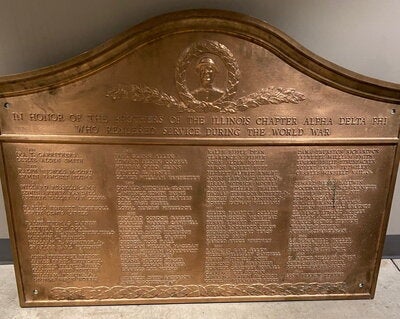
Folger Adam Jr.’s eyes were drawn to the bronze plaque hanging over the fireplace in the dining room. “In honor of the brothers of the Illinois chapter Alpha Delta Phi who rendered service during the World War.” Below, there were many names.
Adam was an LAS student from Joliet, Ill. Enough time had passed since that war — the first World War — for it to be discussed in courses as history. Yet staring at that plaque, at the names of his fraternity brothers from a generation prior, something resonated, because history was repeating itself. A second World War was coming.
Remember that plaque.
The Illinois chapter Alpha Delta Phi was established in 1912 as a social and literary fraternity. They currently fund two creative writing competitions through the University of Illinois English Department, each carrying namesakes with stories of their own.
These stories are built with the limited information available from that time. Not all details can be confirmed. Still, the lore is significant to Illinois Alpha Delta Phi and the university. Bob McMurray (BS, '85, Mechanical Engineering) is a board member of the Illinois chapter who has been working to keep the lore alive.
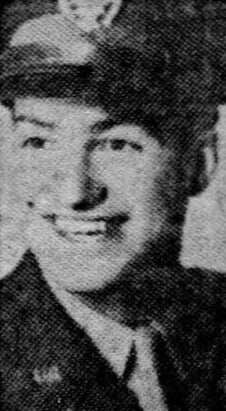
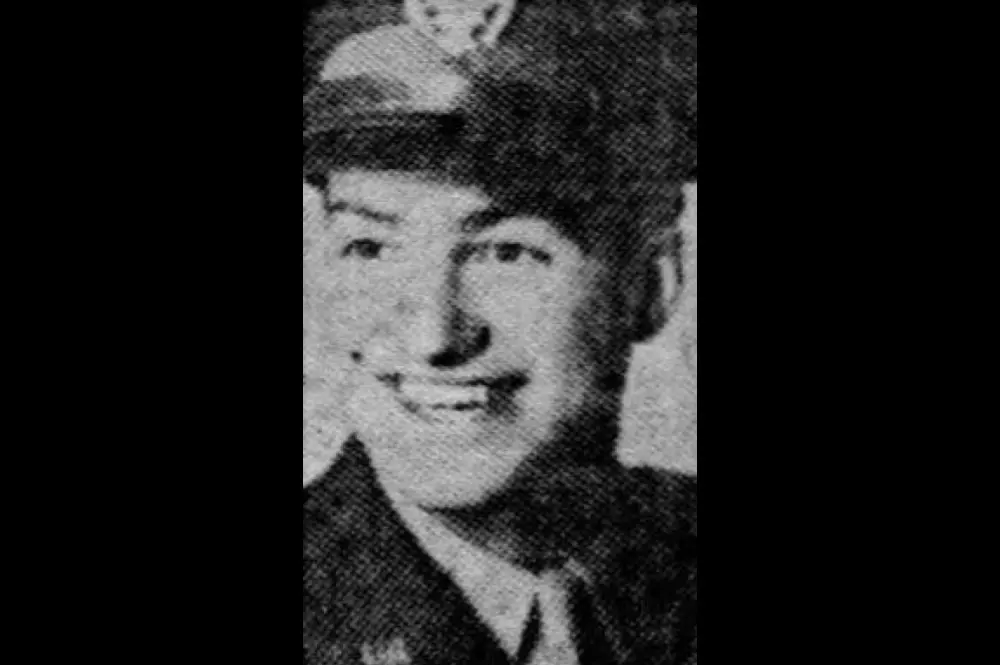
The first of the two prizes is the Folger Adam Jr. Prize for Poetry, named after the student from before. He joined Illinois Alpha Delta Phi in 1939.
“He was a rising poet as an undergrad and recognized as such by the English Department,” McMurray said. “He had at least a warm working relationship with a number of professors … and without that link between Folger Adam Jr. and the professors at this university, this story would have never been told.”
During World War II, Adam served in the U.S. Army Air Force 48th Squadron. He graduated in 1942 and married another U of I alum, Frances Harriet Stone, at some point around that time.
While overseas, he remembered the bronze plaque above the fireplace in the Illinois Alpha Delta Phi house, and he wrote a poem.
Head inclined,
Your hair awash,
Do you contemplate the fish, my friend,
Or the shadows in their lone way across the floor,
All in silence.
There were soft nights in the mow
When the stars and the night,
Unconcerned,
Turned their back,
And returning through the wet grass you wondered:
Is it really so? Can it be?
Tomorrow is a heat of molten bronze
Cooling in a mold of sand,
Bearing names to be forgotten:
“We thrill with pride” and “Let us bow our heads
in prayer.”
Do you find the moment empty
And the banquet cold?
Hold and listen…
For after the scraping of the chairs has ceased,
There may be some mention of your name.
“There are so very many that to read them all…”
(And, besides, the aperitifs grow cold.)
“Perhaps some other time…”
Be content,
For when the metal cools,
Your name will live forever
In honor,
Fastened tightly to a wall.
He slipped the poem into an envelope and mailed it to his professors back at the university. By the time it arrived, Adam was believed to be dead.
“When it got here to the professors, they published it in local periodicals,” McMurray said.
The exact circumstances and timing of Adam’s death are unknown. He was involved with Operation Hailstone, an attack against the Japanese Navy Feb. 17–18, 1944. His reported date of death by the military, which is not always accurate, is several days later at Makin Island.
Adam was one of 10 Illinois Alpha Delts who died in WWII. As his poem foretold, his name was on a plaque alongside the names of his fellow fallen fraternity brothers, to be displayed in the house.
But the brothers who survived were not willing to let those names be forgotten. Thus begins the story behind the second prize’s namesake: John Larimer Rainey.
Rainey served in the war as a navigator for B-17 bombers in the European theater. He survived and returned to Illinois. McMurray explained that Rainey’s name acts as a representative of the whole Illini Alpha Delt class of ‘43 — the class that made sure this history was remembered.
“The class of ‘43 was keenly aware of their brothers who died during World War II, and it is their initial fundraising efforts which have provided the endowment from which our Alpha Delta Phi literary competitions have been funded since their inception,” McMurray said.
They were the first stage in preserving this piece of history, but someone else would need to keep the story alive into the next millennium. That person was Tom Livingston (BS, '90, media studies), a former chairperson of the Illinois chapter.
“It had been kept alive, as an oral tradition, by Alpha Delta Phi's Tom Livingston, who had been the sole keeper of the physical poem since his time as an undergraduate,” McMurray said.
Livingston kept a folder of historical materials — bits of concrete evidence supplementing the story carried down by the class of ‘43, including the poem itself. That folder was eventually handed to McMurray, who has continued working to preserve the lore.
“That oral tradition, and the knowledge that the physical poem had been preserved, passed to me recently, and it is my belief that lore is a critical component of a healthy fraternity,” McMurray said.
As the description for the Folger Adam Jr. Prize in Poetry on the English Department website says, “The Creative Writing Program can think of no more powerful representation of how literature lets us commune with those no longer near or with us. It is fitting that the prize in Adam’s name has affirmed the lives and language of generations of poets after him.”
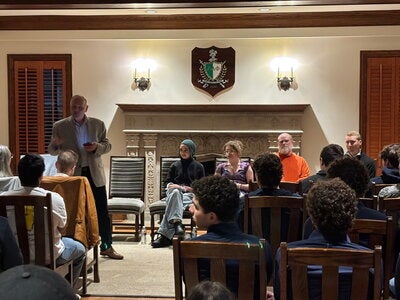
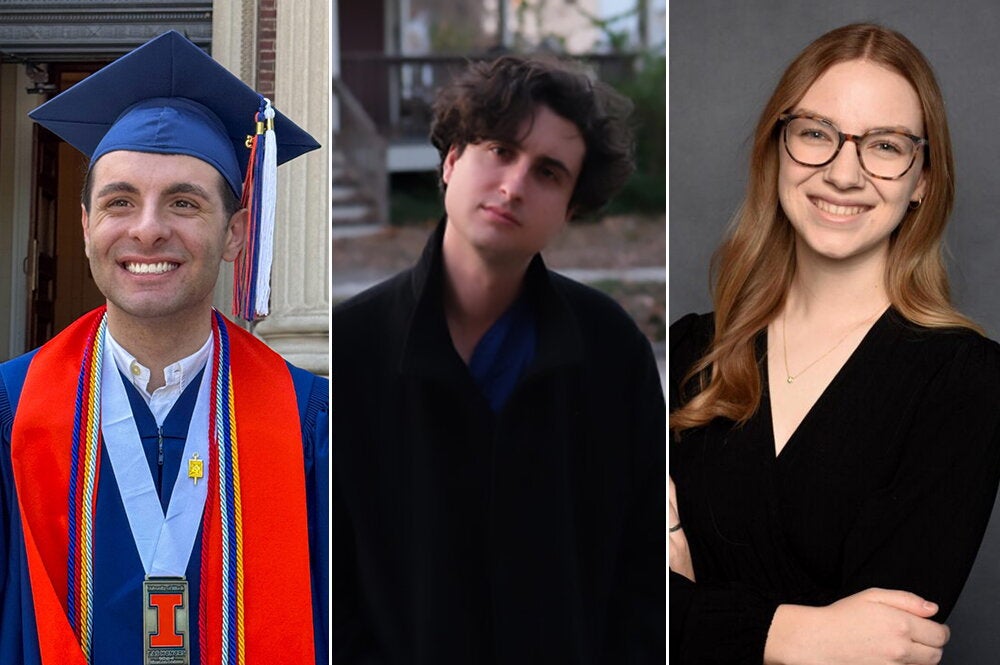
On April 27, this year’s recipients of the Folger Adam Jr. Prize in Poetry and the John L. Rainey Prize in Fiction were honored at the Alpha Delta Phi house on Daniel Street in Champaign.
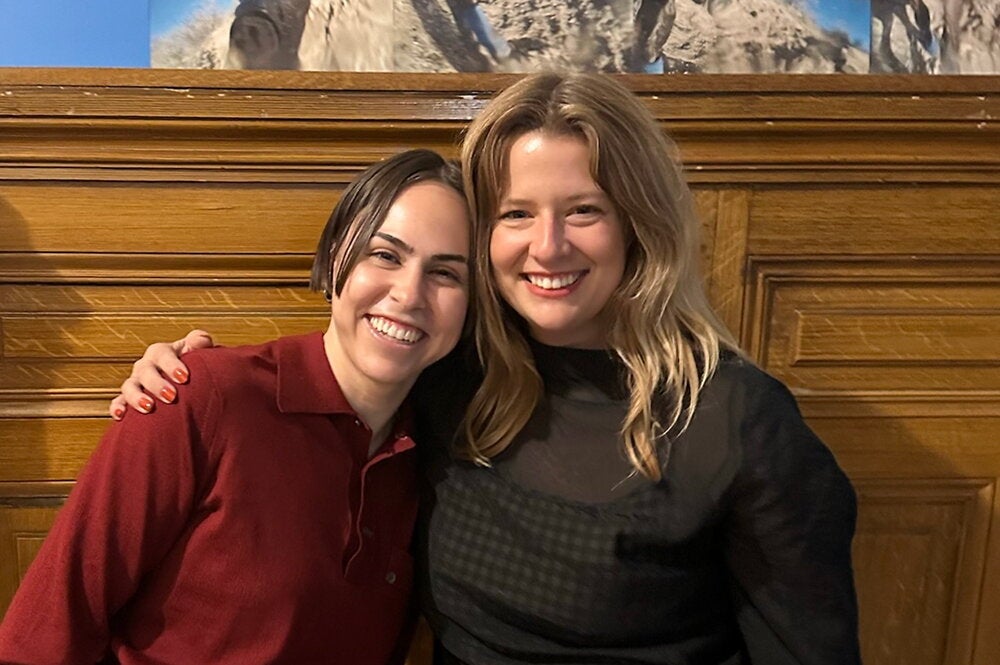
Lama Ghrayeb won the John L. Rainey Prize in Fiction, and Sabrina Longo won the Folger Adam Jr. Prize in Poetry. Longo said McMurray told her about the prize’s history.
“Coincidentally, the story behind the prize aligned with my research interests,” Longo said. “A lot of my time at the university has been spent researching WWII, fascism, and labor histories.”
A new plaque was unveiled at the ceremony as well, featuring Adam’s poem and a brief biography.
Longo said she discussed “the eerier irony of a bronze tablet bearing Adam’s name given the last stanza of his poem” with some other attendees at the ceremony.
While we cannot know how Adam would feel if he could see his name and poem on a plaque today, we can see how important the preservation of his and his fraternity brothers’ memory was to the Illinois Alpha Delts.
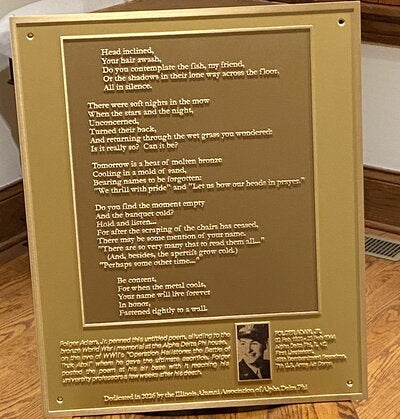
“Memorializing the poem in a plaque was not only remembering its poet, Folger Adam Jr., but the Alpha Delta Phi Class of 1943 whose steadfast honoring of the loss of their fraternity brothers during World War II may be the actual story here,” McMurray said. “They created these Creative Writing awards and their continuing endowment, partnering with the same English Department who originally published Folger Adam's poem, to not only keep the memory of Alpha Delts who gave the ultimate sacrifice, but to help foster the same kinds of artistry within the university's undergraduate population that Folger Adam Jr. expressed during his brief life.”
In his poem, Adam says the names on plaques are forgotten, as there are too many to read. Generations of Illinois Alpha Delts — from the class of ‘43 to McMurray — were determined to make people remember.
“Ultimately, the Alumni Board of Illinois Alpha Delta Phi, and I, want to demonstrate to our newest members that they are now part of a shared experience that is real, and serious, and that they are joining a legacy of creativity, community, and honor,” McMurray said.