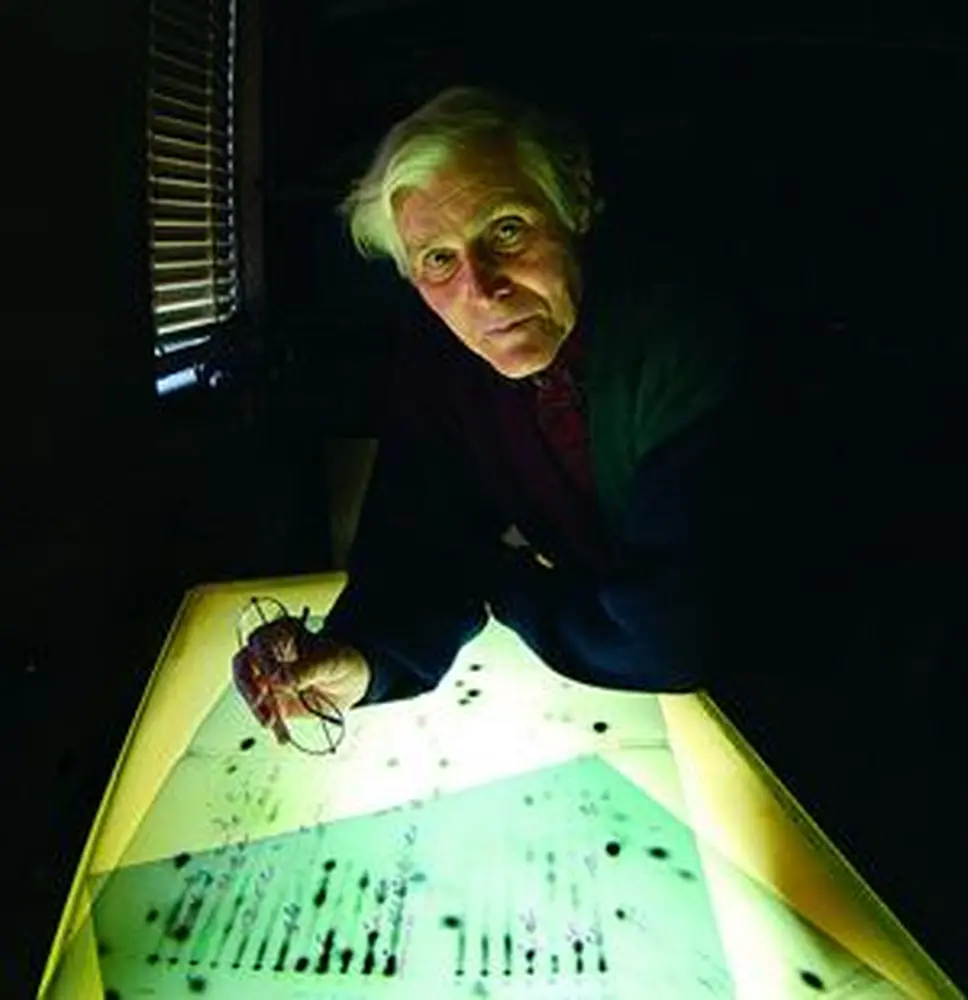
Carl Woese, the microbiology professor credited with the discovery of a “third domain” of life, died Sunday, Dec. 30, 2012, at his home in Urbana, Ill., after a nearly half-century career at the University of Illinois. He was 84.
Woese, who also served as a professor in the Institute of Genomic Biology, adopted a molecular approach to classifying organisms, and in 1977 he and his colleagues reported that the microbes now known as archaea are as distinct from bacteria as plants and animals are, thus overturning universally held assumptions that life had only two main branches—bacteria and everything else.
“Carl was the greatest evolutionary biologist of the 20th century—a true revolutionary,” said U of I physics professor Nigel Goldenfeld, a longtime colleague, collaborator, and friend of Woese. “Beginning as an outsider, he turned a field that was primarily subjective into an experimental science, with wide-ranging and practical implications for microbiology, ecology, and even medicine that are still being worked out.
“The largely untold story of the intellectual struggle he endured, and his years of hard, painstaking work have been a model of how scientific discoveries get made and a source of inspiration to all those whose lives he directly touched, be they scientists, educators, students, or laypeople.”
Woese’s discovery of a new domain of life stemmed from his painstaking analysis of the ribosome, a protein-building machine abundant in all living cells. Rather than classifying organisms by observing their physical traits, as others had done, Woese looked for evolutionary relationships by comparing genetic sequences.
“We are all saddened at the passing of Dr. Woese and our collective thoughts are with his family,” said Phyllis M. Wise, the chancellor of the Urbana-Champaign campus. “It is truly impossible to adequately describe or to categorize his contributions to the University of Illinois, to biology and to the world during his long and distinguished career here. The campus community has lost one of our giants this week.”
Born July 15, 1928, in Syracuse, N.Y., Woese earned bachelor’s degrees in math and physics from Amherst College in 1950 and a PhD in biophysics at Yale University in 1953. He studied medicine for two years at the University of Rochester, spent five years as a postdoctoral researcher in biophysics at Yale, and worked as a biophysicist at the General Electric Research Laboratory in Schenectady, N.Y.
He joined the faculty of the University of Illinois in 1964 as professor of microbiology and has served in that capacity ever since.
Woese received a MacArthur Foundation “Genius” Award in 1984 and was elected to the National Academy of Sciences in 1988. He was awarded the 1992 Leeuwenhoek Medal (microbiology’s premier honor, awarded by the Royal Netherlands Academy of Arts and Sciences) and he received a National Medal of Science in 2000.
In 2003, Woese received the Crafoord Prize in Biosciences, administered by the Royal Swedish Academy of Sciences, which also awards the Nobel Prize. (The Crafoord is widely considered the equivalent of the Nobel Prize for areas of science that fall outside the terms of Alfred Nobel’s original bequest.)
“Carl was truly a man of vision, creativit,y and passion, with a deep love of this university,” said Gene Robinson, the director of the Institute for Genomic Biology. “Carl not only rewrote the textbook in evolutionary biology, but his discovery also has given us the tools today to study the human microbiome, the incredibly diverse and complex assemblages of microorganisms in our bodies that contribute so much to both health and disease.”
Woese is survived by his wife, Gabriella; their children, Gabriella and Robert, who both live in Atlanta; and a sister, Donna Daniels, of New York.