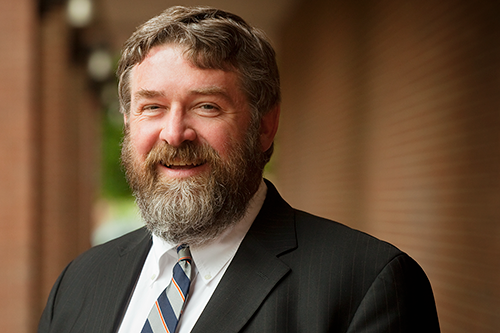
As he was transitioning out of his position as head of the Department of Political Science, Robert Pahre had no idea that his term would end with a surprise gift that would allow him to quite literally “pay it forward.”
At the department’s first ever alumni awards ceremony in April 2019, members of the Board of Visitors, a political science alumni board, announced the creation of the Pahre Fund, which was designated to benefit undergraduate students. There were no other requirements attached to the fund; the board wanted Pahre to be the one who decided how the money was used.
“They were leaving it open for me to decide what was meaningful for me, because the most important thing in gifts and honors is what's meaningful to the person involved,” Pahre said. Off-campus courses have long been meaningful to Pahre, and it took him a couple of months to ponder how the fund might help.
As those months passed by, the idea finally came to him.
“I thought, ‘Well what isn't being funded? Where's the gap?’ And the gap is the infrastructure,” Pahre said.
Before someone teaches a class, there could be many things an instructor needs to do to make sure the class runs as smoothly as possible. For example, in political science, students have the opportunity to take classes that take place off campus.
Pahre has taught classes about national parks that actually bring students to national parks. Drivers are often needed, which the Pahre Fund could help pay for. With the Pahre Fund, instructors can prepare for these classes by going out to the location before the class starts. Other possibilities for the fund include supporting teaching assistants or acquiring class supplies.
“That's the gap that benefits students, which I care about a lot,” Pahre said. “But it benefits students in a nonobvious way.”
Having studied abroad in Vienna during his own undergraduate years, Pahre said those kinds of experiences can be academically and personally transformative for a student’s learning.
“Hopefully people will come up with ideas for off-campus programs that I have not imagined,” Pahre said. “There's the stuff that you imagine personally and then there's the stuff you can't imagine personally. And the stuff that I can't imagine is more interesting because I haven’t imagined it myself.”
John Beck (BA, ’71, political science; MA, ’74, journalism), who was president of the Board of Visitors when it created the Pahre Fund, said that the Pahre Fund is one initiative of several that the board has taken recently to support undergraduate study in the department. Another initiative includes a mentoring program for undergraduate students to meet with and be mentored by political science alumni. The next session of this program is scheduled for October.
Beck said that the board members believe that Pahre is particularly interested in furthering the department in terms of students, faculty, and other resources.
“I certainly think Bob deserves some recognition in terms of a scholarship with his name on it, for the job that he did in the five years as department head," Beck said.
To learn more or support the Pahre Fund, visit here.