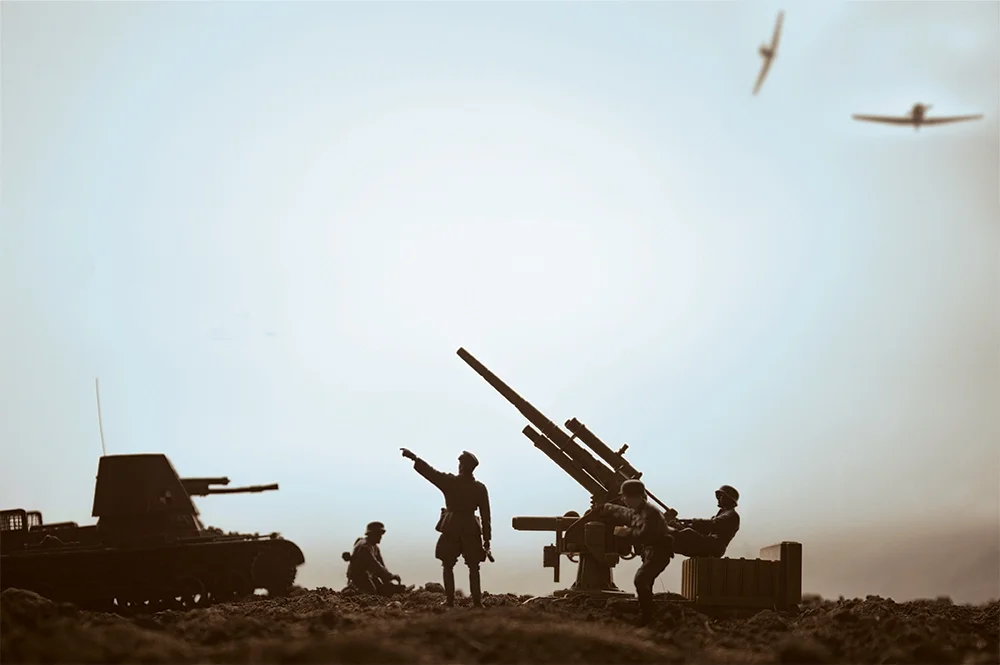
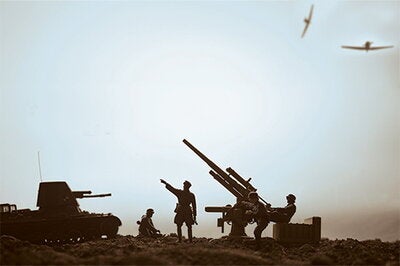
World War II became a global war in 1942, after Japan attacked Pearl Harbor, drawing the U.S. into the war. All the world’s most powerful nations were at war with one another, and the fighting spanned the globe.
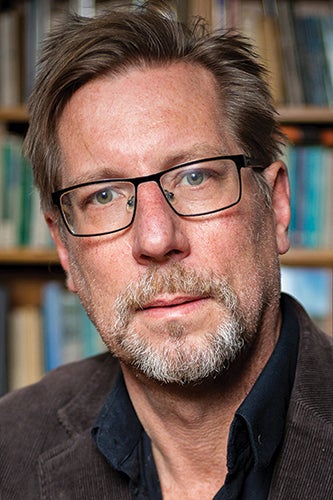
But the war was global in other ways too — in the unifying idea of a fight for freedom, in the struggle against imperialism and racial injustice, and in the migration of workers and refugees. W. D. and Sara E. Trowbridge Professor of History Peter Fritzsche wrote about the significance of the events of that year in his new book, “1942: When World War II Engulfed the Globe.”
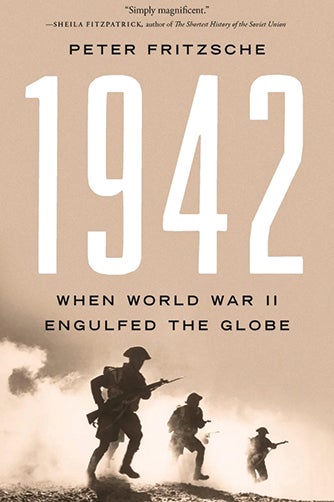
The book portrays what a world at war was like and how it impacted people on both the battlefields and the home front. Half the world’s population was involved as soldiers, laborers or refugees, Fritzsche said. The fight against fascism became a symbol for racial, religious and ethnic struggles at home — what Fritzsche calls “second fronts” or “parallel wars.”
Japan’s victory in Singapore, a British colony, in February 1942 affected race relations from South Africa to the U.S. India was fighting for its independence, and Mahatma Ghandi was one of the most-watched figures in the world at the time. There were resistance movements in Malaya, Burma, the Philippines and Nigeria.
In the U.S., Black Americans wanted more freedom, while white Southerners wanted freedom from government intervention, and white South Africans opposed anything that might lead to something other than white rule, Fritzsche said.
“Nigerians said, ‘If we’re fighting for the British to save the Poles from the Germans, why shouldn’t we be fighting for our independence?’” he said.
“People should be at liberty to decide their futures. This idea of self-rule metastasizes and is expanded and interpreted to people’s struggles all over the world against imperial and colonial domination,” Fritzsche said. “It was being fought everywhere — in the shipyards, bars, housing and streetcars. The ‘people’s war’ was fought not only in Guadalcanal and Stalingrad, but in Detroit and Mississippi and Johannesburg.”
The vast number of deliberate noncombatant deaths made WWII a completely different war than WWI or the Napoleonic Wars. Soldiers accounted for about 30% of the 65 million casualties in WWII, compared to 90% in WWI. Most of the civilian deaths in WWII were due to famine or flood in China and India, but a substantial number were targeted for their ethnicity. Jews who were killed during the Holocaust accounted for 10% of the civilian casualties, with 75% of European Jews murdered, Fritzsche said.
In addition, the Japanese targeted the Chinese, the Germans targeted the Slavs, and Great Britain and the U.S. targeted German civilians in bombing campaigns designed to destroy morale and industrial capacity. Nearly every country in the Western Hemisphere interned its Japanese residents. The war was as much about racial and ethnic domination as territorial control, he said.
“We need to remember the profound unsettlement of the effort, the massive numbers of civilian dead and the constant reignition of racial and ethnic conflict, all the wars out of conventional bounds, which the victorious end of the war against Germany and Japan, V-E Day and V-J Day and the soldier’s kiss on Times Square, hides from view,” Fritzsche said. “Nineteen forty-two is a warning, not a guide.”
New books by LAS professors
“Reading Better States: Utopian Method and Environmental Harm in the Global South,” by Rebecca Oh (English)
“Dracula Urbanism and Smart City Mania: Urban Change in the Twenty-First Century,” by David Wilson (geography and geographic information science) and Elvin Wyly
“Indifferent Cities” by Ángel García (English)
“The Wake of HMS Challenger: How a Legendary Victorian Voyage Tells the Story of Our Oceans’ Decline,” by Gillen D’Arcy Wood (English)
“Medicalizing difference: The eighteenth-century construction of the ‘hermaphrodite,’” by Stephanie Hilger (comparative and world literature and Germanic languages and literatures)
Editor's note: This story first appeared in the Spring 2026 issue of The Quadrangle.