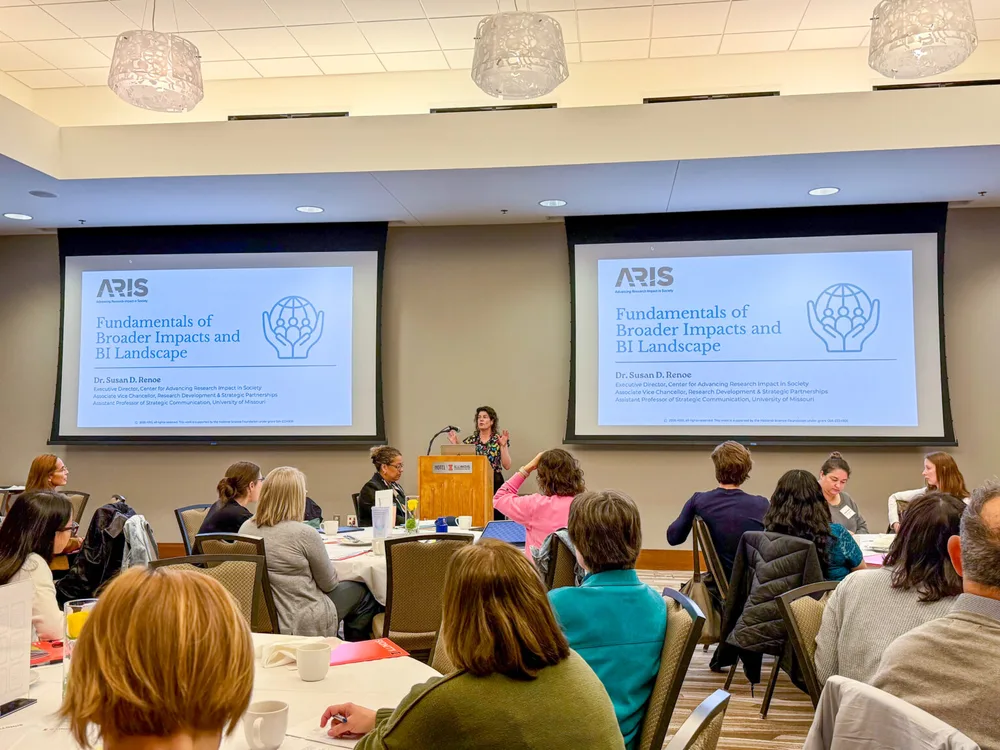
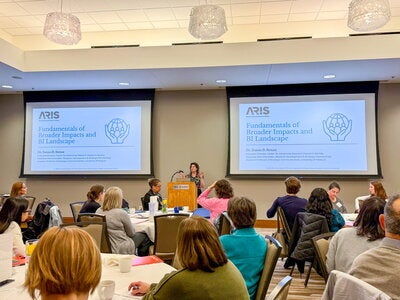
The College of LAS and the Center for Social and Behavioral Science hosted a one-day, multi-session workshop titled “Designing Competitive Broader Impacts: Strategy, Evaluation, and Communication.” U of I faculty and research professionals across social and behavioral sciences, natural sciences, and research development attended.
“What made this workshop especially valuable was the partnership between CSBS and LAS,” said Erika Cornelius Smith, senior director of research strategy for the College of LAS. “We both work closely with faculty in the social and behavioral sciences, and together we were able to create a space where researchers could learn new strategies, exchange ideas across disciplines, and think more intentionally about how their work can benefit communities and society.”
The workshop was held at the iHotel and Illinois Conference Center. It was delivered by Advancing Research Impact in Society, a national initiative for advancing research impact and public engagement.
ARIS is supported by the National Science Foundation and works with universities, nonprofits, government agencies, industries, and other organizations to make research more accessible to the general public. ARIS executive director Susan Renoe facilitated the workshop.
“The ARIS workshop provided faculty with a toolbox for designing and writing about the broader impacts of their work,” said Alison Bell, LAS associate dean for research.
Attendees were taught how to align broader impacts with evolving funding priorities, develop meaningful and measurable impact plans, communicate research value to diverse audiences, and strengthen competitiveness for external funding opportunities.
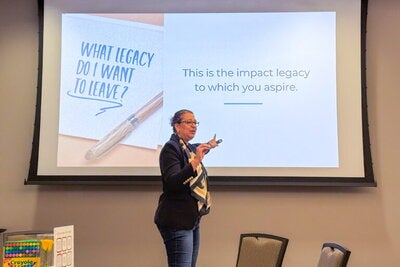
“These skills are increasingly important for science communication and for public engagement more broadly,” Bell said.
There has been a growing movement for scientists to become more effective communicators with the general public. As experts in their field, they are best equipped to explain their research, but they need to learn how to break it down to an accessible level for folks who are not in the same field.
Another key aspect of the workshop was interdisciplinary work. Attendees had time to discuss their research and what challenges they had encountered. They shared ideas for how to make their research more impactful, and in doing so, they built connections across their areas of study.
The workshop included hands-on activities as well, like making a collage to creatively communicate the vision, purpose, and potential impact of their research. It was one way to challenge the attendees to share their research through a non-traditional medium.
“One of my favorite pieces of advice was for faculty to design broader impacts around the topics they are most passionate about,” Bell said.