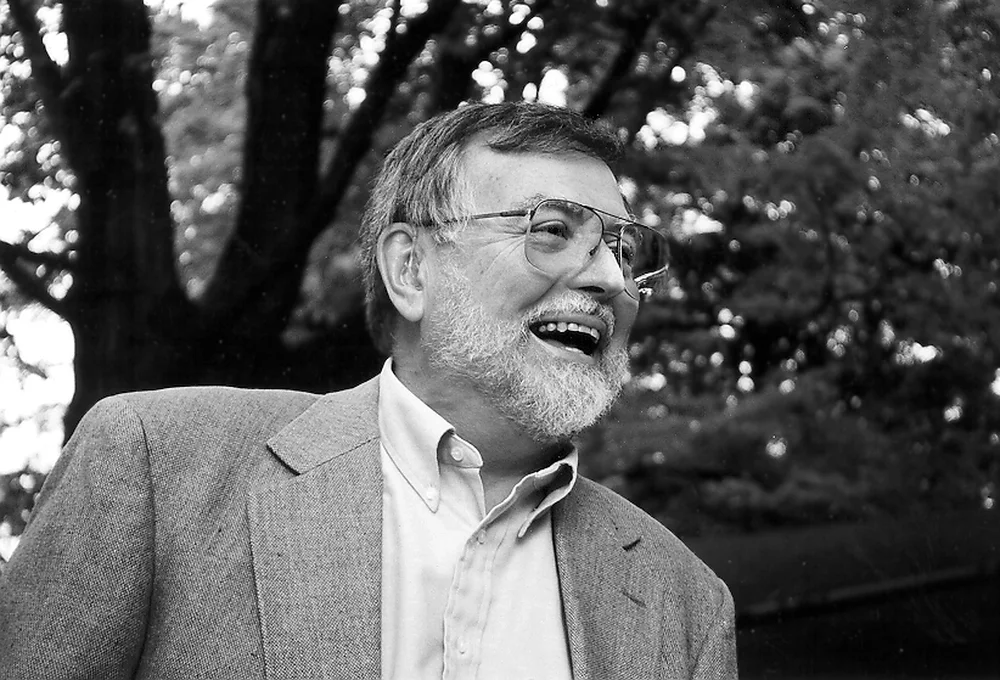
The life work of Jim Davis (BS, '54, psychology) has revolved around answering a single, deceptively simple question: How do small groups of people reach decisions? In the process of doing so, he has influenced business practices and Supreme Court decisions, reinvented the field of group decision making, and earned the honor of being considered the greatest social psychologist of his generation. Reid Hastie, a psychology professor at the University of Colorado at Boulder, describes Davis as the Michael Jordan of group decision making. "You want to sit at his table every evening and be sure you're on his team the next morning."
Group decision making is the study of the choices and judgments people make as a group. During Davis' 30 years in this field-nearly all as a professor at the University of Illinois-he has analyzed the process these often disparate groups go through in reaching consensus and how different combinations of talents and interests influence their performance. What has set his work apart from others is his systematic and exacting approaches. His data are the basis of a sophisticated mathematical and computational model that may one day predict a group's problem-solving potential.
A case in point is the petit jury. Jury studies have been a staple of scholarly inquiry into law practice for centuries but most of them rely on experience, intuition and hearsay, not on empirical research. In the 1960s, Davis began using mock trials to study the effects of jury size and courtroom procedures on the outcome of a trial. His research has also illuminated the influence of social attitudes toward crime, prior juror experience and consequences of a crime on a victim. When the U.S. Supreme Court was asked to rule in the 1970s on the legality of reducing jury size from 12 to 6 members—seen as a means of speeding trials to relieve an overburdened court system—they consulted Davis' research. Davis' jury data are also being poured into a predictive computer model.
Though officially retired, Davis is breaking new ground by turning his analytic eye toward groups that must reach quantitative judgments. Juries will continue to claim his attention. But he's taking on new kinds of groups in dire need of consensus—making decisions that evoke dread, such as judgments involving AIDS and nuclear waste sites.